 EKIP– Expert Club for Economics and Politics A Different Opinion
I dedicate this article to my friend Vladimir Karolev,
With whom we have repeatedly discussed water concessions,
district heating, resorts, beaches and services. [i]
"Bath" or "shower": vital signs of the problem
This question did not arise, for example, for the residents of Sofia in 1994 and early 1995. The reason is very simple - there is simply no water.
And there is no water, because the resources (of the Iskar dam and the cascade above and below it) for the city's water supply are managed by the municipality. At that time, Sofia Water and Sewerage was the only such company owned by a municipality. But the dam and the cascade are owned by the state. Kremikovtsi AD (then under a different name) received permission to use the waters for industrial purposes. The history has not been studied in detail, copies of the decision can probably only be found in the State Archives. But probably the decision of the municipality. At that time, it did not protect the consumption of water by Sofia residents, but the owner of the company, the main and formal one among which was the government.
In fact, however, the interest is of the creditor and suppliers of the enterprise, which at that time was part of Multigroup. The result is that out of 680 million m 3 of the volume of the dam, about 27 million m 3 remain in it. For the city of Sofia and perhaps several hundred more settlements. It is very strange that the effects of the cessions of receivables from Kremikovtzi and the unpaid commodity credits from Bulgargaz, NEK, BDZ and three ports have been well studied, but not the commodity credit for the functioning of this enterprise during that year, covered by the citizens of Sofia and Bulgaria. This credit is not only in the shortage of water and the costs of dealing with its half-yearly lack. The water that reaches people's homes for ¼ of the day is also very harmful. They, probably not all, find salvation for their drinking, cooking and other needs in the city's mineral springs.
The caretaker government of Mrs. Reneta Indjova, as is evident from the report on its work, managed to describe the state of the problem (for example, more than half of water consumers do not have water meters, industrial consumption is four times larger than domestic consumption, and mineral springs can cover only half of the annual consumption of households in Sofia) and to some extent solve it, completing the transition of Kremikovtzi AD to its own water sources (by the way, some of them were at hand even before the drying up of the Iskar dam) and forcing state consumers to install water meters. The conditions set at that time for solving such problems with water ownership took five to ten years.
In the fifth year, in 1999, "Sofiiska Voda" was handed over to a concession to "United Utilities" (UU), and after 2010 the private share (77.1%) was already owned by "Veolia Voda", the remaining shares were owned by the municipality.
In 2022, the "bath" or "shower" problem also does not exist.
But the reason is not a lack, but an abundance of water at a low price. Keeping water prices low for drinking and hygiene purposes subsidizes owners of bathtubs and swimming pools, as well as those who use it to irrigate yards and fields.
In 2014-2015, Bulgaria ranked second in the EU in terms of tap water consumption after Italy with 190 liters per person per day, far exceeding all other member states.
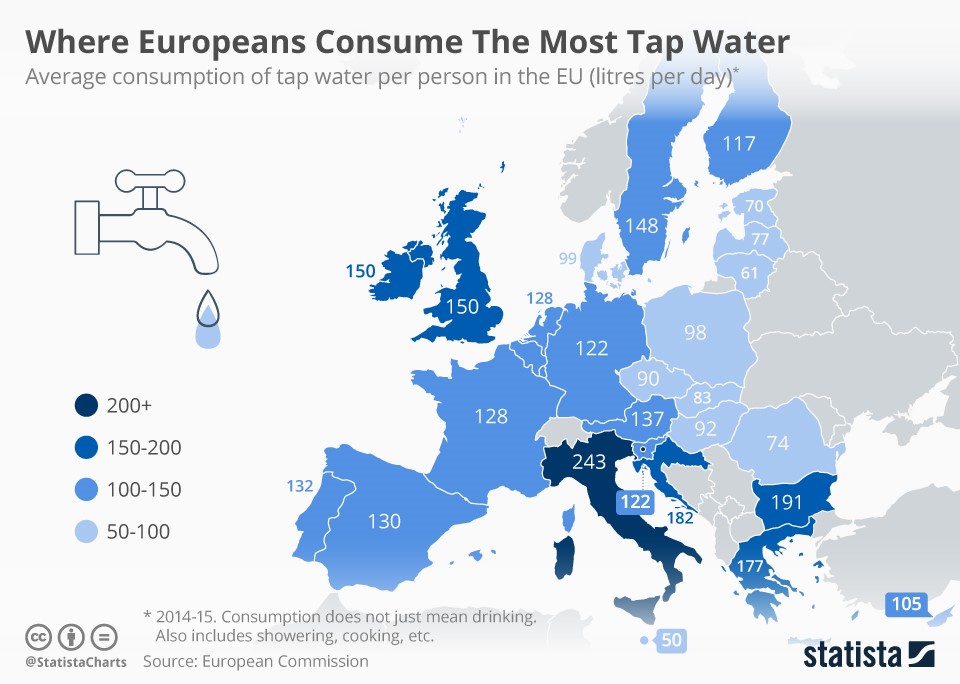
Source: Statista
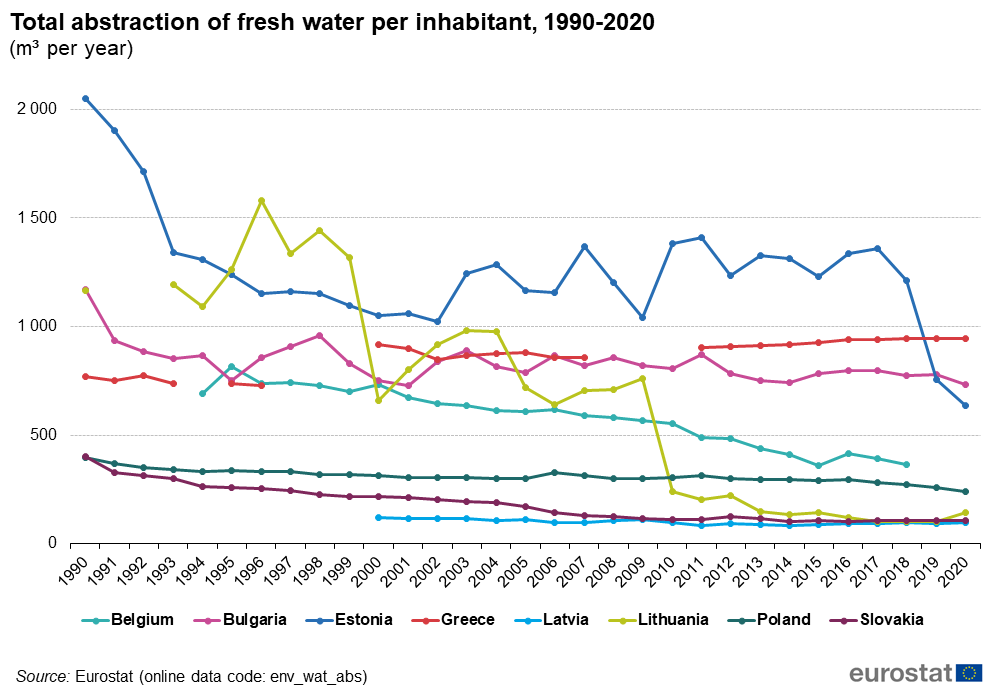
In countries like Bulgaria, there has been a steady trend of decreasing water abstraction per capita over the past 30 years. It often remains higher than in countries like Belgium and other older EU member states (with the exception of Greece and Italy). In Bulgaria, the average annual volumes have not changed in fact since 1995. This is clearly seen in the following Eurostat graph of the dynamics of water abstraction from 1990 to 2020 in Bulgaria, Belgium, Greece, Estonia, Latvia, Lithuania, Poland and Slovakia.
The problem with prices and quality
The high consumption and waste of water is a direct consequence of the price. In Italy, it is the lowest in 2021 - 40 euro cents for the metropolis of Milan. The highest price is in Oslo - 5.51 euros. For comparison, the price of water for household and equivalent public and other consumers in Sofia is 1.5 euros. According to this indicator, Sofia is in the group of 1/3 of the 36 most frequently observed metropolises in Europe. Warsaw, Budapest, Athens and Tallinn have lower water prices for household consumers.
For the period from 2000 to 2021, this price has increased about 7 times. The comparative result of the private concession of Sofiyska Voda compared to other water and sewerage companies was summarized by Vladimir Karolev and is presented in the following table using NSI data.

Indicators in this table can be specified for individual water utilities, but this is not a task that can be done in one article. The problem lies partly in the fact that information on prices does not exist in a summarized form, is not collected in one place in a way that is convenient for comparison, and is not summarized either by the EWRC, the two ministries responsible for water resources and the relevant infrastructure, or by specialized public organizations such as the Bulgarian Water Association (BAW) and the numerous organizations of nature and environmental defenders. [iv] One of the effects of this dispersion of data and information is the difficulty of orientation in the state of the sector, the impossibility of assessing its condition by non-specialists, and last but not least, the focus on the only visible indicator, on the dynamics of prices when they are raised. Why this happens may become clear later.
Varna Water and Sewerage Company, as far as can be judged from the comparison of the annual Water and Sewerage Company reports and the pricing and other decisions of the EWRC, is one of the good companies in Bulgaria. However, its receivables collection rate is 58%.
“Bathtubs” are not just a metaphor. They are a unit of measurement for illustrating the volume of wastewater, also applied to Bulgaria. According to the European Drinking Water Information System, “in Bulgaria, households and some industries in 332 urban areas generate 7.1 million pollutant equivalents (PE) of wastewater every day, which is an amount equal to about 14 million bathtubs or 1.41 million m 3 of water”. Here in 2020, only 30% of water is treated according to the requirements of the EU Waste Water Directive of 1991. For the EU, the average treatment rate is 82%.
The dispersion of price information is a consequence of the scattered property rights over water resources and infrastructure and the politically distorted rules of price formation.
The “affordability” of water
"Ensuring conditions for providing universal access and social affordability of water and sanitation services" is the first of the twelve principles by which, according to the Water and Sanitation Services Regulation Act (Article 7), the EWRC should be guided.
Access to water and the prevention of water pollution acquired the status of a human right after being included as Goal 6 in the list of 17 Sustainable Development Goals. The path to this status was long, as for the other such goals. In the EU, despite the fact that since 1991 and 1998 this right has been the subject of two directives (the already cited one on wastewater and the one on drinking water), from 2014 to 2017 the citizens' initiative Right2Water (uniting around 120 non-governmental organizations, including from Bulgaria) [v] Ultimately, at the end of 2017, water supply is the European Pillar of Social Rights, as part of the 20th principle: “Everyone has the right to access basic services of good quality, including water, sanitation, energy, transport, financial services and digital communications. Those in need should be provided with support to access such services.”
"Social tolerance" is a further development of these directives and initiatives, but it is not entirely clear what is meant by its proclamation.
The Slovenian constitution, for example, states that since it is a “right,” water “is not in this sense (italics mine) a marketable good.” The quality of water there appears to be better than that of Bulgaria, because in 2020, “households and certain industrial enterprises in 158 urban areas produce 1.5 million pe of wastewater per day, which is an amount equal to about 3 million bathtubs or 0.29 million m 3” and 61% of the water is treated according to the requirements of EU directives. But this is an achievement from before the country’s constitution was changed in this part of it in 2017.
The aforementioned Bulgarian law does not link social affordability to price. However, it is obvious that social affordability has a price: when water quality does not meet certain standards or access to water is limited, investment is clearly needed to reach the relevant standard.
The existence, maintenance and time of achieving the relevant standard (regardless of who and when introduced it) largely explains the above-cited difference in water prices for Sofia and other European metropolises. For example, for Budapest, one cubic meter of water is 23 euro cents lower in price for 2021 than for Sofia, and in Warsaw or Tallinn – by 8 and 68 cents, respectively. But in Hungary, purification according to EU standards is 52%, in Poland – 87%, and in Estonia – 98% of the supplied and used water.
The opposite approach, that is, in Bulgaria, linking "social affordability" to price according to some abstract criteria, results in relatively low quality.
This effect is evident from the NSI's water access data:
- From 2010 to 2020, the population connected to drinking water treatment plants increased by only 2.7%, to 49%, half of the population does not have such connectivity;
- Again, over the same period, the population with a water supply regime increased almost fourfold, from 1 to 3.9% (for ¾ of these people, the regime is still less than six months a year);
- The price increase still has a positive effect: over the same period, the population with public sewerage but without water treatment decreased more than twice, from 22.9 to 9.6%;
- As a kind of proof of the NSI's meteorological assumption that private treatment facilities are more efficient, data on industrial wastewater show a ten-year reduction of 53.9%, with the improvement being most visible in metal production (which is carried out on a concession basis) – 2.5 times less wastewater at relatively constant production volumes;
- The dynamics are opposite in private household water treatment: the population with its own wastewater treatment for the same period decreased from 29.4% to 23.8%, it is not clear what the driving factors are in this dynamics.
Since the previous article, catastrophic publications about the price of water have begun to appear more frequently than in 2020 and 2021. The pre-election atmosphere, an unforeseen situation (with the water supply of Svoge) and several flooded villages in Karlovo region have drawn attention, on the one hand, to the percentage increases in prices of the various regional water utilities themselves, without taking into account the investments (which the increases were supposed to finance), and on the other hand, to "abuses" not only in the water sector, but also in side activities (for example, logging and hydroelectric power plants owned by NEK), directly or indirectly affecting access to water or the condition of water basins.
It is interesting that no one pays attention to the ownership of water and sewerage companies and the participation of consumers in pricing.
In the dominant state-municipal water supply sector, the price increases per cubic meter for the next five years are expected to be around 60%, for some regional water supply companies – 80%. The reason is clearly in the plans to improve the quality of access to water and the purification of used water.
Let's go back to the example of Sofia Water. By 2026, the increase in the price per cubic meter will be significantly lower - 40%. It will reduce water losses to 1/3 or even almost 30% of the supplied quantities. The new plan, as required by law, will be submitted for discussion to the Sofia Municipality before being submitted for approval to the EWRC, and in the meantime it will be available on the company's website.
Is this price increase "tolerable"? Presumably, yes.
Currently (the latest data is for 2020) a Sofia resident uses 25% more water per day than the average statistical citizen of Bulgaria, 127 liters, almost 4 m 3 per month. The monthly price of this amount is approximately 16 leva, and the average gross salary for the city is 2,352 leva (in June this year). In other words, the monthly price of water in Sofia is actually equal to the price of three packs of cigarettes, one bottle of quality brandy or four cheese patties, also of high quality.
Again about private participation in water supply
Unlike political discourse, the Strategy for Development and Management of Water Supply and Sewerage in the Republic of Bulgaria 2014-2023 attempts to analyze ownership in the sector. It mentions ownership issues over 60 times, in different contexts, across 106 pages.
The main findings on this topic are as follows:
- “the complexity and uncertainty surrounding the ownership of infrastructure and the management of water and sanitation systems and facilities;
- the lack of predictability and transparency in the regulation of service levels, prices and the methodology for setting prices for water and sanitation services, which assumes that financing is readily available and the return on equity of water and sanitation companies is low or zero, and
- "political influence on operational decision-making by both the Water and Sewerage Organizations and the State Water and Sewerage Regulatory Authority";
- The uncertainties surrounding the ownership of the water and sewerage systems and facilities and the deductions of 80% of the water and sewerage company's profit as a dividend for the state create serious obstacles to the loan financing of the water and sewerage company.
However, the analysis of the causes of this uncertainty, ambiguity, and unpredictability seems incomplete. There are at least three fundamental omissions that determine the current state of affairs in the industry.
- In 1991, the constitution (Art. 18, para. 1) stipulated that “subsoil resources, the coastal beach strip, republican roads, as well as waters, forests and parks of national importance, natural and archaeological reserves, defined by law, are exclusive state property.” This was done before Slovenia, India and other countries, whose basic laws define access to water as a fundamental right and an exclusive object of state property.
I signed the constitution with disagreement on this and five other provisions. My main argument was that in this way the rights of the owners of the earth's surface (land and forests, for example) are not respected, when these rights are restored, duly regulated, and the underground resources are not discovered or developed. In these cases, private property turns out to be initially limited and unequal (which contradicts Art. 17 of the constitution). Moreover, private owners in this context have no incentive either for exploration, or for investment, or for their own participation in the development and exploitation of resources on their own territory. If they discover such a resource (say, water, but not only), they have the advantage of keeping what they know for themselves. Or to seek political connections with municipal and state institutions and authorities.
- Even when the exclusive rights of the state are defined by law and “are managed and administered in the interest of citizens and society,” as required by paragraphs 4, 5, and 6 of the same article, the individual citizen or owner finds himself in the position of “sandwich filling” of layers of state owners, representatives, located at least at the local and central levels.
- In 2009, through a change in the Water Act and the then introduced section "Management of Water Supply and Sewerage Systems", an attempt was made to include the population in the management of water resources. Formally, this role should be performed by the so-called "Water Supply and Sewerage Associations" (WSSA). The strategy until 2023 recommends that WSSAs "become fully functional".
The prototype for the AViK are the regional "water councils", known in the history of the Netherlands and Flanders from the beginning of the 12th century. Later, Dutch water councils were adopted in Northern France, the Swiss cantons and practically everywhere in Europe, North America and in many countries on other continents.
The basic idea of these councils is that land and capital owners (initially farmers) negotiate as much as possible all the details of water resource management, development of new sources and prices that cover the costs of the agreed investments. In the Netherlands, these investments also include the “reclaiming” of land from the sea and the construction of protective dikes. How this enterprise works today is described in a special OECD brochure. It has five institutional (government) levels – two central and three regional and local. (In addition to these, international treaties are also added.)
The overlapping of these layers of governance creates problems even in the Netherlands. Judging by the OECD review (but this also follows from the economics of property rights), the main challenges facing the world-paradigmatic Dutch tradition are independent supervision, auditing and reliable information on the state and development of water supply systems.
Although provided for in the law in 2009, AViK received regulations for their functioning only in 2014. They are not commercial companies, they do not distribute profits, their members are the state and the municipalities (municipality), on whose territory the V&K operator operates. Most often, the state representative, the regional governor, is the chairman of AViK. There can be only one association on the territory of one agglomeration. Financing (prices) and investment plans are approved by KEVR.
The strategy suggests that the AViK "must balance their legitimacy towards all members, even small municipalities that will not have a blocking minority."
What is meant by “balanced legitimacy” is a mystery.
Currently, the water and sanitation operators are municipal and state-municipal. Legitimacy (i.e. the belief that they are managed in the most appropriate way at the moment. The regional governors are appointed by the Prime Minister, and they are either representatives of the state in the associations, or appoint such representatives. The chairman and members of the EWRC are elected by the legislative assembly. The complaint from the EWRC, probably not entirely justified, is about non-transparency in determining prices and investments. Subsidiarity, i.e. the principle that decisions are made at the lowest possible level of individually identifiable equals. Taken literally, a recommendation of the Strategy for Balanced Legitimacy is to neutralize the voice of small municipalities.
It turns out that almost none of Elinor Ostrom’s principles for managing common resources, for which she received the Nobel Prize in Economics in 2009, are applicable. [vi]
Concession as restoration of property rights
Concessioning water and sanitation is the only way to at least partially restore the rights of private owners and the population. Concession implies, on the one hand, the preservation of exclusive rights to water under Article 18 of the Constitution, on the other hand, the preservation of the increments of the concessioned territory for water supply, water purification, etc. (i.e., the infrastructure) as state property, and, on the other hand, it reduces the levels of political mediation between consumers and providers of water and water services to one - that of the municipality.
The water and sewerage operators themselves will be interested in sharing information and plans with their customers.
Separately, changes will be needed in the regulations for the work of the HVAC&R. The activities of the BAL will improve by themselves. And the EWRC will work in more companies as it works with Sofia Water.
[i] This article is a continuation of "Concessionize This: Water and Sewerage and the Benefits of Private Supply of Public Water", published on May 18, 2022 by EKIP.
The author is a lecturer at Sofia University, one of the founders and first executive director of IME ( www.ime.bg ), now chairman of its board, member of the Mont Pelerin Society and the NOUS network, as well as manager of KS2 EOOD and chairman of the Environmental Protection Commission in the Supreme Soviet (1990-1991).
[ii] It is not clear whether 2020 marks the beginning of such a trend in Bulgaria. The reader can use the link to EUROSTAT data for comparison of other water indicators. In this article, I consider only those of them that provide information on the effects of water resource ownership. In the first article, one can see the statistics of water supplied to households and the share of drinking water losses for the last ten years. For ease of verification, here is a link to the NSI database on the topic.
[iii] The NSI methodology for calculating water losses contains the following key elements: a) they “are formed by physical losses during water transport, unregulated use, inaccuracies in measurements, etc.”; b) “the volume of losses is aggregated for a group of operators, avoiding repeated counting”; c) “at the basin level, water losses are calculated using a regionalizing factor “delivered water” and d) “it is assumed that water losses during self-supply are negligible.”
[iv] BAV unites the Union of Water Supply Operators, the regional Water Supply and Sewerage Companies and about 20 corporate members, which are generally leading European and global suppliers of water infrastructure and water protection elements. BAV has made an exceptional contribution to the transfer of technologies and the training of the personnel of the Water Supply and Sewerage Operators.
[v] The initiative was supported by German and Austrian trade unions, initially developed as a sub-topic of the regulation of so-called services of general interest, and was initially supported by Irish and French members of the European Parliament. At that time, the center-left majority in the Slovenian parliament amended the country’s constitution, including a new Article 70a, which states: “Water resources are primarily and permanently used to supply citizens with drinking water and households with water, and in this sense are not a market commodity.” Slovenia was the first European country with such a provision. But this is not a constitutional precedent at all; water is considered a fundamental human right in the constitution of India, for example. In mid-2010, the UN General Assembly voted in favor of a resolution that defined access to clean water and sanitation as a human right. (Bulgaria and 39 other countries voted on this resolution as "abstaining"; these countries include: Armenia, Australia, Austria, Bosnia and Herzegovina, Great Britain, Denmark, Estonia, Ethiopia, Greece, Guyana, Iceland, Ireland, Israel, Canada, Cyprus, Kazakhstan, Korea, Latvia, Lesotho, Lithuania, Luxembourg, Malta, Moldova, Netherlands, New Zealand, Poland, Romania, USA, Slovakia, Turkey, Ukraine, Croatia, Czech Republic and Sweden.
[vi] Stated in the assertoric mood, these principles look like this.
- Clearly define the boundaries of the resource category.
- Relate the rules of commons management to local needs and conditions.
- Make sure that participants affected by the rules can participate in changing those rules.
- Ensure that the rights to establish rules of community members are respected by external institutions.
- Develop a system to be implemented by community members to monitor member behavior.
- Use ascending-graded sanctions for rule breakers.
- Provide accessible, low-cost ways to resolve disputes.
- Build a system of accountability for the management of the common resource that is rooted at the lowest level of responsibility and encompasses all interconnected higher levels.



.png#filelinks)