 EKIP– Expert Club for Economics and Politics A Different Opinion
With their preemptive stance against any agreements and negotiations with GERB, "Continuing Change" is trying to maneuver from a battlefield where they are certain to lose to one where they could win. However, on this battlefield their main opponent is no longer GERB, but their own coalition partner - "Democratic Bulgaria". Let me explain.
In the ideal post-election situation for the PPDB, they would have been able to force GERB to support their government without having to return a similar gesture and thus legitimize Borisov. It was with this idea that the two parties united. The bet was that if they overtook GERB in the elections and they had the first move in parliament (with the first mandate to form a government), they would be able to put pressure on GERB. Alas, as we know, this did not happen and so the variables in the young coalition's political calculus fundamentally changed.
The first term gives GERB a decisive tactical advantage
Since GERB will get the first mandate, Borisov can now pressure the PPDB in the same way that the coalition hoped to pressure him. What is it? GERB will offer a compromise Euro-Atlantic government that includes PPDB leaders in key ministerial positions and a program to push through key reform priorities. In return, GERB, and Borisov personally, receives legitimization from the anti-corruption "democratic" vanguard, which agrees to join a government led by them.
This is a legitimation that the PPDB certainly does not want to give for obvious reasons. Governing with GERB now practically renders meaningless everything that these parties have been doing since 2021 (in the case of the DB, even earlier). And it is a political humiliation - to legitimize Borisov, whom you arrested a year ago. Yes, this will secure power for the PPDB, perhaps even for a full mandate, but it sets a very bleak prospect for their long-term political development. Borisov has the incredible talent to strangle any of his coalition partners. As Dr. Nikolay Mihaylov recently expressed, if they accept such a coalition, Borisov will lead the PPDB to the scaffold of their own political execution, as has happened with every of his coalition partners in the past.
If the PPDB agrees to a partnership with GERB, it means political suicide
Any formation that accepts to be a main partner in a government led by GERB loses its parliamentary presence in the next elections. This happened with the "Reformist Bloc", and later with the "United Patriots". Incidentally, both formations were coalitions in which serious internal conflicts arose even during their government with GERB. Internal conflicts that led to the split of both coalition formations before the next elections. Subsequently, none of the constituent parties of these political unions managed to cross the barrier to enter the next parliament.
Currently, the constituent parties of the “United Patriots” have practically disappeared from the political scene. The few survivors of the former “Reformer Bloc” that did not disappear or were not absorbed by GERB (SDF) reformatted themselves as “Democratic Bulgaria” and managed to regain their presence in parliament only in 2021 – 4 years after they were expelled from it. The PPDB should be well aware of the history of GERB’s partners in government and hardly want to risk a similar fate. But what is the alternative, given their losing (second) position in the last elections to GERB?
If they don't agree, it means they will lose more in the next election.
If they do not accept Borisov's proposal for a compromise partnership government, the PPDB will receive the second mandate to form a cabinet... but they cannot do anything with it. What they would most like is to be able to force GERB to support their government unilaterally, without having to include GERB in it and thereby legitimize the party and Borisov himself. But from the position of a second force, they cannot demand that GERB support their government, given that they have already rejected their proposal for a compromise government.
GERB (and especially Borisov, with his inherent pathos and drama) will accuse the PPDB of a complete lack of dialogue and reciprocity. "The PPDB first rejected our proposal for a compromise partnership government that respects their priorities, and then they want us to support their independent government! And from the position of a second force that lost the elections to us!" This is what GERB will say, this is what Borisov will insist on. And he will be right.
In such a development of events, no one will blame GERB for failing to form a government. The blame will obviously lie entirely with the PPDB. And accordingly, when elections are held again, the PPDB will most likely erode further support, while GERB consolidates. And the distance between the two forces will increase even more in favor of GERB. This is one of those chess situations in which the one who has the first move always wins. The PPDB's inability to win the elections condemns it to choosing between Boris' coalition scaffold or the erosion of additional support in the next elections. The most nightmare scenario for the PPDB would be to repeat the electoral dynamics of last Sunday, in which support for them falls by another nearly 100 thousand votes, and that for "Vazrazhdane" increases by the same amount.
The PP is trying to compensate for a big loss with a small victory
Realizing the situation they find themselves in, the PP seems to be trying to take a new political gambit. With the explicit position against any form of governing partnership with GERB, the PP is issuing a direct challenge to the coalition partners in the person of Democratic Bulgaria. Their logic is as follows. Since in the current situation, no matter what they do, they will lose to GERB, let them at least guarantee themselves the role of the leading anti-corruption, anti-Borisov party. The PP most likely sees this as a move that can ensure their survival as a major political formation, with a permanent long-term presence in parliament.
With this move, the PP is no longer just starting to implicitly, but explicitly compete for this electorate, which the DB has been representing since its establishment in 2018. The headquarters of "Democratic Bulgaria" are in a serious dilemma. If, after the PP's move, they subsequently come out with a position denying the possibility of a partnership with GERB, it will turn out that they are simply following a set message (as a command) and will thus reinforce the impression that it is the PP that is the leading force in the coalition, and the DB are simply passive followers. An impression that is already there to some extent anyway. This will initiate a process of merging the DB into the PP in the eyes of the urban, strongly reformist Euro-Atlantic electorate, which feels hostility or is at least highly critical of GERB and Borisov in particular. That is, it is precisely this electorate that has formed the majority of the DB's voters in recent years.
What will happen, however, if the DB does not support the PP's position and says that they are ready to negotiate with GERB for governance? Then an explicit war will break out between the PP and the DB. We will witness a coalition collapse, which will probably occur even faster and more explosively than a thermonuclear one. From "We continue the change" to the second, they will attack the DB as traitors to their own electorate and absolutely all the political positions and principles that they have defended in recent years. And their argument will be very strong.
Does "Democratic Bulgaria" have a winning streak?
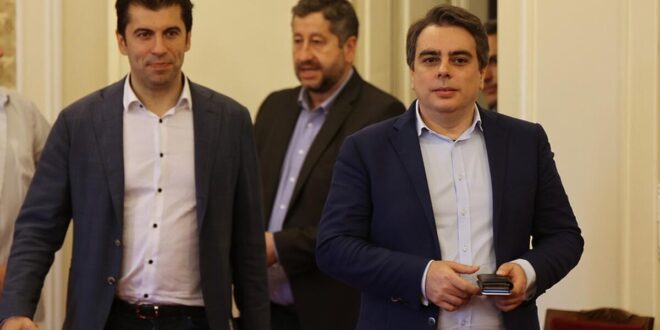
In this way, the surprising position of the PP from yesterday aims to turn a big loss (against GERB) into a small victory (against DB). The battlefield for them has already changed. The conflict with GERB, of course, is not over, the war continues, but the PP is playing a tactical retreat and maneuvering towards another battlefield - one where they believe they can achieve a victory with which to strengthen their weakening positions on the political map in Bulgaria. Yes, Kiril Petkov and Assen Vassilev are thus stabbing Hristo Ivanov in the back. But there are no rules in politics. Like in war.
Now we all wonder - how will Democratic Bulgaria react? Unfortunately for them, it seems they will lose, whatever decision they make. But can Hristo Ivanov think of a move similar to the one taken by his "partners"? A move that could partially compensate for a big loss with a small victory?






Hr. Ivanov surprises me! Small calculations, but that's how it is when you're young.