EKIP– Expert Club for Economics and Politics A Different Opinion
The concentration of seven consecutive elections and the record failure in the presidential election require a brief note with structuralist analysis. To refresh the memory.
At the heart of the political crisis lies the combination of two rifts (cleavage – for political scientists from the NBU and the Faculty of Philosophy), represented through the party groups in the National Assembly. The first is along the lines of the world realignment – globalists versus national-localists, while the other is a local issue – who should represent “Euro-Atlanticism” in our country, or more specifically, should Delyan Peevski participate and how exactly.
The first division has two components – Vazrazhdane, which remains the most consistent and hence the largest localist party. And others like it, such as Velichie, which turn the pancake upside down and are, to put it mildly, incomprehensible, and accordingly lose relevance. Or like ITN and MECH, they are too “moderate” and do not give the clear requests for change demanded by the target electorate. BSP is a complete tragedy, they do not even deserve a comment. Either way, these are non-Euro-Atlantic MPs, and no matter how weak they are in terms of political influence, they hinder globalist plans even with their presence. Sometimes it is enough for someone to simply not applaud enthusiastically at the party congress or not stand up for the Ode.
I described the second division in my previous article on the issue, titled " The Night of the Long Euro-Atlantic Knives":
“The problem is that for the moment, due to the aforementioned attractiveness, the Euro-Atlantic sector is too crowded– 26% for GERB, 24% for PPDB, almost 14% for MRF – and these are only the explicit cosmopolitan-globalists, ITN and BSP continue to have one foot in the same puddle. The second reason for the excess of Euro-Atlanticism is that the last parliamentary elections were also the last for the old division, specifically in its 2020 form – ideological convergence of the parties on all major issues, but division along the lines of who is good and who is mafiqta. Full agreement on how and where to govern, the discord is for the captain’s seat. Some of us still remember up to a whole year ago, we remember that PPDB came to power to expel Borisov and Peevski. ”
Euro-Atlantics cannot share Euro-Atlanticism. They quarrel, they fight. The extreme globalists (PPDB) want the moderate globalist (Borisov-GERB) without the dominant new-globalist (Delyan Peevski). But the same extreme globalists are not ready for a temporary alliance with the biggest anti-globalists (Vazrazhdane) in order to make an anti-Peevski coalition. There is no arithmetic majority, respectively.
We recall that this problem is not new. And it was temporarily resolved by imperial fiat after the start of the war in Ukraine. Then a clear message was sent from the Embassy that internal squabbles are not important, what is important is that Putin is defeated in the Donbas fields.
Therefore, the brave fighters against the mafiqta temporarily gave up on expelling the evil forces, made a meeting, drank coffee with Dido on his birthday, and dusted themselves off until they were all numb. All of this is also described.
After the failure of the Ukrainian summer offensive and the shift in the embassy's focus to Israel and the American elections - the assembly lost its glue and returned us back to the basic conflict with the two faults.
Currently, the second (with qualities for the 18th) smart and beautiful echelon (after covering Hristov Ivanov) is trying to survive against the long knife of Delyan Peevski. Contrary to my expectations, the real cartwheeler among the Euro-Atlantics is not Borisov. And the first victim of the process of shrinking to size turned out to be, in a sense, the DPS, instead of the PPDB. Although their turn also comes on a roller skate and a unicycle.
Regardless of the difficult-to-know winner, the structural direction of the process is clear - Euro-Atlantic consolidation is underway with force, while national-localists cannot even come up with a name for themselves, beyond the "kopecks" they are being hurled at.
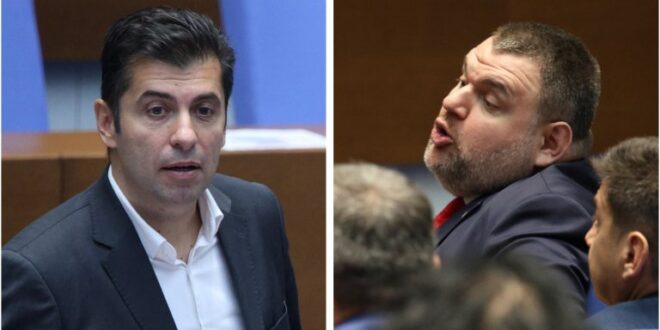
Photo of the publication: BGNES