 EKIP– Expert Club for Economics and Politics A Different Opinion
The idea of a so-called unconditional basic income (UBI) has gained some popularity in recent weeks. It represents a minimum amount that every citizen of a country would receive, regardless of whether or not they work. Why a UBI is a bad idea, read here.
Michael Tonchev
Let us set aside these lines to make sure that such an idea will never be taken seriously. The American journalist Henry Hazlitt smashed all similar social policies back in the middle of the 20th century. But as is known, from time to time, when politicians exhaust their arsenal of demagogic proposals, they decide to reconsider some schemes that have long been discredited. BBD is one of them.
This article will analyze the general plan for the introduction of a universal basic income, and point out the differences with the one proposed by Bulgarian supporters of the idea. Although presented as a panacea, the unconditional basic income suffers from many of the same problems of current social systems.
Distorted stimuli
Let's say that we are well-intentioned and generous politicians and we do not want any of our small, but proud and hard-working people to receive less than 1,000 leva per month. That is, without any conditions, everyone in our society will have a monthly income of at least 1,000 leva. The state will pay the difference to those compatriots whose salary is below the chosen level.
So far so good – but only because we have described the plan without analyzing it.
The first effect of this social program is the distortion of incentives in the economy. Let us take, first of all, a person who before the program was earning a salary lower than 1000 leva. Under the new legislation, he will not only receive his previous salary, but he will also be guaranteed an income of 1000 leva. No matter how much he earned before the BDD, he is now guaranteed 1000 leva per month. What happens next? He decides that he no longer needs to work so hard to earn 1000 leva per month. In fact, he will not need to work at all and stops doing so.
What happens to the person who, before the new plan, received a salary of 1,000 leva per month? He also sees that there is no point in working anymore – whether he works or not, he is guaranteed an income of 1,000 leva. Why then work in vain? And he drops out of the workforce.
The impacts of the law would be negative enough if they stopped there, but unfortunately, they continue after the 1000 leva ceiling. What happens to the person who previously earned 1100 leva? Under the new law, he would struggle for a whole month for just 100 leva more. He is likely to decide that it is not worth working 160 hours a month for 100 leva. He could easily decide not to work at all and just spend that guaranteed 1000 leva. He could find some hobby – for example, learn to imitate the songs of forest birds. And the worker who received 1200 leva? He may also decide that it is not worth a whole month of work for that extra 200 leva. Many of the people who previously earned 1200 leva per month will decide to drop out of the workforce. And so on, and so on.
Does this mean that ultimately no one will work? In our example case – unlikely. There will still be some individuals who will work for salaries significantly higher than 1000 leva. But their incentives to work will also be significantly reduced, as you can see in the following graph:
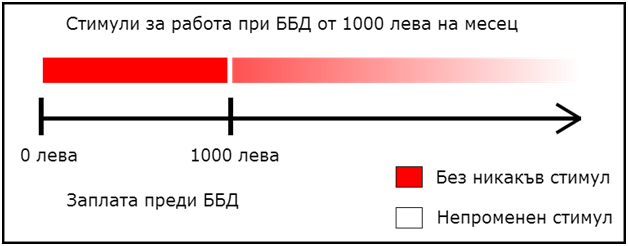
In fact, if a law is passed whereby everyone receives 1,000 leva per month and, in addition, no one can receive more (so that we are all equal), Hazlitt proves in his book Man vs. The Welfare State that then indeed, if the law is followed, the productivity of the state will drop to zero.
The plan proposed in Bulgaria is slightly different from the general minimum guaranteed income that was just analyzed. First, the state does not pay the difference between the original income and the guaranteed income, but actually pays the entire amount to each person. This does not reduce work incentives to the same extent as the minimum guaranteed income, but it does create other problems.
Neither will all adult citizens (including the richest) receive the BDD for a long time, nor will politicians be able to resist the temptation not to hand out special privileges to different parts of the population (note 1). The other difference is that the proposed number for the BDD is not 1000 leva, but is significantly lower (not specified specifically in the plan), but it should be borne in mind that the same analysis can be carried out with whatever numbers we are dealing with.
After all, the BPD does not eliminate the problems that give rise to poverty, but only addresses their symptoms.
The cost of redistribution
The reasons to doubt the appeal of the BDD do not stop there. There are some features of the welfare state that are universal side effects of bureaucracy and state control. In America, of every $5 collected in taxes for welfare benefits, only $1 reaches the beneficiaries [2]. That is, 80% of taxpayers' money is lost in bureaucracy. It is not far from the imagination that in Bulgaria this percentage is higher, knowing the nature of our corrupt political and bureaucratic system.
Displacing private solutions and enterprises
Perhaps you are not yet convinced. Let us continue. The history of all welfare states (and those that are no longer) shows beyond doubt that when the state undertakes to provide a service that was previously offered voluntarily by free and uncoerced people, it crowds out these successful private initiatives. That is, when the state takes over the care of the well-being of the population and decides that it will now take care of a given issue that affects society, then private entrepreneurs have no incentive to compete with state projects that, no matter how inefficient, are financed by taxes - which the state can always raise. Would a person start a new enterprise if he knew that at any moment the state could enter the same market and crowd out the competition, fueled by taxes that are almost infinite compared to the entrepreneur's available funds?
Besides crowding out private social initiatives from the market, we should note that when the state redistributes money to society, it does not grow on trees or fall from the sky. These funds have to come from somewhere – that is, from taxes. Every time the state imposes a tax, it crowds out the private investment, jobs, and businesses that would be funded with that money.
As the great 19th-century French economist Frédéric Bastiat observed, we often gaze dreamily at what is seen and completely ignore what is not. One can touch the projects financed by the taxes levied on the population. But too often we forget that if the money had remained in the taxpayers' pockets, it would also have been used to create other jobs - and used more intelligently than politicians, however philanthropic they may be. Can anyone else - especially a stranger, a faceless official living in another city - tell you how to use your own money better than you?
The fallacy that government spending can raise the standard of living of the population and stimulate the economy is similar to the claim that when you are lying in a bathtub, you can raise the water level by scooping a glass of water out of the bathtub and pouring it back into another part of the bathtub. [3]
Conclusion
Even without focusing on the moral failings of the welfare state, it is clear that even the most well-intentioned socialism is doomed to failure because it cannot change the laws of the economy. The BDB would be prone to political manipulation to win votes, and this is probably why the idea was introduced to Bulgaria.
The effects of the BDD will be: de-stimulating the labor market, a decline in aggregate production, pushing efficient private social enterprises out of the market and creating an obstacle to new businesses, investments and, ultimately, the creation of new jobs (which the people will not even realize, because they will never see them).
The GDW is another fallacy that something can be made from nothing, or that there is such a thing as a free lunch. In other words, the GDW is the thinking that the state can help the economy in other ways than by simply withdrawing. Other solutions inevitably involve redistributing resources to the lower classes, or, as is often the case in pseudo-capitalist states, by creating monopolies and regulations in the name of social security that actually only concentrate economic power in the hands of the upper class.[4]
Notes
[1] When the state distributes a BDD to every citizen regardless of their actual income, other problems arise for the system. First, bureaucratic costs increase because a system is being built in which people who earn above the BDD must first be taxed and then this money returned to them. For example, a person who earns 1,200 leva per month will first pay taxes on the BDD payment, and then receive (part of) the amount back.
Furthermore, there are more insidious problems with the Bulgarian BDD scheme from the perspective of public choice theory. Although proponents of this plan claim that BDD 1) will be guaranteed to every Bulgarian regardless of how much they earn and that 2) all other social benefits will be eliminated and only BDD will remain, this will not happen in reality. Let us discuss the two claims separately.
1 – It will be difficult to defend the payments of BDD to high-income Bulgarians during an economic crisis. The people will cry out “how come the poor have stomach aches from hunger, while ‘we’ give X leva of BDD to these rich people who don’t need it?” (ignoring the fact that it is not the poor who pay BDD to the rich, but the rich themselves).
Another option is for the discontent to come from the pension system – the elderly, who have been robbed by the state many times over their lives, will demand higher pensions. But for reasons explained in other EKIP articles (namely, that the system is a pyramid), the state will not be able to deliver these higher pensions to them. Then, the anger of the elderly will be directed at the rich who receive the BDD. One way or another, a group of the population will no longer receive the BDD.
Over time, fewer and fewer people at the high end of the income spectrum will receive BDD. It is pointless for BDD supporters to point to their plan and claim that their constitutional change will “guarantee” BDD for all Bulgarians. Don’t they realize that just as they intend to change the constitution, future generations will be able to change it to repeal BDD for the wealthier?
Moreover, there will be constant pressure to raise the payments of the remaining people who still receive the BDS. Again, the claims of BDS supporters that their plan will eliminate corrupt politicians by prohibiting tinkering with its details are irrelevant – the incentives that exist in their social system inevitably encourage people to want to increase their income through political measures.
2) Even if all other welfare benefits are eliminated when the BDD is adopted, this does not mean that the system will remain that way forever. On the contrary, historically, whenever the state is given a new way to redistribute funds, it has taken advantage of it and not given up its other powers. To be completely fair, we should note that just because all schemes similar to the BDD have not worked out the way their proponents hoped, it does not mean that this one will turn out to be rotten. That is, history does not have to repeat itself. But since the incentives in society are the same under all such systems, there is a strong tendency for the same result. Inevitably, there will be some group that will ask the government for just a little help - just to keep warm in the winter, just to feed their children, just to afford so-and-so - and soon the whole corrupt welfare system is back, along with its endless parade of lobbyists and bureaucrats.
The analysis of the text of the bill itself will be left for another article, but if readers doubt the ability of politicians to create more and more loopholes in a law, then I direct them to the text of the plan itself. It already provides work for unemployed craftsmen in the form of installing a loophole for athletes – there is a special clause that guarantees successful young athletes under the age of 18 a BDD (while other minors do not receive a BDD), as well as a clause that gives double BDD to adult athletes who have reached the top in a national championship. It seems to be a trend already, but I fear that it may soon turn into a whirlwind if we add another loophole.
[2] The Costs of Public Income Redistribution and Private Charity, by James Rolph Edwards, Journal of Libertarian Studies, Volume 21, No. 2, Summer 2007, 3-20 – http://mises.org/journals/jls/21_2/21_2_1.pdf
[3] More sophisticated advocates of government spending might argue that in times of crisis, aggregate demand can be stimulated through government projects without crowding out private enterprise because there are so-called slack resources that the private sector is not using. Economist Robert Murphy refutes this fallacy in his article “Does 'Depression Economics' Change the Rules?” ( http://mises.org/daily/3290 ).
He notes that the state is not able to target and draw into use only these idle resources, but inevitably draws in other resources that could be used by the private sector in more productive enterprises. But even this is too much, because even if the state could apply Keynesian theory perfectly, the states that actually exist in the real world do not do this - the motto of Keynesian commentators is "spend, spend, spend, no matter what."
[4] For more analysis on the topic of welfare, visit http://thelibertyhq.org/learn/index.php?listID=24






The idea of introducing a BDD is a rather dangerous utopia that could lead us to envy countries like Haiti. To overcome poverty, efforts are needed to increase the level of education (resp. professional suitability), ease the regimes and regulations that hinder the creation of new businesses (resp. new jobs), reform taxation, as well as tie the social benefits received to specific commitments on the part of those receiving them, so that they can be stimulated in a useful direction. For example, unemployment benefits should be guaranteed when increasing professional qualifications, and benefits for children with their education and upbringing.
Very accurate statistics, but unfortunately I don't live in an incubator 😉
It's a good idea to read some basic elements of a given topic before starting to write competently:
https://goroned1.wordpress.com/2015/01/19/%D0%B1%D0%B0%D0%B7%D0%BE%D0%B2%D0%B8%D1%8F%D1%82-%D0%B4%D0%BE%D1%85%D0%BE%D0%B4-%D0%BE%D0%B1%D1%8F%D1%81%D0%BD%D0%B5%D0%BD/
It is precisely because we have read them that we allow ourselves to comment on them. And in itself, "it is good to read X" is not an argument against the position contained in X. That is, with your comment you do not refute the position expressed by us in the material.
The comment cannot be intended to refute "your position". It is intended to draw the attention of people who would read this material to make a comparison with what is the subject of your position. Having different positions is a good basis for finding a solution to the total failure of policies over the past 25 years. It would be great if you provided a place to post a response.
http://www.lentata.com/page_7764.html