 EKIP– Expert Club for Economics and Politics A Different Opinion
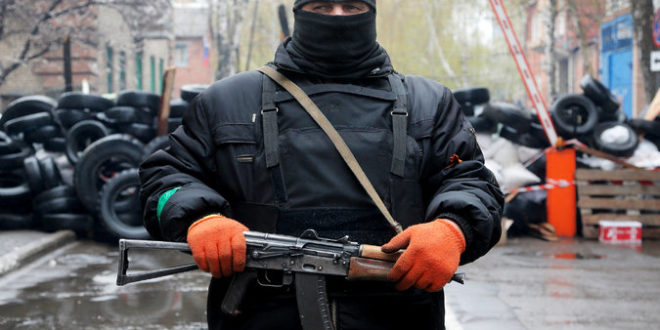
Just a month and a half after Russia annexed Crimea, Ukraine is on the brink of (civil) war. This time, the conflict is taking place in the eastern part of the country, north of the Sea of Azov. In this article, we will attempt to present a libertarian position on the events in Ukraine.
Since the beginning of the month, anti-government, pro-Russian protests have erupted in some cities in eastern Ukraine, and in many places the protesters are supported (led?) by armed units in plainclothes. The scenario is almost identical to the events in Crimea, with the difference that the troops are now actively engaged in combat. Roads to several cities have been barricaded and administrative buildings have been seized, with soldiers attacking local police stations and city halls, and NATO reports that a concentration of Russian troops has been detected not far from the border with Ukraine. Moreover, the Russian Foreign Ministry is no longer even trying to fool anyone with the naive excuses with which it “justified” its actions in Crimea, that “Russian citizens may suffer.” Sergei Lavrov, the Federation’s Foreign Minister, directly described the interim government of Ukraine as “incapable of taking care of the fate of the country,” which is almost tantamount to declaring it illegitimate.
Russia’s poorly concealed actions raise the question: which war, if any, is just and justified? Assuming, with all the conventionality, that state armies exist to protect the population, they should act only in cases where another state has already violated the individual rights of a citizen of the first country. Regarding the events in Ukraine, we cannot speak of such actions – neither during the occupation of Crimea, nor now, when the Ilyichevsk and Kuibyshev regions are occupied. Even the Russian Foreign Ministry in both cases did not mention any violence against their citizens. It is interesting to pay attention to the military invasion of Crimea a month and a half ago. At that time, the Russian authorities “argued” it with the potential danger to the Russian population of the peninsula. But this is a completely invalid argument. In this way, they could always excuse military intervention in any part of the world. Using this logic, all it takes is for your neighbor to be Russian and for some official in the Russian Ministry of Defense to decide that you could potentially harm him, as a result of which the Russian authorities would have a reason to send soldiers into your living room.
The same applies on an individual level – if one person hits another, just because they suspect they have been threatened, they are committing a crime. Since they are not protecting their own citizens, the conclusion is that in both cases the Federation is an aggressor, completely unjustifiably occupying territory of its own choosing – that is, we have no reason to view their actions in any other way than as criminal.
Many accept Russia’s behavior as criminal, but defend the intervention of another country – the US, NATO or the EU. In doing so, they not only break with the libertarian position, but also commit at least two logical fallacies: the enemy of my enemy [1] and the false dilemma [2]. From a libertarian perspective, committing one crime does not justify committing another, no matter how noble the purpose of the latter. If Ivan hits Peter without first being subjected to violence (i.e. without acting in self-defense), the former undoubtedly commits a crime. But no matter how good and noble George’s intention to stop the aggression may be, if he robs Maria in order to arm himself and help Peter, George also becomes a criminal. A US military intervention in Ukraine would be just that – harming some group of individuals (the US taxpayers) in order to carry out the seemingly noble mission of saving those suffering on the other side of the world. The latter does not mean that one should look with apathy at what is happening in Ukraine, but that people who are not interested in the events should not pay the price for someone’s political ambitions, and that “good intentions” are not a sufficient reason to force someone to do it.
According to a similar position, Russia is an aggressor and as such must be punished for its crimes in Ukraine. Of course, criminals must be held accountable for their actions. But there are two delicate points when it comes to sanctions between states. First, trade sanctions against Russia by the US or the EU will punish both Russian citizens and those living in the West, rather than the politicians who actually ordered the military intervention. We must not forget that it is not “nations” that trade, as some economic schools incorrectly assume, but individuals.
Consider the following example: an embargo on metallurgical goods produced in Russia. In order for trade to occur between two individuals or organizations, it is clear that initially Russian producers must cooperate best with consumers in the United States or Europe. When the links between them are severed through government intervention, both sides lose. Russian miners will become poorer, and many will probably lose their jobs because they will produce less.
Their customers in America will have to find another producer of metallurgical goods, for whose production they will most likely pay a higher price, which will reduce their competitiveness. Even if we assume that this industry is being punished because one of Putin's right-hand men is at the head of Russian metallurgy and the sanction was aimed specifically at him, he is actually the last in the chain and most likely will not feel the punishment as strongly as the dozens of miners and other specialists who will potentially lose their jobs and income.
Second, Obama’s position on the conflict in Ukraine is puzzling. As we have seen, the American president is right to criticize Putin for the ongoing occupation of Ukrainian cities. Interestingly, Obama is particularly uncritical when he himself was ordering military operations and drone strikes in many countries in Africa and the Middle East. Obama’s double standards and pro-war orientation also cost thousands of lives. In 5 years of military operations in Pakistan, the number of people killed, mostly civilians, is estimated at 2,400. We cannot help but be skeptical of the “humanitarianism” of someone who unabashedly orders the destruction of people, almost all of whom pose no threat to the US population at all.
The conflict in Ukraine is yet another example of the aggression that results from political power and absolute control over a large and well-armed army. The libertarian position on this is clear: war and violence, except in cases of self-defense, are criminal. The same is true for the violent execution of “good deeds.” In cases of terror, responsibility must be borne by the perpetrator—the politicians who order the actions and the actual perpetrators, not the entire population of a given country. And this rule applies regardless of whether the perpetrators are Americans or Russians.
[1] My enemy 's enemy - this fallacy is when an individual accepts someone else's actions simply because they are directed against something they dislike, regardless of whether they are actually right or legal. Interestingly, during the occupation of Crimea, some libertarians, including Lew Rockwell, also fell into this fallacy, claiming that Russia's actions were justified simply because it did the opposite of the "enemy" the United States.
[ 2 ] False dilemma – a situation in which either A or B is accepted as true, although both assumptions may be correct/false at the same time. Since Russia’s actions (A) are incorrect and unacceptable, the actions of the opposing party must be supported.


I want to express my position on the matter.
People really like to systematize things, i.e. to be able to say that in a situation some are the good ones and others are the bad ones. However, there are situations when there are no good and bad ones, but only bad and bad (or worse). So: Who is right in the case of Ukraine?
For me personally, no one. This is about power. That is, who will take it. And accordingly, the population is aligned in favor of the wishes of the specific country. For example, Russia is directly FOR the right to self-determination of part of the population of Ukraine, while the USA, the European Union, and so on are AGAINST it. Everyone looks after their own interests (for Power and Influence) and pushes their thesis in the newspapers and the media in general.
I personally would like such conflicts not to arise at all. And they would never arise if the population were given the opportunity to self-determine. And when I say "to self-determine" I do not mean to do this on a group level (for example, an entire region of Ukraine), but on an individual level. That is, I consider myself Russian and accordingly I go to live in a Russian region without asking anyone and waiting for permission from anyone. This would be possible if the state released control over people and allowed them to associate as they wish. However, since it is a question of power (economic and political), the state would never allow people to self-determine as and when they wish. That is why such problems arise: Large groups of people are forced to self-determine as Ukrainians, for example, without them wanting this. And at some point the situation escalates. A certain limit of patience is reached and unrest begins.
For comparison: If people were allowed to define themselves as they wished, then large groups of dissatisfied people would never form. The process would be continuous, people would adapt and problems would not exist. In short: problems come from forcing people to be something they do not want. And after problems arise, people wonder who was wrong and who was right. In this case, for me, the whole system is wrong, not that there are "good" and "bad" participants. Problems arise because of a faulty organization, not that one was "good" and another "bad".
About the referendum in Crimea: They spat on it as illegitimate because there were Russian forces there, etc. If I were Putin, I would let in international observers and hold an absolutely transparent referendum. The result would be the same as now: the majority of voters would be in favor of joining Russia. And what will Western observers do when they have no one to blame? They will probably come up with some other excuse to be against it!
To the previous comment:
"I personally would like such conflicts not to arise at all. And they would never arise if the population were given the opportunity to self-determine. And when I say "to self-determine" I do not mean doing this on a group level (for example, an entire region of Ukraine), but on an individual level. That is, I consider myself Russian and accordingly I go to live in a Russian region without asking anyone and waiting for permission from anyone. This would be possible if the state let go of control over people and allowed them to associate as they wish."
This is an extremely wrong way of thinking because:
1. Not all countries have a homogeneous population by area, as Bulgaria does. But even in our case, your thesis is not applicable, because:
2. I define myself as Bulgarian. Right across from my house lives a man who is an ethnic Turk, and although his grandparents lived in Bulgaria and some of them were also ethnic Bulgarians. (As far as ethnicity is more of a conscious choice, but that's another topic.) So, our third neighbor is, whatever that means, a Bulgarian-Mohammedan / Pomak. The ethnic Turk, in principle a nice and helpful person, and also an honest citizen, would define himself as a Turk (whatever that means) and in the event of a conflict would prefer our area to be "Turkish". I have no idea how the other neighbor would define himself. Which leads me to the conclusion that it is precisely such a way of thinking that would lead to conflict, and people who would otherwise live peacefully and quietly, as long as someone does not pressure them to define themselves.