 EKIP– Expert Club for Economics and Politics A Different Opinion
Recently, the heated debates around healthcare reforms have returned. But instead of the conversation going in the right direction, namely towards the topic of liberalization of the health insurance market, it has gone astray and has turned towards the gap of fines and collection. We are not saying here that there are no problems with the collection of insurance premiums - many groups of people are practically exempt from paying such premiums in one way or another. What is truly worrying, however, is that the financing of healthcare, since the establishment of the Health Insurance Fund, has increased dramatically, while the quality of healthcare services has remained at the same level. In this short article, we will examine in a very general way what are the reasons for this. When the NHIF was established in 2001, its budget was worth 628,826,100 leva, and by 2014 it had swelled almost 5 times to about 2.8 billion leva. We should conclude that the quality of healthcare in Bulgaria since 2001, even taking into account inflation, has improved several times - in the aspects of disease prevention, reduction of mortality due to socially significant diseases, increase in life expectancy, but this is not the case.
For comparison – the population of Bulgaria in 1989 was 8.9 million, and in 2014 it dropped to 7.2 million, the factors for this are many – the negative growth as a result of the reduced birth rate (10 per 1000 population) and the high mortality rate (14.6 per 1000 population) of the population over 65 years of age. Another factor related to the reduced population is emigration, which is difficult to measure, because the main destinations for this are in the EU, and Bulgaria is in a border union. Infant mortality is another sign of the reduction of the population, which compared to the 90s (14.8 per 1000) of the last century has decreased, but still maintains high levels (9.4 per 1000 as of 2011). The ratio of the population between 0 and 14 years of age (13.8% of the population) compared to that over 65 years of age (18.8% of the population). The increased mortality compared to previous years in diseases in the top 3 of the clinical pathways financed by the NHIF, namely - diseases of the circulatory system (71,644 deaths in 2012), malignant tumors (18,299 cases in 2012) and diseases of the respiratory system (3,974 cases in 2012). Malignant tumors (cancer) have shown an increase in recent years.
How to spend on health
The key to the listed problems of the health system lies both in the consumption of funds from the Health Fund and in their absorption by hospitals. It is important to specify in how many different ways everyone (except for students, pensioners and groups exempt from payments) pays for health in Bulgaria. The following graph may shed some light on the fog surrounding the financing of health services in Bulgaria:
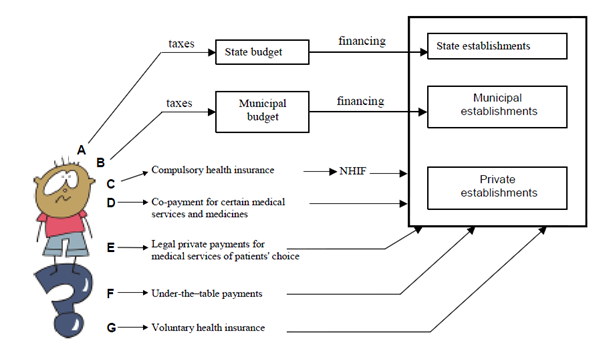
It is evident from the scheme that, in order to finance the health system, the patient is charged in several different ways, not only on a state and municipal, but also private line. It is important to emphasize that the money from these “cash registers” flows into several streams. For example, there is the so-called crony capitalism in the health system in Bulgaria, namely, private hospitals benefit from public funds. This is not, of course, liberalization, but artificial maintenance of market players who consume public funds in hollow clinical pathways and false directions, and of course this is paid for by those bringing money into the system. It should be noted that despite the state of the system, the number of hospitals continues to grow, as in 2011 they were on average 5 per 100,000 people, and the average for the EU is 2.6 per 100,000 people. The increase is sharp and coincides with the founding of the NHIF as an institution.
Part of the reasons for the increase in hospital facilities compared to the Union average are reduced to the following – lobbying by state and private hospitals, which benefit from such a dysfunctional system. Another problem related to the NHIF budget is that it is voted on every year by the National Assembly. This means that 8% of the money that the state takes for health insurance to a public structure is like an 8% tax, the use of which depends on the will of the national representatives.
In a very simple way, one can explain the responsibility and spending of the money from the Fund when it is in the hands of the state and when it is a company or a private fund. The responsibility when consuming public and private money is different, i.e. NHIF has no interest in making a profit, nor in maintaining budgetary discipline. The responsibility lies with the institution, not with specific individuals, and as a public structure, NHIF can receive subsidies and support from the state budget.
Where does the hole in the NHIF come from?
Every year, the NHIF ends up with a deficit, and in 2014 it reached almost half a billion leva, which necessitated an update of the budget. This does not lead to bankruptcy, as it should be in a private fund, on the contrary - the NHIF is constantly supported with financial injections. It can be said that the treasury is drained by state and private hospitals through clinical pathways, drug dealers (with the help of various patient organizations). A simple example of this is that a patient is admitted for problems with the respiratory system - the health record records that he is being treated for broncho-pneumonia, in which the costs of care would be much higher than for a common cold, which is often the real disease.
Subsidizing certain medicines is another problem - through lobbying by some patient organizations to have money allocated for them by the NHIF, the justification is usually that they are the "only ones on the market" that would help the patient. This purposefully subsidizes pharmaceutical companies offering this product, distorting market demand and supply, excluding other players on the market that offer the same or similar medicines or their generics. Consumers are harmed by not being left with a choice of several products, but only the one subsidized by the NHIF is offered. This harms competing pharmaceutical companies and they withdraw or stop offering their product.
The third way to benefit from the NHIF is by creating a "private hospital", according to the priority diseases determined by the Ministry of Health and the NHIF for the coming year, in which the most money will be poured. For example - next year, an increase in cardiovascular diseases is expected - expect an increase in hospitals for the treatment of diseases related to the circulatory system, which on paper will treat you for things that you are not sick with. It is no coincidence that the number of hospitals in Bulgaria and the number of employed medical personnel is constantly growing - there is subsidization from the state.
Private health insurance funds strictly monitor how money is spent, because it depends on whether a fund will remain a market player and whether it will be effective as such. Wasting and sinking money into the so-called clinical pathways would be much more difficult, because of the constant control. But in the system we have today, competition is killed in one fell swoop, because it is pointless to fight a monopolist, and it is also more profitable for everyone to be treated through public health care, because they pay 8% of their earnings for it anyway. Real market liberalization should consist in eliminating the monopoly of public health insurance and allowing private funds to compete and provide a higher quality and standard of health care for the population.






In the healthcare and pension system, from a legal point of view, it is a violation of the Constitution and GENOCIDE - https://www.facebook.com/atanas.shalapatov/posts/1562875143990714
In comments #2 and 3 here - http://www.investor.bg/blogosfera/363/a/kakvo-stava-zad-zavesata-na-neotlojnite-reformi-v-zdraveopazvaneto-193635/#comment-newest
I have described in more detail.