 EKIP– Expert Club for Economics and Politics A Different Opinion
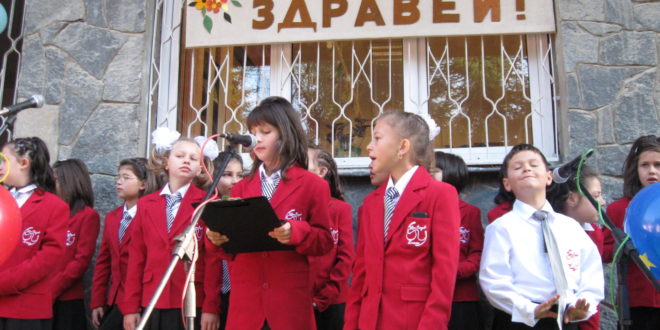
 Today is September 15th – the day when all students head to their favorite school. Or at least that’s how the authors of the native reading books try to present the situation. Unfortunately, however, the situation is far from rosy. Quite the opposite. The situation of Bulgarian education is so critical that every passing year, during which the necessary reforms are postponed, causes irreparable and immeasurable damage to thousands of people in our country.
Our education system has been in a kind of collapse for a long time, visible to many, but the root cause and its corresponding solution somehow elude the general public. Various social groups exchange accusations of the most diverse nature: the state is to blame for paying teachers too little; teachers are to blame for not doing their job conscientiously; parents are to blame for not raising their children properly; students are to blame for not taking education seriously, etc. There may be some truth in all these statements, but no one says what is at the root - the state monopoly in the education system produces functional illiteracy and effectively destroys human capital.
Central planning in the field of education, based on the principle that every child must necessarily receive free and strictly regulated education by the state, strictly in accordance with the standards of the Ministry of Education, is detrimental to future generations and to the much-desired increase in living standards. The reasons for this are the misunderstood mission of school (education) in people's lives and the inability of state officials to understand what the market needs, and hence the totally wrong strategy in its implementation.
Education – goals and the problem of economic calculation
For most people, the purpose of education is to socialize a person, to educate him in generally accepted morals and values, to give him a common culture, to prepare him for life, etc. But the supporters of these ideas miss the fact that the only valid mission of the “school” is to capitalize on human potential and prepare a person for successful realization in the free market. All other results are optional additions. Moreover, the idea of the state and its education as an educator is key for all left-wing totalitarian regimes. It is the indoctrination of the younger generation that can guarantee the stability of a despotic regime in the future, so it is dangerous to claim that the state should educate morality or values. But our education fails precisely in fulfilling its main mission, from which all the problems announced in society originate.
And this should not surprise us. There is no way that a deeply anti-market central-planning system can produce a market product with high added value for the free market. Here again we can pay attention to the problem of economic calculation. In its essence, education is an economic process – parents spend money (in public education, the majority of the costs are borne by taxpayers), children spend a solid part of their time, and those working in the system offer their service. But since the voluntary moment of exchange of funds is absent (as in a purchase in a store, for example), the quality (always a subjective concept!) that appears in a competitive market environment is also absent. Instead, we have a process that begins with the forcible seizure of income through taxes, passes through central planning (compilation of state standards, curricula, textbooks, etc.) and in the form of coercion (Art. 52 of the Constitution of the Republic of Bulgaria) is expressed in the imposition and implementation of the central plan.
Let us leave aside for a moment the first part of this process, which in itself is a sufficient argument against this system, and consider the remaining two.
The planning part of the process is dominated not by normal market logic, but by a mixture of lobbying, political interests and irrational “scientific” thought. The curricula have almost no connection with real life, are based on quantitative principles (horariums) and are quite often a field of conflict between different scientific circles at the highest levels of regulatory bodies. Subjects of unnecessary complexity are studied, subjects with infinitely dubious practical application, and at the center of most programs is the subject of literature (in which a compulsory matriculation exam and an exam are held after the 7th grade), which adds absolutely no value in its current form. On the other hand, there is a lack of market-oriented disciplines - the subjects of computer science and information technology have a minimal connection with the labor market in the sector, with the others the connection is practically zero.
The state does not and can never have a mechanism by which to assess the individual characteristics and needs of each student, to adapt them to the requirements of the market and to ensure quality education for all. The only possible approach for it is to consider students as a homogeneous mass of personal identification numbers, each of which receives the planned amount of information in bulk.
The realization of education
In the executive part of the process, the situation is even more difficult. Quite often, mainly according to teachers' unions, it is said that teachers' salaries are too low and this demotivates teachers to do their job conscientiously. It should be borne in mind, however, that we can hardly expect motivation to do work from civil servants, such as teachers. And this is not their fault, but the system - since it does not function on a market principle, it does not have the ability to generate real labor prices, and hence quality control. In this environment, the teacher has no interest in working better, since his income does not depend on this. Moreover, state funding stimulates a negligent attitude to work (less effort for the same salary means higher efficiency for the teacher). But even if we assume that salaries can be high and teachers are highly motivated, then even with perfect implementation of the plan (which is undoubtedly bad, as we noted above), the results would not improve significantly.
It is impossible for users of the service to make an informed and realistic choice. Students and the parents who legally represent them cannot rely on the pricing system that the free market would provide to guide them towards the better school.
The missing market in education
We can safely say that the education system in Bulgaria embodies the victorious mature socialism– everyone in the system is equal – both talented and mediocre students and teachers; the program is the same for everyone, regardless of their needs; all schools are free and receive the same state subsidy, [1] regardless of the quality they offer; all units of the system are under the strict hierarchical control of the state authorities with minimal opportunity for free private initiative (which is also strictly controlled through accreditations).
As a result of this corporate monopoly (because the state with its institutional network is a huge corporation, insatiable for public funds, which offers nothing of quality in return ), those leaving the system have not accumulated almost any useful knowledge, but have lost 12 of the most important years of their lives in the meaningless implementation and over-implementation of the central plan. The fatal thing in this case is that from this moment on they have to realize themselves in the labor market, for which they are very poorly prepared, and the lost time cannot be returned. As a result, we observe low labor productivity, leading to low wages, high youth unemployment, which, ironically, is combined with a search for qualified personnel by business.
But when we talk about private education, the leftist argument always comes to the fore: “What will happen to the children of poor parents?” And again, we must remember – education cannot be a positive right. That is, the right to education for one cannot be tied to the obligation of someone else to provide it for him. Although leftist thinkers believe that the collective awarding of diplomas will lead to collective enrichment (it is unknown by what mechanism), education is an individual investment in the future, and the causal relationship between education and wealth is exactly the opposite. Parents invest in their children, trying to provide them with the best possible realization in life.
Nowadays, with the development of the Internet, information is everywhere and it is not even necessary to go to school and spend a lot of money to get a quality education. An example of this are the many well-paid programmers who began their education independently at home, without teachers, without coercion, guided only by their own curiosity and resourcefulness.
But the leftist idea that as many people as possible should receive a quantity of education (because the state cannot offer quality), dressed up in equality, completely distorts the process. The uncontrolled production of diplomas by the state, which is a result of the current system, has the same effect as the uncontrolled printing of banknotes – their devaluation. We can argue that for poor families (and for the rest) state education is a disservice, because in this way their children receive a useless diploma, in exchange for lost time, being deprived of the opportunity to navigate the labor market and try to educate themselves according to its needs and their capabilities.
The above statement eloquently shows the total failure of public education in Bulgaria and the urgent need for privatization and deregulation in the sector. The standardized training process only standardizes mediocrity, because just as a socialist economy cannot produce wealth for all, but only evenly distributed poverty, so too, public education cannot educate all, but produces evenly distributed illiteracy.
However, the necessary reforms are not visible on the horizon...
[1] Which is provided per number of students, which further distorts the incentives in the system and leads to waste, as beautifully demonstrated by the case of the school in Pordim, where people who may have never set foot in a classroom are studying on paper, but taxpayers nevertheless subsidize with thousands of leva.




I'm interested in your opinion on education in the Scandinavian countries, which is the best in the world, and which is also free?
I completely agree that reforms are needed, but privatization of the education system is not the answer. I completely agree with most of your articles, but this one is not one of them.