 EKIP– Expert Club for Economics and Politics A Different Opinion
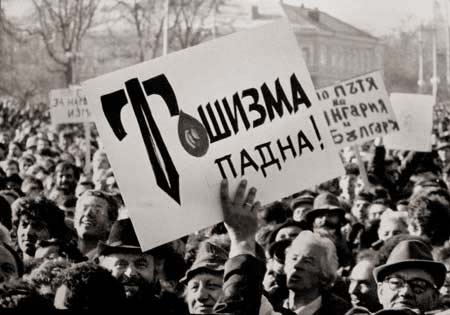
Today we mark 26 years since the fall of the communist regime and the start of the so-called transition. What happened on this day – in short, due to the crumbling socio-economic system in the USSR and the Eastern Bloc, the socialist economies could no longer survive on artificial respiration and, led by Gorbachev's perestroika, began a process of liberalization. The result of this in Bulgaria was the removal of Todor Zhivkov from all leading positions in the state, followed by the beginning of democratic changes.
26 years later, can we say that the transition was successful and is it even over?
Unfortunately, to this day, many people, including well-known “blue” politicians, tell the story incorrectly, leaving the wrong impression. The most widely circulated expression describing the changes is “the transition from communism to democracy.” This statement in itself is quite contradictory, because democracy in no way excludes communism. It is simply a system that tells us that anything is allowed, as long as the majority of voters support it.
What should the transition from communism be aimed at then?
The answer is simple – capitalism. Socialism (and communism as its radical form) is a system in which the means of production are collectively, not privately owned. The state, the mediator of the collective will, owns all capital, holds a monopoly over it, and manages it in such a way as to satisfy the ever-growing needs of society. The collective good is above the individual, and individuals can be sacrificed (figuratively, but quite often literally) for its realization. Capitalism, on the other hand, requires exclusive private ownership of capital, free and voluntary exchange of the produced goods, and sound money. The role of the state is reduced to a minimum.
Where are we before November 10th?
The organization of Bulgarian society before the changes was typically socialist (some apologists for communism try to explain the failure with the concept of “state capitalism”, but this is an oxymoron). Private property was officially banned until before Decree 56 of January 1989. The state is the monopoly owner of all economic power. A real price market does not exist (except for the “black market”, which reflects some realities), all prices and wages are determined on the principle of central planning (that is, blindly). Individual freedom is absent, the borders are closed, the media are uncompromisingly censored. There is no real banking system, the BNB is engaged in price control and central planning, the lev is an unsecured currency, uncontrollably printed for lending to state-owned enterprises.
This system logically fails to create normal living conditions, and after November 10, timid attempts to change it began. All reforms stopped after the vote of confidence lost by the government of Filip Dimitrov, and even went in the opposite direction, after the democratically elected government of Zhan Videnov came to power. The story from there on is well known.
Where are we today?
To answer this question, we need to see what we have reformed and what we have preserved from the socialist regime.
Economy : The desperately delayed privatization of state-owned enterprises was nevertheless carried out, and today the Bulgarian state owns relatively few assets. There is a functioning private sector, everyone is free to create their own company and develop it, but unfortunately the state actively interferes with this. There are numerous regulatory bodies and mechanisms by which the government can influence economic processes, which contradicts the idea of capitalism. The CPC is a good example of how any more resourceful entrepreneur can turn into a potential criminal.
Taxes : In a socialist society, we can say that taxes tend to 100%, since workers do not work for themselves, but for the Party, counting on it to satisfy at least part of their needs. To date, the situation is significantly better, but not in absolute terms. According to various estimates, the redistribution of GDP (which is the real indicator of the tax burden) tends to 40%. Quite often we compare ourselves with countries like Germany and Sweden, where the percentage is over 50, but such a comparison is untenable. High taxes do not lead to prosperity, but exactly the opposite. Wrong cause-and-effect relationships are made between the high standard of living in Western countries and their high taxes. A society striving for capitalism must fight for fewer and lower taxes (example – Switzerland).
Education and healthcare : Things are critically bad here. Education functions in the same way as during socialism – total state control, central planning, no connection with individual needs and the market. This is one of the sectors that needs urgent reform, because we can safely say that for Bulgarian schools, November 10th has not yet arrived. The situation in healthcare is not much better. The state is still a complete monopolist of health insurance services, medical education, and postgraduate specialization. It is evident that both among the authorities and among society there is communist propaganda about the doctor as a servant of society, about medicine as a noble and selfless activity, not subject to economic laws, and the word profit is perceived as blasphemy when it comes to medical activity. It is important to note, however, that by allowing private medical practice, patients still have the opportunity to choose, and doctors have the opportunity to freely practice their profession and receive reasonable income completely legally.
Energy: Unfortunately, capitalism is absent here too. Energy facilities are either state-owned or regulated by the state. There are no real market prices for electricity and electricity transmission services, and at the center of the system are NEK and SEWRC. The necessary liberalization pro-market reforms are constantly postponed, and state-owned companies are constantly in debt. We expect to see the promised reform, which is planned to come into effect in 2016.
Police and judicial system : Unfortunately, things have not changed much here either. The Ministry of Interior system operates on the principle of privileges (the basis for the pre-1989 regime), and only a few days ago employees protested to keep their coveted bonuses (20 salaries upon retirement, etc.). There is no quality control, work is evaluated on a quantitative basis (time served), and the main role of the police is not to protect people's property, but to protect and serve the authorities (which is a natural consequence of the fact that the authorities are their employer). In terms of the judicial system, we are leaders in spending as a percentage of GDP, but at the same time, the widespread corruption, inefficiency and dependence on the powerful of the day are an open secret. It was only in 2015 that an attempt at reform was made, which, however, remained in the realm of "historical compromise".
Public sector, financial system : Bulgaria has a strongly expanded public sector. According to NSI data for 2014, the number of people employed in the public sector is over 700,000, which is almost 1/3 of total employment. These figures show the extremely high role of the state in the economy and of redistribution as a (false) method of prosperity. In terms of its budget policy, the state is also not doing well. Since the beginning of the crisis, Boyko Borisov has been talking about "tightening the belts", but in fact, since 2008, the state budget has been in constant deficit, and significant layoffs of civil servants have not been made. Regarding the banking sector, things are more acceptable. After the mass bankruptcies of banks in 1996-1997, the country is in a currency board and the lev is as stable as the euro. But since the euro itself is an unsecured currency, dependent on the ECB's policy, it is not entirely correct to think that we have secured "sound money" as a condition for prosperity.
The EU as an alternative to the CMEA : The advantages of the current economic union, of which we are a part, are obvious. It is designed to function as one large free market, where Europeans trade and move freely, thus prospering. Unfortunately, however, the policy of the European Union (which directly affects us) is not particularly pro-market. Legislation abounds with regulations, and until recently there were even quotas for dairy producers. Ideas for harmonizing tax policies are increasingly being sneaked in, which move away from the ideas of freedom and a free market. European funds, on the other hand, provide a comfortable resource that the authorities have at their disposal for spending (and abuse), but which is very wrongly seen as a vital necessity for the development of our economy.
The assessment that we can make, as an answer to the question in the title, is the following: The transition is not over. In some areas it has not even begun, in others it has stopped at the initial stage, and somewhere there is even a reverse development. Still, the overall situation is better than 26 years ago. Freedom is there, private property has been restored, albeit with all the reservations above. Hopefully, after another 26 years, socialism will be gone forever.



Let's take a more global look at the current global financial system and I have explained it under the article (comments 11 and 12) - Christopher Dembik, Saxo Bank: A new global crisis is inevitable - http://www.investor.bg/analizi/9/a/kristofyr-dembik-saxo-bank-nova-globalna-kriza-e-neizbejna--205684/
Bulgaria can move directly to a resource-based and planned ecological economy, in short because it is a long explanation, especially for the word planning, because the "invisible hand" of the "free" market has led the world into planetary catastrophes, that is, the greater cause of the catastrophes is the deregulation of financial capitalism, because with industrial capitalism, neoliberalism is especially needed, but to some extent
Mr. Shalapatov, your comment is inadequate, I have nothing more to say to you.