EKIP– Expert Club for Economics and Politics A Different Opinion
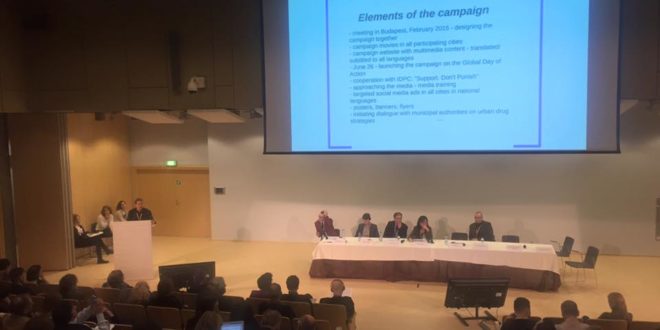
 At the beginning of the year, I received an invitation to participate in the Urban Drug Policies conference, which was held in the Polish capital Warsaw. The idea of the event was to bring together Polish officials responsible for formatting and implementing state drug policy with representatives of the sector from other countries with similar or radically different approaches to the problem. The task was to jointly develop a joint declaration with which to send a message to the upcoming UN UNGASS assembly, where a serious revision of the global approach to drugs and citizens who use them is expected. Here I share my impressions
The Frankfurt Way
In the early 1990s, as almost everywhere in Europe, heroin use skyrocketed, and the German city of Frankfurt was no exception. In addition to the epidemic problem of abuse, severe addiction, and overdoses, Frankfurt was also experiencing the negative consequences of injecting in public places. In one of the city parks, about 2,000 injections were reported daily. This created risks of spreading infections even among people who did not use substances. Instead of doubling the costs and using force against users, as others were doing, the local government adopted a different model.
Their model can be characterized by 4 pillars – control, prevention, treatment and harm reduction. In the years when neither methadone programs were widespread nor was it known whether clean needle programs were useful, the community in Frankfurt began to implement them. Injection rooms were opened, along with therapy programs for those who wanted to give up their habit. The results were not long in coming. Overdose deaths dropped from 170 per year to no more than 20, crime fell significantly, open consumption practically disappeared.
Zurich and Switzerland
The Swiss have always been a shining example of everything. They don't like to listen to others and agree with the widespread opinion. This is how they approach drugs. Exactly 30 years ago, Zurich had the problem of Frankfurt. Injecting in public places, increasing deaths from overdose, etc. The Swiss are developing a fundamentally different approach to the generally accepted one. Instead of treating addicts as criminals and applying public order laws, they accept their condition as a disease, as a problem of the health system and practically remove the police from solving it.
If you are a heroin addict in Switzerland, the following happens to you: you go to your GP and share your problem with him; he examines you and you both agree on your heroin dose; you get a prescription with which you can go to one of the injection rooms and get your dose of heroin for free; you can only consume it in the room in question and under the supervision of a medical professional. Usually, after you get your dose of heroin, you get dressed and go to work. Yes, Swiss drug addicts are people with families, jobs, positions in society. Very often, you can't distinguish them from clean people in any way, there is simply no subculture of drug addicts who prick themselves with common needles, wallowing in misery. When a person can easily satisfy his strong need for a substance, the rest of his day can be devoted to work, self-improvement, family, etc. things that in the eyes of the average Russian drug addict, for example, are practically impossible, because of the social isolation he is subjected to.
The Swiss representative at the conference shared that because their system works so well and addicts don't die, in his country they are already faced with 70+ year old heroin addicts, for whom new ways must be invented for heroin to reach them, because they have difficulty moving and cannot get to the injection room on their own. The system is so good that overdose cases are reduced to zero. Yes, I'm sure someone will say to themselves "But how can I pay for someone else's drug addiction and give them free heroin".
The Swiss are a calculating people and have done their math quite well. They have calculated that giving addicts what they need for free is the cheapest way to deal with this problem, dozens of times cheaper than prohibition and keeping them in prison. Naturally, these measures cannot be considered as encouraging use, just as we cannot consider providing insulin to diabetics as stimulating diabetes. From the point of view of the Swiss, the two conditions (diabetes and severe addiction) are almost the same – a disease and chronic, for which we have no cure, but we can significantly alleviate the condition of the sick with the right approach.
Portugal
In 2001, Portugal surpassed everyone in its courage, but let's first trace what Portugal was like before that fateful year. Until the 1970s, the country was practically isolated from the rest of the world and ruled by a military junta. After the changes, it quickly became the new cheap party destination for vacations. Its proximity to North Africa made it a convenient route for importing hashish and heroin into Europe. Thus, an epidemic problem with heroin quickly developed in the Iberian country. Society did not have mechanisms in place to communicate and deal with such challenges, so the solution was the then popular prohibition. The costs of putting people in prison increased, crime increased, and overdose deaths also increased. In search of a way out, a unique political consensus was reached, in which the ruling and opposition parties agreed that they would support whatever solution was proposed to them by a team of top scientists in the field.
After serious research and discussions, the team came up with their solution – the possession of personal quantities of all drugs from cannabis to heroin should be decriminalized (not punishable by imprisonment) and all funds that were spent on prosecuting addicts should be redirected to their rehabilitation and reintegration. Since then, Portugal has seen a decline in overdose deaths, a decline in teenage drug use, and a decline in crime every year. To this day, experts consider Portugal’s example to be the most successful and the one most likely to be implemented worldwide when the world finally realizes the devastating impact of the War on Drugs.
Statements
In summary, I can say that the solution to dangerous addiction and drug use lies primarily in the communities themselves. Wherever this problem has been tackled, the communities themselves have played a key role. Police, central and local authorities, NGOs, scientists, experts, teachers, parents sit at the same table and develop mechanisms with which to cooperate. Wherever we can consider that this problem has been solved, this has happened by stopping treating addicts as criminals and perceiving them as sick people in need of help.
What an addicted person needs is support, empathy, love, a sense of community, of family. He needs something other than the needle, something that gives him a reason to live and feel significant. It is high time that in Bulgaria we started treating them this way, and that is why we do not need special laws and directives from above, we need a rethinking of our understanding of the world and society.
The war on drugs is a failure. A world without drugs is impossible. They have accompanied humanity throughout its history, and to think that through violence we can add and subtract elements of human nature is as naive as it is to think that we can eradicate greed or aggression in man.
Portugal, Germany, Switzerland are countries that showed extraordinary courage and determination 20-30 years before us and showed us that their policies work. We no longer need experiments to understand what works. We already know what works. All we need now is the civic and political will to do the right things.
This article is part of the collaboration between EKIP and the Bulgarian Libertarian Society’s legalization campaign – Liberty420– ahead of the “Freedom for Hemp” March, which will take place on April 24, 2016.