EKIP– Expert Club for Economics and Politics A Different Opinion
In connection with the media partnership of the Expert Club for Economics and Politics and the March "Freedom for Hemp", our team set out to analyze data from a demographic survey on people's attitudes towards the possible decriminalization or legalization of the hemp plant. Over 2,000 people participated in the online survey. These are our conclusions:
Preliminary expectations
We approached the topic with preliminary expectations of two different groups of people who are "For" and "Against" in some way the liberalization of the regime regarding hemp. We viewed the division as generational. We expected the people who are against to be aged 36+, fluent in Russian as their only foreign language and drawing information from traditional media in their native Bulgarian language.
On the other hand, we expected the "For" people to be young, working-age, in-laws who get information from new media and mostly do so in English.
It was precisely these expectations that we wanted to confirm through the demographic study. The idea behind it was not simply to do a kind of census of people "For" and "Against", but to understand exactly what kind of people are behind these positions, what their values, dreams, aspirations in life are. Therefore, our study was more of a demographic one than anything else.
With these expectations, we approached the study.
The results refuted some of our expectations and confirmed others.
Results
It is important to say in advance that the sample we processed is not representative. Due to the specificity of the questionnaire (online questionnaire), we received a vast majority of completed surveys in the age segment 18-36 and significantly fewer 36+. It is very difficult to confirm the above statements when we do not have a clear comparison of a relatively equal number of both age poles.
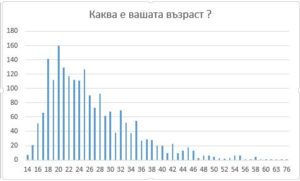
The lack of respondents from the appropriate age group made this demographic survey more about the youth in Bulgaria.
However, we can draw several main conclusions from it:
- Young people are prepared on the topic of cannabis and its legal status
Our respondents answered several questions surprisingly well. ¾ of the respondents do not consider marijuana to be a drug, which is the truth. Due to the merging of several concepts into one, especially in the Bulgarian language, words such as "drug" and "addiction" appear, which have more than one meaning.
For example, for the Bulgarian "Zavisimost" in English literature there are two different concepts - dependence and addiction, which mean different things.
Dependence is a biochemical process resulting from the use of a substance, associated with the development of tolerance (a reaction of the receptors it stimulates) and later the feeling of discomfort and problems when stopping the substance (withdrawal).
Addiction is a disease state that is associated with a change in the functioning of the dopamine reward system in the brain. It does not necessarily have to be a consequence of the use of chemical substances, but can be related to gambling, extreme sports, sexuality, etc.
We have the same problem with “narcotic,” which comes from the Greek “narkos,” meaning sleep. Narcotics were considered to be substances that put you to sleep, such as opium derivatives. In this sense, stimulants like cocaine and amphetamine are not narcotics either.
The correct term is “drug” or Biologically Active Substances. These are all those that in some way affect the function of the body. In this context, hemp is no different from aspirin or lemon balm tea. It also cannot fall into the broad concept of the word drug because it does not develop a distinct and serious physical dependence.
On the other hand, again ¾ of the respondents understood that there is a difference in the different legal statuses of the plant – legalization and decriminalization. This question was extremely important in order to know whether our respondents are aware when they state that they are “For” or “Against” a certain legal status of the plant.
- There is still some generation gap.
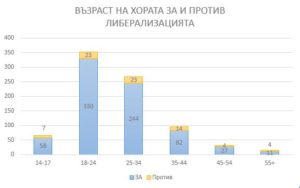
At least according to our available data, we can say that there is some kind of generational gap on the topic of hemp.
Of the entire sample forming the support for the liberalization of the hemp regime, only 16% of respondents are over 35 years old.
In the sample of respondents who are against liberalization, the percentage of people over 35 is twice as high – 30%.
- Huge support for people living abroad
After Sofia and Varna, we have the most completed surveys from those living abroad (92). Of these, only one respondent has declared himself against the liberalization of the hemp plant. This speaks to the huge difference in the perceptions on this topic of Bulgarians who live in their homeland, draw information from local sources, communicate with their compatriots, and those who are elsewhere in the world, draw information from local sources, meet people from all over the world.
- In Bulgaria, it is still believed that prohibition protects children
This is perhaps one of the most important myths to debunk.
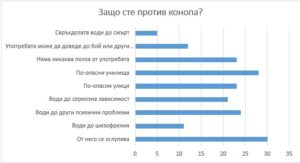
Our initial belief was that the bans were supported largely by mothers who were worried about their children. This was partially confirmed by the survey. There were many more parents in the “Against” sample than in the “For” sample.
Also, when we asked people why they were "Against," second only to the notion that "marijuana makes you dumber" was that schools are safer when weed is banned.
The laws of economics and global practice on this issue show exactly the opposite. In countries like Portugal and the Czech Republic, where cannabis possession is decriminalized, the use of all drugs among teenagers is declining. The same is happening in Colorado, where hemp is fully legalized for those over 21.
The economic logic behind this seemingly paradoxical truth is that when a product is banned, its supply goes into the hands of people who are experts in the so-called black, unregulated market. A large component of the price of the product is the risk of being caught, therefore, to be successful, you have to overcome any moral barriers to trade. Therefore, the black market is in the hands of immoral, armed gangs, who do not care whether they sell to vulnerable children or to mature individuals.
Also, economic laws say that when a product is banned, in addition to its price, its potency per unit weight in pure product increases, and the quality of the product itself plummets. We observe the same thing with the hemp market in Bulgaria. Instead of hemp, teenagers are sold synthetic imitations of the plant, which, unlike it, can be dangerous and even deadly.
Yet another study, this one by the World Health Organization (WHO), places countries with strict prohibition such as Bulgaria and France in the top 5 countries with the highest cannabis consumption among teenagers.
Therefore, logically and factually, the statement "Children are safer when cannabis is banned" is a myth, not a fact.
The other myth, that "weed makes you stupid," is harder to dispel because scientists are still not certain whether it's true or false. There is evidence that shows mental decline in long-term users, but at the same time, other studies are emerging that deny such a correlation.
Another point worth noting is the low percentage of people who believe in the dangerous and toxic properties of cannabis. Only 5 people noted that they believe that there is a lethal dose of cannabis.
- Those who support the liberalization of hemp prefer it to alcohol
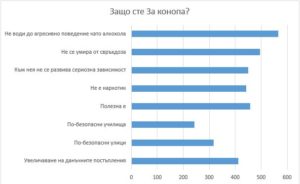
The three most preferred arguments "For" the liberalization of hemp are precisely its advantages over the use of alcohol:
1) Cannabis use does not lead to risks of aggressive behavior like alcohol
2) You don't die from an overdose (like you die from alcohol)
3) No serious addiction develops – also inherent to alcohol
The lack of a scientific approach to determining which substances are legal has been repeatedly highlighted by prominent scientists. Professor David Nutt, a former adviser to the British government on drugs, in his attempt to scientifically classify and compile a kind of top 20 of the substances that pose the greatest danger to the individual and society, places alcohol in the top five along with heroin, cocaine and tobacco - the legal drug that is responsible for the most deaths per year.
- The "For" and "Against" groups ignore family background as determining their opinion on this issue
A total of 40% of respondents who support liberalization sought information from specialized blogs, websites, as well as social networks.
The percentage of those "Against" is around 30, with another pronounced opinion-determining factor appearing there – friends or the so-called "person-to-person" transmission of information (mentioned by 25% of respondents).
It is interesting to note the absence of parents and teachers as a factor determining opinion. It is to them that the burden of educating adolescents on this topic has traditionally been transferred. However, the study shows that, in total, less than 10% of respondents in both groups indicated teachers, parents and relatives as a source of reliable information and an opinion-forming component.
We should also mention the absence of traditional media – radio, television, newspapers as an opinion-forming component. In both groups, the total percentage of traditional media is less than 20.
- More opponents of liberalization speak Russian
A quarter of liberalization opponents speak Russian, while opponents speak 1/5 of their supporters. However, English is dominant in both groups, which partially refutes our initial prediction that opponents do not speak a foreign language other than Russian.
Why are we so interested in the Russian language?
Russia remains the last ideological bastion of drug prohibition. According to the Russian administration, any attempt to help users' lives be preserved in any way, to provide them with support, treatment, therapy, substitute substances, etc. is an encouragement to use. In Russia, even giving a clean needle to an injecting addict to protect him from sexually transmitted diseases is wrong.
Alas, unfortunately, Bulgarian drug policy is significantly more influenced by Russian ideas than by Western ones. The person at the head of drug policy in Bulgaria, the secretary of the National Council for Narcotics Svetlana Yordanova, is a Russian graduate, and all anti-drug propaganda materials and legislative initiatives are translated literally from Russian.
It was expected then that supporters of the bans would become literate in Russian or Bulgarian.
General conclusion
At least according to the current sample, it is difficult to distinguish so much between two different demographic groups that support and deny the liberalization of the hemp plant. There are successfully superimposed myths and fears in society that are denied in the rest of the world, but here they are still the main component shaping public opinion.
Perhaps the most important conclusion is that the efforts of government agencies to push preventive education through the teaching profession and parents are not working at all. Young people seem to easily sense the pedantic and manipulative tone and seek information from independent and unbiased sources.
Traditional media outlets are lagging behind in keeping up with global discoveries in the field or are unwilling to delve into the topic because it is not widely circulated. This opens the door wide for new digital media and social networks to shape the future dominant vision for hemp-related policy.
We are on the verge of a generational revolution. The vast majority of people up to the age of 36 support the liberalization of the cannabis plant. Why exactly the young are "For", we can only speculate. Perhaps because they know in detail the effects of the plant, have acquaintances who actively use it and the popular myths about dullness, schizophrenia, interest in harder drugs or entry into the criminal world do not come true for them.
Either way, in Bulgaria this topic is on the verge of becoming unavoidable for the political class. If now it is more of something that the big parties do not want to deal with, because they do not direct their electoral marketing towards young people anyway, but rather the 36+ age group, very soon these young people will become the 36+ generation and set the agenda of society.
You can download the full results of the study here.
Huge thanks to Nuweb and Tsvetelina Kamenova for managing this study.