EKIP– Expert Club for Economics and Politics A Different Opinion
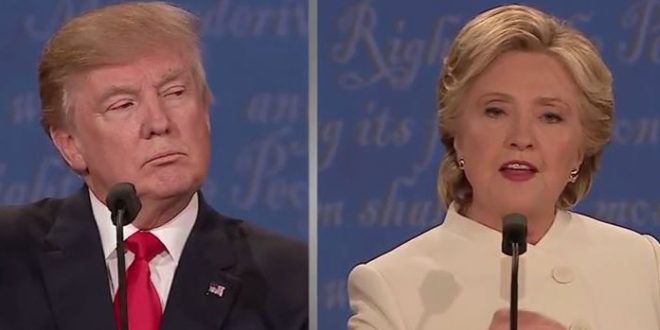
Nikola Filipov: The third and final presidential debate was certainly the most constructive so far. There was a good reason for this: the moderator of the debate, Chris Wallace, was not afraid to ask uncomfortable questions, both to Clinton about Wikileaks and to Donald Trump's accusations of sexist treatment of women. During the debate, both candidates managed to reveal their vision of many of the most pressing problems of American society, which is ultimately the goal of these appearances. For me, both in the second and third, Donald Trump is the winner. However, the reason for this is not rooted in any phenomenal performance by Donald Trump, but in Hillary Clinton's past as a politician holding high positions in the US administration for the last 30 years. In this aspect, the strongest moment for Trump was the one in which the ongoing military operation in Mosul against ISIS was commented on. At this point, Trump countered Hillary Clinton, pointing out that if the United States had not withdrawn from Iraq, there would have been no need for such a battle. The United States withdrew from Iraq when Hillary Clinton was secretary of state. It was the vacuum that formed in Iraq after the withdrawal of US troops that created the necessary conditions for the birth of ISIS. This is not an argument that Hillary can refute. For another debate, however, Donald Trump failed to defend his economic program, which surprised me quite a bit, because despite all its negatives, it is many times better than that of the Democratic Party.
Dimitar Karagegov: I think that the desire of both candidates during the last debates between them was to lose as few votes as possible, instead of gaining something. The expectations of a heated argument never happened. With few exceptions, we observed a literal repetition of the previous debates. Both candidates tried to adhere to the ideological line of their parties. According to Clinton, the government has no place in the decision whether to keep your baby, but it should have a significant role in how to spend everything you make. Trump, on the other hand, is thinking of lowering taxes and preserving the right to bear arms. In terms of mutual attacks, better known as "I'm bad, but you're much worse," I think the scales tipped slightly in Trump's favor. He was definitely more prepared on these issues and his counterattacks were more resonant than Hillary's. Clinton made a weak and unsuccessful attempt to raise the emotion around the Russian hacks, while Trump did quite well in his exposition of the Clinton family foundation and his opponent's political career. Personally, for me, the biggest loss of this presidential campaign is that they abandoned issues like the War on Drugs and Climate Change. It seems, as much as I hate to admit it, that the legalization of marijuana was a topic on the lips of Trump and Clinton only and only because Bernie Sanders was gaining points from it. With him out of the race, there is no need to talk or promise anything along the lines of the War on Drugs, and 60% of American citizens will once again be left with their fingers in their mouths.
Boyan Nikolaev: The third debate had absolutely no meaning, as it followed the pattern of the first two – each candidate tried to denigrate the other as much as possible so that he could be recognized by voters as the lesser evil. In the end, we have two absolutely identical candidates in terms of ratings – disapproved by about 70% of Americans and approved by about 30%. That is, whichever of the two becomes president (it will probably be Clinton, since at least half of the Republican Party has de facto sabotaged Trump's campaign all along), he will be unable to do almost anything in domestic or foreign policy.
The most interesting moment of the third, and of the previous debates, was the reaction of the Americans when Clinton raised the topic of Putin against Trump. For the eighth year in a row (this trend began with McCain), the vast majority of American society is literally not interested in Russia. For them, it is a distant country that they do not like, but they do not perceive either as an immediate threat or as a direct competitor on the foreign policy scene. And this is where the impending catastrophe will come after the presidential election.
Whoever wins will have neither the political mandate from the voters nor the political mandate from Congress and Senate to do anything in the Middle East. If Clinton wins, Congress and Senate will approve her desired military interventions and confrontations with Russia, but her own voters will destroy her and the Democratic governors, senators and congressmen. Currently, over 2/3 of Democrats and Republicans want a total de-escalation of American interventions and confrontations abroad, with the most radical being the progressive-pacifist wing of the Democrats. In the event that Clinton does not intervene in the Middle East, however, she will hand it over entirely to the Assad-Putin-Iran trio and will go down in history as a totally failed president. If Trump wins, the opposite will happen - he and the voters want de-escalation of the conflicts, but he will not have a mandate from Congress and the Senate to reach a compromise with Russia and Assad, and an attempt to do so will likely lead to impeachment.
The above is a recipe for inevitable disaster for American influence around the world, and Putin knows it.