EKIP– Expert Club for Economics and Politics A Different Opinion
See:
Dimitar Karagegov's comment
Georgi Vuldjev's comment
Our media appearances on the topic
Dimitar Karagegov - The collapse of the mainstream media is complete
The thing I will remember about this election purely as a machine and mechanism is the total collapse of traditional media. A candidate won who was not supported by any “independent” media. Only the ultra-Republican Fox sided with their candidate and literally no other significant television, newspaper, or online media. The thing that old school journalists refuse to accept is that they have already lost their role as educators and guides. The Internet has turned everything upside down. With such an abundance of information and perspectives online, it is ridiculous to think that yours is anything more because you are adorned with a formal title.
If Obama won thanks to Twitter and Facebook, then Trump won thanks to media outlets like Buzzfeed and memes like Pepe The Frog. It's no longer important how many TV personalities, actors, athletes and singers will support you, but how good your internet forum troll army is. These are not people you pay or financially encourage. They are loyal to you just because they like you and they should be your main target from the very first moments of your campaign, because with their help the others will join. Between the two choices, I preferred Trump, but I am far from sympathetic. I'm just glad that it's all over and we will finally return to the real fight - for freedom... because neither Hillary nor Trump will give us freedom... we have to take it ourselves, whether from Giant Douche or Turd Sandwich.
Georgi Vuldjev - What does the election of Donald Trump as president mean?
Politically, this is an incredible turn of events and a surprise, not only in the context of the US elections last year, but in the context of political trends over the past 10 years (if not more), and not only overseas, but also in Europe. First Brexit, and now the election of Trump, clearly demonstrate how dissatisfied citizens, especially the white working and middle classes, are with their political elites in the Western world. The ever-increasing state intervention in the economy, which stifles business and leads to the loss of jobs and prospects for the young population, combined with the obvious failure of the policy of globalization through open borders, which in turn fuels the expansion of the welfare state, have led to an escalation of social and political tensions to levels not seen since the early 20th century.
The reaction of the political class was not to listen to the concerns of its own citizens, but on the contrary – to ignore them and silence them through attempts to impose censorship, declaring any of their critics as “racist”, “sexist” or “fascist”. As a result, voters felt betrayed and turned to alternatives like Donald Trump – individuals who are not part of the political elite that demonstrates such a contemptuous attitude towards them. From here on in the political context there are only two possible developments – either the current political elites will realize their mistakes and will stop the direction of their policies, or on the contrary, they will accept that their core voters are forever lost to them and will deepen even more in the same direction, which will only escalate tensions even further and lead to political and social polarization unprecedented in the Western world. Meanwhile, we are witnessing the formation of a new political class, led by people like Donald Trump and other politicians with a generally right-wing (but with some left-populist admixtures) political and economic orientation.
As for the economic future of the United States, it certainly looks brighter under a Trump presidency than it would have under a Clinton presidency. Although Trump has made many and varied populist promises about U.S. economic policy, if we look at it more closely, we see a relatively sensible economic program crafted by a team of very capable experts. Imposing protectionism would be a counterproductive policy that would seriously harm the American consumer, but Trump's economic program also has some serious positives.
In this regard, the three most important measures to note are the planned serious simplification of the tax system and lowering of tax rates, the elimination of a large number of current regulations, as well as plans for private companies to take a more serious role in sectors such as infrastructure construction, which are traditionally dominated by the state. If these three policies are truly implemented on a deep, not just superficial level, they will lead to lower costs for business, which means more resources available for investment, resulting in higher levels of productivity and the creation of many new jobs. Importantly, these new jobs will appear without the imposition of unnecessary barriers to trade. This is of course the best possible scenario in which Trump really fulfills all his serious pro-market promises. If he does, it will lead to a serious boost in the otherwise anemic economic growth of the United States.
In short, the most important economic reforms promised by Trump that must be undertaken to improve economic growth in the US are:
- Reducing corporate tax by 20 percentage points to 15% – this will seriously stimulate investment and lead to the creation of new jobs
- Reducing income tax rates from 7 to 3, respectively to 12%, 25% and 33% - this will reduce the tax burden on the population as a whole and accordingly stimulate both savings and consumption.
- A complete overhaul and radical reduction of current business regulations - Trump's plan in this regard is very ambitious, but this measure, together with the reduction of the corporate tax rate, are key to stimulating investment.
- A stronger role for private investors in sectors that are currently largely dominated by the state – Trump’s economic team recently announced plans to completely privatize new infrastructure projects and to keep newly built infrastructure in private, rather than state, hands. This would lead to a major improvement in the quality of infrastructure and a reduction in government spending. The Trump team has similar plans for other sectors.
Television commentaries - Nikola Filipov and Stoyan Panchev
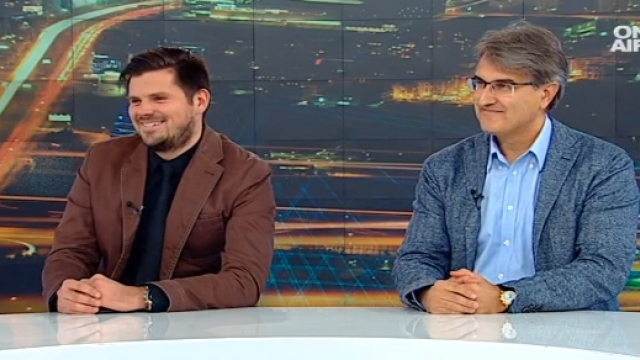
Nikola Filipov in Bulgaria On Air
"Trump is a businessman. He is unlikely to start fighting complex battles with China or Russia. In my opinion, he will try to balance the various geopolitical forces as effectively as possible in order to get the most for his country," Filipov predicts.
Watch the video here: http://www.bgonair.bg/denqt-on-air/2016-11-09/evgeni-kanev-tramp-shte-iska-da-privleche-rusiya-na-svoya-strana-vaprosat-e-sreshtu-kakvo
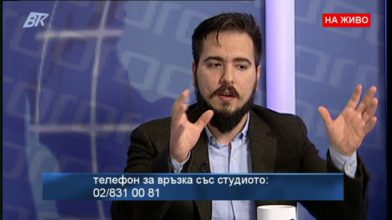
Stoyan Panchev in VTK
"To a large extent, we can say that Trump's victory is based on the culture wars raging in the country, provoked by the left," Panchev summarized.
Watch the video here: http://armymedia.bg/archives/71476