 EKIP– Expert Club for Economics and Politics A Different Opinion
Already at the end of 2016, the "patriotic" idea of imposing Bulgarian food in stores became fashionable again, as the state had to introduce relevant repressive requirements on businesses along the lines of "buy only Bulgarian".
According to the draft law submitted by the Bulgarian Socialist Party, " for part of the quantities of products offered, the production of which is traditional for Bulgaria...must necessarily be produced in the country." The following requirements were written for large retail outlets (with over 2 million in turnover) - to offer for sale at least 51% Bulgarian fruits and vegetables, 70% Bulgarian milk, 25% Bulgarian meat, 75% Bulgarian beverages. If traders do not comply with the requirements, a property sanction of 10% of the annual turnover was envisaged.
 За щастие, Икономическата комисия в Народното събрание отхвърли законопроекта, а и 43-я Парламент беше разпуснат скоро след това. Но с оглед предстоящите избори и нелепите икономически платформи на партиите, е нужно да разбием митовете, че насилственото налагане на български стоки „ще помогне на родното производство“, “че наш‘то е по-качествено“ и „че ще е по-евтино“.
There are legal and economic arguments why such protectionist laws cannot be implemented in practice. Even in this political blunder, we are not the first, because before us Romanians, Irish, Hungarians, etc. have tried to artificially promote their own products. We will also consider their cases.
Why can't it?
The obligations that Bulgaria has assumed as part of the European Union, the case law of the Court of Justice of the EU (CJEU), as well as the policy of the European Commission are more than eloquent that such measures will be stopped, at the cost of hefty fines, if necessary.
What does EU legislation tell us?
- Quantitative restrictions (duties, quotas) on the import and export of goods, as well as measures having equivalent effect (!) are prohibited between Member States (MS). [1]
- Restrictions on the freedom (!) of establishment of citizens and companies between Member States shall be prohibited. [2]
What the case law of the Court of Justice of the EU in Luxembourg tells us
The European legislation on which free trade is based has been further strengthened by the case law of the Court of Justice of the EU. From a series of cases over the past 43 years such as Geddo [3] , Dassonville [4] , Cassis de Dijon [5] , Keck and Mithouard [6] and Towing Trailers [7] it is clear that:
- The measure has an effect equivalent to a quantitative restriction (QR) (i.e. with the effect of a duty, quota, etc.) when:
- have as their object or effect to treat less favourably products originating in other MS
- applies to goods originating in other Member States where they are legally produced and marketed, concerning the conditions with which such goods must comply, even if these rules are also applicable to domestic products
- prevents access of products originating in other MS to the market of one Member State
In order to balance the system and allow for some control by the states, the CJEU has left the following option when it comes to measures restricting or prohibiting certain sales conditions that apply to foreign and domestic traders and products.
Which group does the measure for at least 51% Bulgarian tomatoes in large supermarkets fall into?
The measure itself does not restrict the import of tomatoes, but it would actually have the same economic effect, because traders would face a fine if they offer more than 49% foreign tomatoes. In view of the political goal of stimulating domestic producers at the expense of foreign ones, as well as the real market effect, the measure falls under point 1. Since such a law would be equally applicable to domestic and foreign producers, the only chance for justification is if:
- Bulgaria invoked the ground of protection of human health and life[8]
- For this to be accepted by the EC or the CJEU, we will have to convince them that our law isproportional, i.e. :
- the measure is appropriate to achieve the objective and
- is necessary because there are no other less restrictive alternatives that would protect our health
- For this to be accepted by the EC or the CJEU, we will have to convince them that our law isproportional, i.e. :
The economic arguments below will make it clear why such protections by the state are not appropriate for the given purpose, and are not proportional to the problem (if we can even talk about one).
Why shouldn't you?
On the one hand, it places restrictions on traders' free choice of what to sell, and on the other hand, it limits the chance of goods produced in other countries to be traded on an equal footing with “Bulgarian” ones. We put “Bulgarian” in quotes because it is very subjective whether a cheese or wine is Bulgarian if it is produced from foreign raw materials or imported seeds. But for such petty political populism, these details are apparently irrelevant. And here is what the numbers tell us:
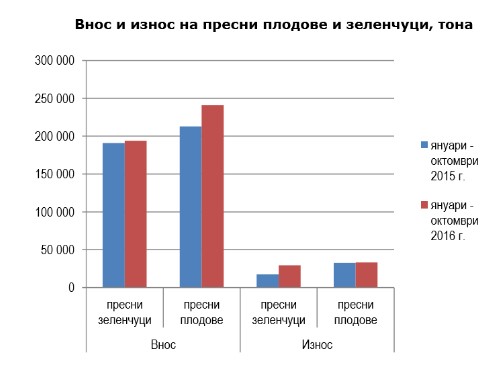
- The export of domestic vegetables increased by 72% in the first 9 months of 2016 compared to 2015, and the growth in fruit was nearly 13%.
- The main quantities of cucumbers, cabbage and onions go to Romania, commented the chairman of the Gardeners' Union– Slavi Trifonov. " The market there is very large, and their production is not enough to satisfy it," he explained.
- It is clear that even if all of our exports were redirected to our stores, we would still need many times larger imports, otherwise the shelves in the supermarkets would remain empty, just like under good old socialism.
- That is, even the most concerned consumers will be left either hungry or fed up with the fact that they have fulfilled their "debt" with their idea and domestic products have become too expensive or have been bought up in an instant.
- Not to mention that we will have to sell imported food products anyway. Then, due to the normal functioning of the market economy, producers from other countries will simply sell to us at much higher prices, because we will be faced with a fait accompli – food or nothing.
- With this law, small producers would be in the privileged situation of being able to sell whatever goods they want, which, with empty shelves at large chains, would automatically raise the prices of foreign tomatoes in neighborhood stores. So, consumers will ultimately pay the bill.

" In other countries like Romania, this worked "
Perhaps the biggest myth that is pushed on us in morning blocks, press conferences, etc. is that Romania applies the same law to protect domestic production without any problems, and that other EU countries have already taken similar measures. But the truth is completely different.
- On the 15th of this month, the EC decided to send a letter of formal notice to the Romanian government over the same “patriotic” law. This is the second step in the administrative part of the criminal procedure, where the state must convince the Commission of its rightness. If this is not done and despite the EC’s recommendations, Romania does not comply, a lawsuit will follow, which will most likely end with a hefty fine that runs daily until the violation is eliminated.
- On the same date, again with a notification letter, another patriotic stronghold of the Bulgarians - Orban's Hungary - was warned that imposing the same profit margin on imported and Hungarian goods was in violation of generally established rules.
- In the mid-1980s, the Irish tried to promote their products through a state-run marketing strategy, but the European Court of Justice rightly stopped these actions. [9]
Conclusion
It is clear that (some types of) protectionist measures are not tolerated in the single European market. It is also clear that such populism will lead to massive price increases, product shortages, or both, accompanied by the expense of lengthy administrative and judicial procedures in the Court of Justice of the EU, which will end with a large fine (covered by taxpayers).
Let's hope that the comrades who " think that most EU countries" do it rethink their policies. Because stimulating contractual relationships between producers and traders is a serious interference in one of the principles of the market economy and our society, namely - the voluntary exchange of goods, services, ideas, etc.
[1] Articles 34 and 35 of the Treaty on the Functioning of the European Union (TFEU ).
[2] Article 49 of the DFES.
[5] Case 120/78 Rewe-Zentral AG v Federal Monopoly Administration for Spirits
[6] Дела C-267/91 и C-268/91 Criminal proceedings against Bernard Keck and Daniel Mithouard
[7] Case C-110/05 Towing Trailers
[8] Article 36 of the DFES.
[9] Case 249/81 Buy Irish.





In Paris, fresh fruits and vegetables cannot be sold if they are not produced within a 100km radius. That is, the key is in the word fresh because it is assumed that, for example, Chinese ones are not fresh because they have several days of travel and must be treated with preservatives (chemistry)
Economic patriotism cannot be imposed by laws, but it can be argued that it is better for us to buy "made in Bulgaria" because this means that there will be jobs, etc., the wheel of the economy turns.
In this line of thought, state-owned cars should be purchased from factories that produce in Bulgaria and I can only think of one Chinese company that produces in our country and American President Trump is talking about exactly that, which is protectionism, and Prof. Ivan Angelov explains protectionism beautifully - http://www.iki.bas.bg/english/CVita/angelov/No248.htm
Britain and the USA invented protectionism, not free trade, that is, they deliberately imposed free trade through the "Washington Consensus", knowing that developing countries could not compete with them, but China got in their way and now they want protectionism again, etc., etc. The topic is big and the systemic crisis must be understood - https://www.facebook.com/atanas.shalapatov/posts/1752811994997027
1. EU laws are designed to protect the "right" to sell to large producers, especially Germany, France, Austria. Bulgaria has never been included in the "producer" column of the EU list, so apart from being a convenient and trouble-free territorial ally to ensure the traffic from/to Western Europe of German and Turkish goods, there have never been any other plans for us.
2. The main part of the import of tomatoes / in particular / and vegetables is from Turkey, not from the EU, despite the strong presence of Greece on our market. The opposite cannot be said for Bulgarian tomatoes on the Turkish market, for example. Naturally, summer in Turkey starts much earlier than in Bulgaria, but the greenhouses there do not immediately stop working at temperatures above 20 degrees, so there can be no comparison between the quality
3. If a manufacturer can export, it means that he produces enough to satisfy the local market. Prices in Bulgaria are even higher than those in many European countries, so for him, the manufacturer, there should be no difference whether he will sell his goods in Bulgaria or outside it. And here follows your shockingly stupid statement - the stands would remain empty without imports!! Come on, right?! That someone will immediately be found / it's a free market / who will see the niche and redirect his goods to the stands in question?!
4. KiriakStefcho, the problem is not in the raw materials with which the cheese is produced, but in THOSE who, being fed up with the EU, do not protest against the use of palm oil /very, very cheap raw material/ in the production of "feta" cheese in Denmark, for example, as the EU has nothing against Hamlet's homeland selling this garbage for a pittance all over Europe. Of course, Bulgarian cheese, produced using traditional technology, will be more expensive!! But it is made from real fresh milk, not from UHT - crap that can sit on the shelves in question for months!! But what do we want, so do we - both cheap and good... there is no such animal in the EU.
5. When presenting graphs, look at where the imports are and what the ratio is with exports, and not just scream how many % they have increased on an annual basis. It has increased, but the final figures - 250,000 imports, 25,000 exports. 10 TIMES difference!! The EU is not impressed by this, is it?! But the producers - do they export, do they export... You see!!
6. And finally - how can a Bulgarian producer compete with a German one, since the laws were created for the German, not the Bulgarian?! Equality - another time!!! Bulgaria once fed Europe with its production, and now it is being pushed into 10 deaf places, by this same Europe.
Countries like Japan, Germany, and the USA have long understood that only the production of a product that brings added value is the backbone of an economy. That is why they periodically do what they can to devalue their currency, which instantly increases exports and, respectively, production. Their domestic markets have long been regulated, and the USA has categorically made it so that each importer sets the price not according to his own desire, but according to the WISH of the American consumer that the prices be low!!! Where is this applicable in the Bulgarian realities?!
A country that, like Greece, relies on handouts from the EU, tourism and shipping, ends up in a situation in which it finds itself irretrievably stuck alone / but with the help of the great German nation.
The EU is, well, a modified CIV
And one more thing - watch your words and your language!! Especially when you talk about Bulgaria and the people who, despite the historical efforts of the rulers of the last 27 years to liquidate the nation / not without the help of your beloved EU /, still somehow manage to even produce something. These people deserve respect, not your vulgar address patriot....
And yes, I would tell you what to do with your love for the EU and its "laws", but my upbringing doesn't allow me. After all, you're just a paid scratcher....