EKIP– Expert Club for Economics and Politics A Different Opinion
Or the story of how the far-right Bulgarian parties sided with the rich resorts against the poor municipalities
The Ministry of Environment and Water officially announced that an eco-assessment has never been carried out on a management plan for a Bulgarian natural or national park. Here we are talking about an external eco-assessment, since a comprehensive and detailed ecological assessment is included in every draft park management plan and it is a basic element of the plan. It also became clear that any attempt to build a site by the park directorate or another entity will be subject to a separate eco-assessment and EIA, as well as that the new Pirin Park Management Plan prohibits any construction of ski infrastructure outside the existing zone. What is different is the larger tourist area in Pirin Park, breaking the 13-year-old regional monopoly of Bansko as a resort.
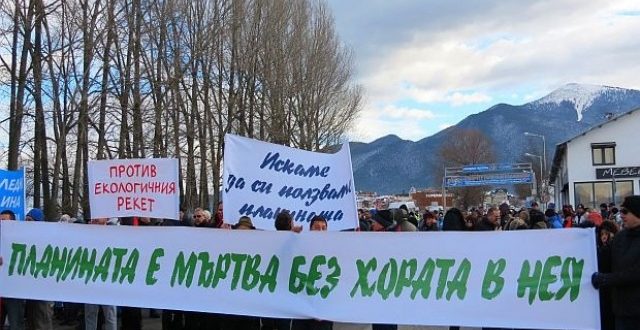
Despite all these undeniable facts, for rationally inexplicable reasons, Yes, Bulgaria/The Greens and Nova Republika organized a protest against the Ministry of Environment, Water and Environment, demanding that the new plan not be adopted and that the old one continue to operate. This would preserve nature and, although the new plan does not foresee any second lift*, it would not be built....
In the end, the minister knelt down and, admitting that he was violating the law**, decided to conduct an eco-assessment of a plan that does not contain a single object. This in itself is not a problem, but every step of the procedure will be appealed "for sport" and in reality 2-3 years will be added to the already absurdly long, about and over 10-year procedure for adopting a new 10-year plan (i.e. it will expire before it is even adopted).
It is time, however, to tell each other the truth - nature in Pirin and in Bulgaria as a whole has no problem not just with a second, but also with a third, or even with a fourth lift. It has a problem with the monopoly of Bansko in Pirin and with the monopolies of Borovets and Pamporovo in Rila and the Rhodopes.
Where did regional monopolies come from?
The history of Bulgarian resorts is long and complex, but today we clearly see three regional monopolies– Bansko in Pirin, Borovets in Rila and Pamporovo in the Rhodope Mountains. The three resorts and the businesses in them are doing well and you should not be fooled by the occasional whining here and there that things are bad. As with any monopoly, do not feel sorry for them at all – tourists and prices are constantly growing.
The monopolies of Bansko and Borovets are a direct function of the management plans for the Pirin and Rila parks. Unlike developed Western countries, in our country the parks are drawn in a communist way – with a compass and on a map. That is, the places for tourism are not designated in advance, and much of the valuable nature does not enter the park at all, because the compass has not reached it. Ultimately, the two regions and all tourism in them turn out to be managed by national park management plans, which inexplicably give a monopoly to the two resorts and impose total bans on any tourist activities outside them.
The logical thing is happening - the entire tourist flow in Rila and Pirin flows into Borovets and Bansko, which gives entrepreneurs an incentive to build there. The mayors of the municipalities do not take measures with general development plans, construction is done piecemeal, and so today we have at least aesthetic problems with the distribution of hotel bases.
The strange thing about the whole situation is that the old management plans for the two parks were written by experts from the Greens and their NGOs. How and why the “ecologists” created these monopolies and started the chain reaction that led to the overdevelopment of the resorts remains a question with no obvious answer. But this is an indisputable historical fact to this day, although conveniently hushed up and even purposefully criticized.
The situation in Pamporovo is quite different. As we said, the parks in Bulgaria were created and outlined according to communist principles and for some unknown reason, the most mystical Bulgarian mountain, the Rhodopes, turns out to be without such protected areas. Pamporovo continues to develop as a good winter resort, but every attempt to compete in the region fails. The fact is that many of these failures are a consequence of interference by the central or judicial authorities, so here the protection of the “Pamporovo” monopoly leans towards the good old Bulgarian corruption model – I do business, my politician uncle protects me from competition.
Why is nature suffering?
Interestingly, nature suffers not from monopoly, but from the lack of competition. As similar as the two things may sound, in this case they are different.
If you look at the interactive map of the world's forest fund GlobalForestWatch, you will see that none of the three resorts has a real problem with forest loss. The new management plan for Pirin Park has carried out an inventory of the forest fund and has established a net increase of 20,000 decares in 10 years. That is, naturally and artificially planted forests exceed those cut down (for any reason) by 20,000 decares. Just for comparison, this is 20 times more than the area of the sites in the Bansko ski area, and I would like to clarify that for the construction of most of them there was no need to remove trees at all.
A very simple and well-known effect in economics is obtained – economic development takes people out of labor- and resource-intensive sectors and they move to services and industry. Translated into simpler language, when people are poor, they support themselves through extensive (requiring a lot of land) agriculture, logging, wood processing, livestock breeding – all activities that are a scourge on the condition and size of the forest. When you take people out of poverty, they start doing other things – tourism, restaurants, light industry, etc.
If the locals around Bansko, Pamporovo and Borovets had remained poor as mice, they would have gnawed away the entire forest in the last 15 years. Just like the poor municipalities in the region around the three major resorts are doing, like the poor municipalities in the Central Balkans are doing, like the poor municipalities in the Western Stara Planina are doing, like the poor municipalities in Strandzha and around Burgas are doing (whether it is a coincidence that they are often governed by mayors with Turkish names is another question).
Or, in short, when you concentrate the entire tourist flow in three large resorts, you deprive the surrounding municipalities of a livelihood opportunity. On the one hand, this creates unnecessary overdevelopment in the large resorts with certain negative effects, but on the other hand, it generates poverty in the rest of the region and leaves only livelihood options that destroy nature.
The problem isn't the second lift, it's the monopoly and lack of competition, right-wing fool
The right-wing parties in Bulgaria (including GERB) have allied themselves with the Greens to convince us over the past ten years that the only problem with the Bulgarian forest fund is the removal of a few hundred trees for some mythical second lift in Bansko. A second lift that no one has ever seen or drawn, let alone started to permit – let alone build.
But even if we assume that this second lift will pass through a particularly dense forest, the wood needed to remove it will be at least 150 times less than the illegally cut wood in Bulgaria every year and 5 times less than the annual natural growth of the forest in Pirin Park. So I dare say that nature does not have a problem with the second and third lifts, regardless of whether they are in Bansko, Borovets or the gigantic lift currently under construction in Pamporovo.
The problem of Bulgarian nature is the poor municipalities in the mountainous and semi-mountainous regions left in misery, which have no livelihood options other than logging (legal or illegal), wood processing, agriculture and livestock farming on a small scale and particularly harmful to the forest.
It is completely inexplicable why it is the right-wing parties in Bulgaria that do not want to talk about this problem, since it fully corresponds to their (supposed) ideology – market economy, competition, demonopolization, clear ownership of natural and other assets. The right-wing parties should be the ones to say that it is necessary to break the monopoly of the three large resorts and allow others to do tourism (be it ski tourism or not) and to escape not only from poverty, but also from the death grip of the mayors with Turkish names and their ethnic party. This will both stop the overbuilding in the nerve centers naturally, and will also stop the destruction of the forest fund generated by poverty and misery.
Instead, the Bulgarian "right" is busy diverting attention from statistically insignificant issues for the forest, such as a three-month scandal over whether 11 pine trees grew crookedly enough over a ski slope to be cut down, or by blinding the eyes of the voter with endless commissions and inspections that neither detect anything wrong nor produce anything useful. Imagine how these absurdities look through the eyes of a person in the countryside who (like me) has seen poor people extracting wood in a RESERVE with the full awareness of the local "right" MP...
So, in short, even the forest won't wonder why the leftists will come to power with such "rightists".
*The mayor of Bansko also seems not to have read the new plan for Pirin Park and spoke complete nonsense in his interview on Nova Television.
** As of 12:00 the next day, the Ministry of Environment and Water has not yet taken any legal steps to reverse its decision, probably realizing that they are illegal and may be liable for them.