EKIP– Expert Club for Economics and Politics A Different Opinion
On April 23 of this year, the first round of the presidential election in France took place. As always, it was massive – about 80% of citizens traditionally vote for the president. No matter how disappointing or unconvincing the candidates are – the French participate because they believe that it depends on them.
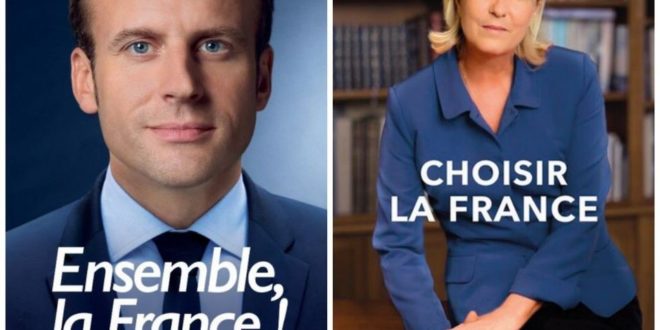
A runoff is coming – on May 7. Two candidates have qualified for it – Emmanuel Macron and Marine Le Pen.
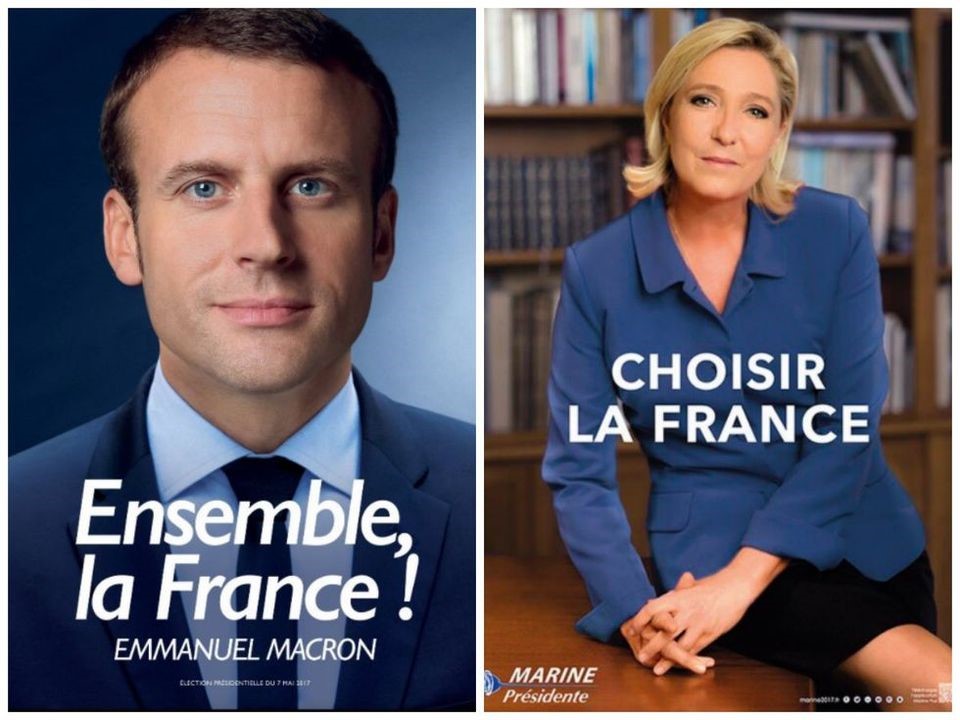
The posters for the second round and the wonders of photoshop.
France is at a crossroads. The nationalists' chances for the first time seem realizable.
After the initial respite, when polls indicated the centrist Macron as the future winner with 60%, the campaign intensified and took on the contours of a real battle. There are surprises. Right-wing sovereigntist Nicolas Dupont-Aignan (4.9% in the first round) on April 28 announced the signing of an agreement for a joint campaign and government with Marine Le Pen. And on the 29th he announced that he would accept the post of prime minister. A mutually beneficial deal – it is associated with a party claiming to be the successor to General De Gaulle, and he – an opportunity to recoup what he spent on the campaign without having passed the 5% barrier.
It is difficult to estimate how many of Dupont-Aignan's 2 million voters will follow him, but for the first time since its creation, the National Front has a political ally. The other important circumstance is that the leader of the left, Mélenchon (19.58%), refused to call on his supporters to support either party. The Republican Front of 2002 is no more.
Many French people are preparing to vote with blank ballots, with invalid ones, or to abstain. Whoever leads France, changes are coming for the EU that will also affect us, the Bulgarians.
Emmanuel Macron ("En Front") is the favorite of the predictions. If elected, he cannot ignore the huge, shouted dissatisfaction of his people, he must overcome the next obstacles - to appoint a government that is competent enough, without "old, tired faces" and dependent financial capacities. The leading thread in his program, schematically presented, is: The direction is right, the troubles are due to its wrong implementation by the wrong people, the new faces will lead the country out of its miserable situation. Then in June there will be parliamentary elections - Macron and "En Front" need enough deputies to have a majority for the reforms of the young president. And the unions, an extremely strong factor in France, are preparing a "fifth round", i.e. massive pressure: strikes, protests and demonstrations, which are planned to begin immediately after the end of the electoral process.
All this, including the percentage of those dissatisfied with the EU, expressed through support for Eurosceptic candidates (48.82%), will force Macron to act to reform the current European Union. If he does not do so, in 2022 Marine Le Pen will win the presidency in the first round.
Ms. Le Pen is attacking the second tranche of the election campaign with incredible energy and enthusiasm. After her traditional opponents – the Socialists and the Republicans – announced their support for Macron, this week she rushed to the deep countryside – the small towns and villages, the “victims of globalization”, the “forgotten” and the unfortunate. Her slogan is “Vote for France”. She lurks for Macron’s every little mistake and hits hard. The final duel will take place on May 3 on television. The physically strong and emotionally untouchable Le Pen is trying to tire and exhaust her opponent, dragging him into a mad race across the territory.
If, for various reasons, she wins this May – all more or less informed observers know what will happen: the tile that will drag the dominoes towards the dissolution of the Union falls. Let us remember that the original idea for the creation of this Community was to bring Germany and France closer together economically, politically and emotionally. The bloodiest wars of the last century started from the enmity between these two countries. If France ( the third nuclear power in the world, after the USA and Russia ) leaves – hostile, closed and impoverished, what would keep the others, who are also dissatisfied. What the process will be – two-speed, three-speed, gradual or abrupt, with or without shocks, we do not know. The truth is that in the immediate future Europe will not be at all generous to its poor, inept or corrupt members. The time is coming for a separate …
And now – to our leaders. Surely they, no less than the author, understand all this. But what do they do? The horizon of our politicians is infinitely short – until the next term, until the next post or service. A day should pass and they will be sitting in parliament. To patch up the budget, to pass the European report, to absorb European funds, to raise pensions, etc., etc. Even if they were not corrupt, they are still unsuitable. The absence of a real vision, idea and program for the coming decades is inexcusable. Not wishes, not empty words like Plevneliev’s “Bulgaria twenty, twenty”, which we do not even want to be reminded of.
And why is that? Why do we accept them? We elect rulers who still remember that the USSR supported us economically because we were faithful. That is no longer the case. Let us remember the satisfaction with which the phrase " Whatever the bosses in Brussels say " was greeted in the media and the justifications from politicians - the same mentality.