EKIP– Expert Club for Economics and Politics A Different Opinion
Author: Daniel Angelov
Game theory is a science that studies human behavior and decision-making in conflict situations with the aim of maximizing profit. Conflicts are situations in which the outcome of each action of one party depends on the course of action of the opposing party. In its original form, the theory referred to zero-sum games, in which a gain for one player is a loss for the other. Today, it is far more widespread and is an umbrella term for the science that studies decision-making processes.
The theory's emergence as a branch of science occurred in the period before and during World War II. In 1928, John von Neumann published a paper [1], and in 1944 a book [2] co-authored with Oskar Morgenstern. The first mathematical discussion of one of the most famous games of our time – the prisoner's dilemma – was by Merrill Flood and Melvin Drescher in 1950.
What is the "prisoner's dilemma"?
The dilemma is the following situation: two people are in prison on suspicion of being complicit in a crime. The investigating authorities offer both of them to betray their friend by giving evidence in court against him. The further course of events depends on how the prisoners will act, but at the same time, no one knows how the other will act.
If suspect A blames B, and B remains silent, thereby confirming his guilt, then B will be convicted and A will be released. If each accuses the other, they will both be convicted of the crime, but at the same time they will receive some leniency for testifying and the sentence will be reduced. If both criminals cooperate (with each other, not with the authorities) and refuse to testify, then they will receive a shorter sentence for a lesser crime due to lack of sufficient evidence.
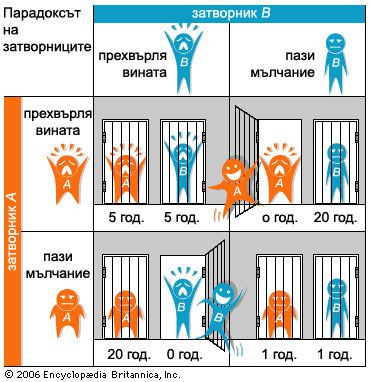
Let's look at the situation logically: as we already said, the suspects are in different rooms and cannot agree on their actions in advance. Suspect A interprets the situation as follows:
- if suspect B speaks and:
- I speak up – we both get a 5-year sentence;
- I keep quiet - I get a 20-year sentence. - if suspect B does not confess anything and:
- I don't admit anything - we both get a one-year sentence;
- I speak up - they set me free.
In both cases, silence is a wrong strategy, therefore, for suspect A, the more favorable choice is to cooperate with the investigating authorities. But since the situation for B is absolutely identical, a situation is reached in which both of them shift the blame onto the other and receive 5 years in prison. Individually, their choice is logically sound, but the collective mix of the two individual choices brings an undesirable result for both of them. Even if they were sure of the solidarity of their partner, both of them would still choose to shift the blame, because they prefer no sentence to any prison sentence.
We can apply this dilemma to other areas, such as resource ownership. The result confirms the tragedy of the commons. Here's how it works:
Use of public goods
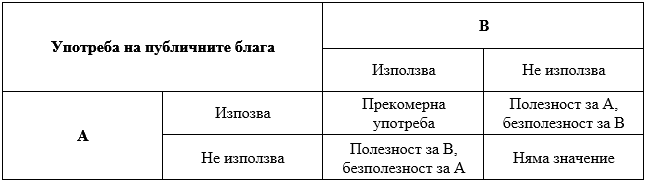
- if both do not use the good– it does not matter what the ownership is;
- if only A uses it– usefulness for A, uselessness for B; and vice versa – if only B uses it – usefulness for B, uselessness for A
- if both use it– there is excessive use.
The most logical and rational action for both is to use the good, because otherwise it is useless to them – non-use brings no utility. This leads to a desire to use the good as much as possible and therefore to its excessive use and subsequent destruction.
Financing public goods
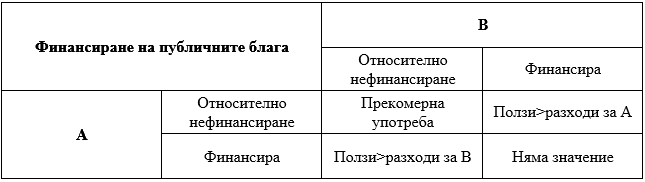
- if both finance it– the good is available;
- “I use more and pay less than the other” - if A finances the good with a larger amount than B, and B uses it equally or more than A, it follows that for A the costs are greater than the benefits compared to B. This creates an incentive either for non-payment by A, or again for excessive use;
- if both use it without paying– there is no free lunch and sooner or later the good is destroyed.
What is the conclusion?
The conclusion from the application of game theory to the sphere of resource ownership is the following - the individual motives of A and B differ from the result that is obtained in their interaction. Separately, both A and B wish to use the good more than the other and at the same time pay less, but by following these motives, provided that the ownership of a given good is common, the only thing they would achieve is to degrade the good.
Although game theory is a young discipline, the problem of common ownership of resources can be traced back to the 19th century, when economist William Forster Lloyd wrote about it. [3] In a situation where an economic good has collectivized ownership rights, it is enjoyed by all, and at the same time, none of the owners think about the negative consequences that it has on the other co-owners or on the good as a whole. Driven by their individual interest, each of them seeks to maximize their utility.
The solution to the problem is not to create restrictions on the use of the resource, but to privatize its ownership (something we have written about before ) . The reason lies in assuming personal responsibility for negative consequences. When property is private, the owner is directly interested in the consequences of his actions, unlike in common property, where responsibility is collective. He benefits fully from the positive consequences, but also bears full responsibility for negative ones. By privatizing common property, we solve once and for all the prisoner's dilemma applied in the sphere of property rights.
[1] Neumann, J. v. (1928), "Zur Theorie der Gesellschaftsspiele", Mathematische Annalen, 100 (1): 295–320. English translation: Tucker, A. W.; Luce, R. D., eds. (1959), "On the Theory of Games of Strategy", Contributions to the Theory of Games, 4, pp. 13–42.
[2] Neumann, J. v., Morgenstern, O. (1944), “Theory of Games and Economic Behavior”, Princeton University Press
[3] Lloyd, W. F. (1833). Two Lectures on the Checks to Population.