EKIP– Expert Club for Economics and Politics A Different Opinion

Photography is one of those strange creations of human culture that is difficult to fit into strictly established frameworks. It can be both art and an aid to science, used for entertainment, advertising and what not. We are so accustomed to it - and at the same time so dependent on photography - that it is impossible to imagine life without this technology. It is not just about entertainment, even news or art, but also about the highest achievements of civilization, related to science, health care and so on. At the same time, however, the short, about 200-year history of photography is an indicative lesson in capitalism, in which incredible success was achieved solely through market mechanisms.
The very birth of photography came entirely from brave entrepreneurs who risked their own funds to achieve life success.
The history of modern photography is usually associated with the Frenchman Louis Daguerre, who "discovered" photography in 1839. In fact, Daguerre and his partner Niépce had been investing their own time, funds, and imagination since the 1820s.
The birth of photography from private entrepreneurship
In 1833, Niépce died, but Daguerre continued his experiments. So in 1839, he presented his already developed discovery to the Royal Academy of Sciences - the state commission, which until then had not even suspected of these studies. Despite the obvious breakthrough, it took them a lot of time and lobbying to like Daguerre's product. In the end, he managed to convince the Academy, which bought the rights to his process and declared it a "free gift to the world", and voted Daguerre a pension and various academic titles. This is the most popular story.
However, the history of photography is not a straight line of development and upgrading, but several parallel lines of different photographic processes– some that find their continuation, and others reach a “dead end”. Daguerre’s process – the “daguerreotype” is exactly that. Due to its specificity, it reaches a dead end at the moment when demand increases. It is slow, complex and most importantly – does not allow for the reproduction of photographic images, since it does not create a “negative”, but only a positive image.
Процесът, който променя това всъщност се развива успоредно с Дагер, но не е достатъчно известен, поради очернянето на името на неговия откривател – Хенри Талбот. Неговият фотографски процес, също открит през 30-те години на по-миналия век – „калотипия“ е патентован, а самият Талбот започва да продава този патент на любители или професионални фотографи. Усъвършенстван в последствие, калотипният процес позволява създаването на „негатив“, от който на практика могат да се изкарат безброй „позитивни“ изображения. Всички тези открития се правят от предприемчиви изобретатели, които поемат собствени рискове за печалба.
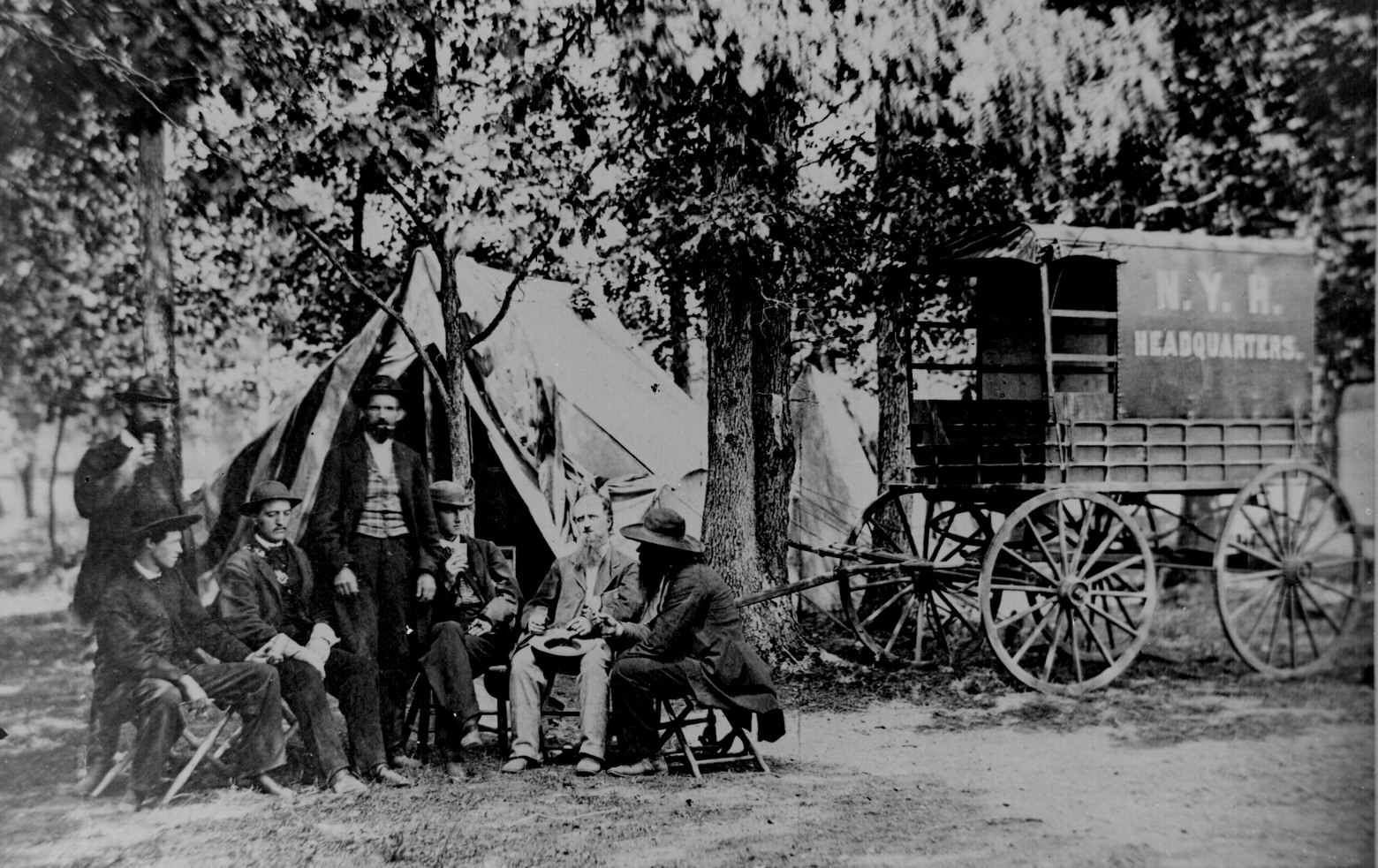
Фотографски екип и част от техниката им по време на Гражданската война в САЩ (1865 година)
In parallel with the development of the technology for capturing images on a surface – negative or positive – in the 19th century, technologies for easy and high-quality capture of this image were also developed. In simpler terms – cameras themselves were also developed. During the first 50 years of their development, cameras were heavy, complicated to operate and almost impossible to take outdoors.
Some of the first war photographs, for example, were taken during the Crimean War and the American Civil War, for which photographers performed truly heroic feats, transporting entire studios in huge caravans with which they traveled into the field. Ordinary people had contact with photography only in specially created studios. And by the way, for quite obvious economic reasons, the prices of photographs in these studios fell with each passing year - everywhere in the world where photography reached.
How capitalism makes photography accessible to everyone
All of that changed in 1888. The huge breakthrough once again made a company seeking profit by taking its own risk – entrepreneur George Eastman founded the still famous Kodak company. The entrepreneur had previously been involved in creating photographic plates in a small rented apartment in New York.
Eight years later, the Kodak company was founded and entered the market with a uniquely different concept – instead of heavy cameras that required heavy tripods and a separate large plate to be placed for a single shot, it offered a small flexible roll of film and a small camera that could be easily carried in the hand. In practice, Kodak’s discovery – created for purely capitalist reasons – dominated the market almost unchanged for the next 100+ years until the advent of digital cameras.
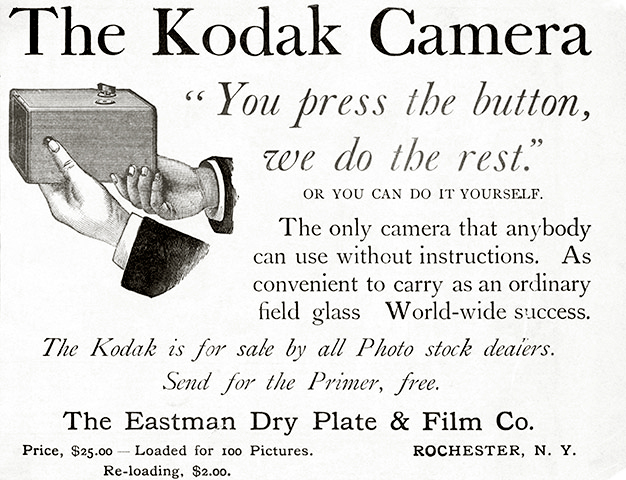
25 years after the Civil War - a Kodak commercial you can hold in your hand
Kodak's success is also due to the fact that these cameras are extremely easy to use. The company makes it as easy as possible to take a picture - when you buy a camera, you get a loaded film with which you can take the necessary frames, then you send the camera to a Kodak office, the film is developed, and the user receives back a new loaded film and the developed frames. All you have to do is press the shutter button.
Thanks to free competition, photography never stops evolving.
Over the years, technology has become more complex, competition has become fiercer, but with it comes a huge variety of types of films, cameras and wealth for every type of photographer who prefers to shoot different scenes to their own taste. The same capitalist motives gave rise to color photography. Cameras – indeed, as we know them today – albeit in digital form, and as some remember them from 10-15 years ago, find their “father” in the legendary and also super successful Leica camera.
The type of photographic film known as 35mm can still be found today, as the most common in stores where you can still buy film. The 35mm format is also the basis on which today's most expensive and professional digital cameras are made, although they capture an image on a digital matrix, not on photographic film. Leica is also a private company, founded in Germany, which established itself on the market in the 1920s. Created for purely capitalist reasons, for the purpose of financial profit and nothing else.
Accused in 1888 of "debasing" photography to a layman's level, Kodak and George Eastman inspired the Swedish company Hasselblad, which went in the opposite direction and created some of the most specialized and sophisticated cameras in the world. Their quality and reliability were so high that NASA trusted them and used their cameras for its photographs of the Moon and the famous "Blue Ball" photo.

"The Blue Marble" - one of the most reproduced images in the world
Photography has developed in the same way in Bulgaria.
Photography in Bulgaria is also fully entering the path of capitalism. All the photographs we have of our revolutionaries – Georgi Sava Rakovski, Vasil Levski, Hristo Botev and the rest – were created in photography studios, where people worked, seeking profit and livelihood through their art. The first Bulgarian photographers and photography studios were created entirely by free people, who invested their own funds in education, renting space and equipment. The first such were created during the Ottoman Empire, when there was no state to support them. Despite this, photographic art in Bulgaria was at its best, so much so that the “first Serbian photographer” was actually the Bulgarian Anastas Jovanovic, a native of Vratsa.
The most famous family of photographers after the Liberation was the Karastoyanovs, who also had their own studios, operating without any state aid, but on a completely free market. In a few years, photography spread throughout the country – not only in large cities like Plovdiv and Ruse, but also in places like Kazanlak, Gabrovo and the then still small Burgas. Traveling photographers reached the most remote villages to take photographs that today are infinitely valuable historical documents – all this solely for capitalist reasons.
Photography and capitalism are inextricably linked
Photography is used for all sorts of purposes today. For many people, the “profanation” of Kodak’s market breakthrough has negative consequences, but without Kodak we would never have the development we have today. It is natural that with this huge market of photographers and photographs, from an aesthetic point of view it is full of poor-quality and superficial “works”. But at the same time, without the “lay” Kodak, without the easy and convenient cameras, we would not have the vast majority of quality photographs today and the ultra-professional “Hasselblads”.
And if we look beyond art – we would not have the accessibility for each of us to be able to photograph our loved ones, friends, relatives, our vacation, what moved us and in general everything that is close to our heart, even if it is not supreme art. The mass accessibility of photography, which has reached each of us cheaply and easily, without the positive influence of state regulations and subsidies, is one of the undisputed successes of capitalism.