EKIP– Expert Club for Economics and Politics A Different Opinion
This article was originally published by Trud newspaper.
Author: Georgi Zayakov
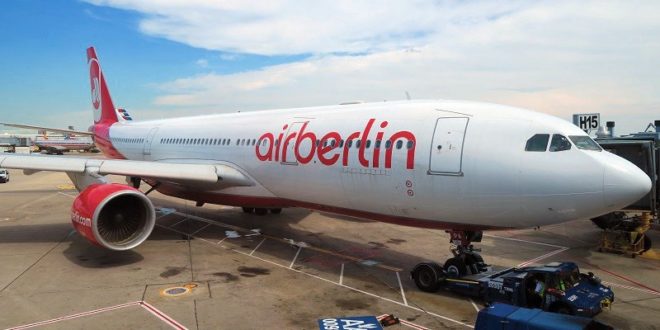
On Tuesday (August 15), Germany's second-largest airline Air Berlin filed for bankruptcy. Since 2008, with one exception, the company has been accumulating losses and debts. The past 2016 was also associated with the largest loss in Air Berlin's history – 782 million euros! Over the past 5 years, the German concern has survived mainly thanks to its largest shareholder – the 29.2% stake in Etihad Airways (UAE). Arab sheikhs have poured over 1.5 billion euros into trying to save the German airline. Most recently, in April, they granted it 350 million euros, which were supposed to secure its future for the next 18 months. In the end, the money ran out in 3 months and this week the German government had to step in and grant a loan of 150 million euros to Air Berlin so that the company could continue its flights at least until November this year. Abu Dhabi is giving up on the company and its future looks bleak. At the moment, the most likely option is its liquidation.
But how did it get here? Both external and internal factors can definitely be identified.
Since 2011, the German government has been imposing an additional tax on passenger flights, which has had two negative effects: it has made passenger tickets more expensive, reducing potential demand for them, and has led to additional costs for airlines. In the first year of its introduction, Air Berlin paid an additional 170 million euros to the German tax authorities. The second state intervention that had a negative effect on the German carrier’s profits was the failure of the infamous Berlin-Brandenburg Airport. It was supposed to be put into operation in 2011 and help Air Berlin increase its passenger numbers from 8 million in 2011 to 12-13 million in 2020. After several delays and cost increases for the project, the airport was never opened – it will not open until 2019 at the earliest.

The third external factor that had a negative effect was the Arab Spring and the increasing level of terrorist activity in North Africa. Air Berlin traditionally enjoyed a strong summer season thanks to its focus on tourist destinations in the Mediterranean. The unrest in the region, of course, led to an outflow of tourists and reduced the German concern's revenues. The last important factor is the increased competition in the "low-cost" segment from carriers such as Ryanair, EasyJet and Wizz Air, which forced Air Berlin to keep prices low and to absorb most of the increased costs associated with the passenger tax.
Internal factors
Careful analysis shows that it is actually internal factors that are crucial to Air Berlin's uncompetitiveness. According to the famous model of the American economist Michael Porter , a company can secure a competitive advantage in a particular industry in two ways - if it is a cost leader or if it provides better quality goods and services than its competitors. Until 2000, Air Berlin was a successful company because it chose a strategy of focusing on costs in a narrow market scope. Such a strategy allows companies to reduce their costs by between 20% and 40% compared to other competitors. With such a strategy, airlines usually rely on standardization in every aspect - for example, they use the same model of aircraft for all flights in order to save on personnel training costs. They also manage to refuel aircraft faster and prepare them for flight, which allows them to operate more flights per day than their competitors. Low-cost carriers focus on ensuring their planes spend as much time in the air as possible.
In its desire to displace Lufthansa from the first position in the German market, the management of Air Berlin decided to begin a transformation of the company - from a "low-cost" strategy to a "hybrid". On short and medium flights, the company remains in the "low-cost" segment and tries to lure passengers with low prices, and on long flights it focuses on business customers, offering them a luxurious service. Such a model is often called "between the chairs" in practice and is associated with significantly lower returns (profits) than traditional strategies (see chart).
As a result of the change in business model, Air Berlin is watering down both its strategy and its image. The company is starting to use different aircraft models and inflating its costs, making it uncompetitive against other companies in the low-cost segment.
When setting prices and promoting destinations, marketing experts are confused about whether to entice customers with “cheap” or “luxury” offers. Over time, even the company’s core business becomes unprofitable– in 2010, the company recorded its first operating loss since 2005, one of many that followed in the current decade. In 2016, for example, the German concern lost 12 euros for every passenger carried.
Since 2008, Air Berlin has tried several times to cut costs - reducing the number of employees and aircraft, but the situation has continued to deteriorate. The "hybrid strategy" and subsequent attempts to optimize costs have led to a deterioration in services. This year, for example, Air Berlin changed the subcontractors that took care of passengers' luggage, choosing the cheaper offer of Airground.
The change led to a boom in lost luggage, and millions of euros in compensation. And this is just part of the negative image the company has acquired in recent years – we must also add the constant flight delays, cancellations, and the frequent lack of stairs, which slows down the transfer of passengers between the airport and the plane.
It is not surprising that the majority of customers in the business segment are avoiding Air Berlin and have switched to Lufthansa services.
What's next?
At the rate at which the company is losing money, it is very likely that the loan from the German government will run out by the end of September. Its debts exceed 1.2 billion euros, and no one is willing to pay them. Competitors such as Lufthansa and Wizz Air are only interested in acquiring certain assets of the company, but would not undertake its rehabilitation. The state will save it, not least because in 2 months there will be elections in Germany, and no one wants to be held accountable by society for such a waste of money. We can expect that the once ambitious and successful company will end its existence. And let's learn from the lesson - a focused business strategy is a vital necessity for every company. Deviations from it can have serious consequences even for the best. After all, we also have our own experience with a bankrupt national carrier in the person of BGA Balkan and Bulgaria Air, which has been experiencing difficulties for years.