 EKIP– Expert Club for Economics and Politics A Different Opinion

Author: Georgi Angelov,
Senior Economist, Open Society Institute
In the late 19th and early 20th centuries, electric cars were preferred – they were quieter and more comfortable, and they also did not require a crank and manual start, as internal combustion engines did. Over time, however, petrol cars overcame these problems: an electric starter replaced the crank, and exhaust pipes reduced noise; petrol cars also developed higher speeds, were charged faster, and could travel longer distances on a single charge.
Most important, however, was the intervention of a legendary entrepreneur – Henry Ford – who began mass-producing petrol cars, sharply reduced prices and introduced the internal combustion engine. Thus, the petrol car won out over the electric car, once and for all… or at least for a century.
Petrol cars - the kings of the automotive market in the 20th century
For a century, oil has been an absolute monopoly, but this has also given rise to a number of excesses – for example, the OPEC cartel. The closeness of governments to oil and car companies is also unhealthy. Car companies are almost like banks: when they have a problem, they run to the state and it saves them, with taxpayers' money. During the last crisis, General Motors was even directly nationalized with tens of billions of state funds.
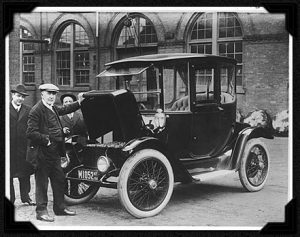 Едисон и електрически автомобил през 1913 г. (National Museum of American History)
In other countries, such as Germany, support for the automotive sector goes through other channels – for example, during the crisis, the government subsidized car companies so that they would not lay off employees and gave subsidies to citizens to buy new cars. Research subsidies are another channel for pouring state funds – billions and billions have been poured in by the American and Japanese governments to develop the so-called hydrogen car, without any visible result.
But besides wasting money, the embrace of the oil and car business with the government also leads to the inhibition of innovation in the sector. General Motors developed the first modern electric car EV1 in the mid-90s, but shortly after stopped production, stopped leasing all electric cars, took them from their owners and sent them to be destroyed!? This is very similar to the fatal decision of the company Kodak – which invented and patented the digital camera, but did not sell it, so as not to undermine its business with cameras and photo film.
The dieselgate scandal is another example. The German government recently announced that there will be no sanctions for the guilty companies, no compensation for the deceived buyers, no ban on old and dirty diesels, not even the tax breaks for them will be removed. We must save diesel, the government announced – because it creates jobs. Nothing pollutes and leads to health problems.
Fortunately, that's not how the system works in the US. There, a non-governmental organization in collaboration with a research university tested several diesel cars in real-world conditions and revealed that harmful emissions were many times higher than in laboratory tests (40 times more for nitrogen oxides). It turns out that this is no coincidence - the cars are deliberately programmed to deceive laboratory tests.
Diesel is already going away, and with it perhaps oil too
Dieselgate in the US has led to investigations, lawsuits, prosecutions, class action lawsuits and has cost Volkswagen nearly $20 billion in damages and fines to date. Moreover, diesel is unlikely to ever recover from this scandal and the enormous costs. The more libertarian American model– involving lawsuits, damages and fines – is proving to be more successful than the statist model in which we rely on the state to monitor environmental standards.
Diesel is going away, and maybe petrol cars in general, but only if there is something to take their place. And that is difficult. After all, the internal combustion engine beat electric cars at the beginning of the 20th century and has a century-long lead in development and improvement. How can an electric car compete with technology that has been improving for a century and has become not only good, but also extremely cheap? There is a way.
Although a century ago the internal combustion engine won in cars, the electric motor wins in all other areas. In industry, in factories, the electric motor is everywhere. Also in household appliances - washing machines, vacuum cleaners, drills and what not. Trams, trolleys and high-speed trains also use electric motors. Thus, in the last century the electric motor has also developed and is advanced enough to compete with the internal combustion engine.
Electric batteries are also developing, and especially rapidly in recent decades. The reason? The boom in computers and consumer electronics. Laptops, tablets, phones, e-books – this is a huge market, the development of which requires ever better and ever cheaper batteries. So, thanks to industry and electronics, we have both a good engine and ever better batteries. Ideal prerequisites for electric cars. But who will produce them?
The return of mass production of electric cars
The big behemoths proved incapable of producing a qualitatively new alternative to petrol cars. German car companies threw themselves entirely into “clean” diesel and buried countless billions in this technology. Despite huge government support, the hydrogen car got nowhere. General Motors made the first breakthrough with an electric car, but they themselves gave up on it. Japanese manufacturers developed hybrid cars, but never took the next step – an electric car.
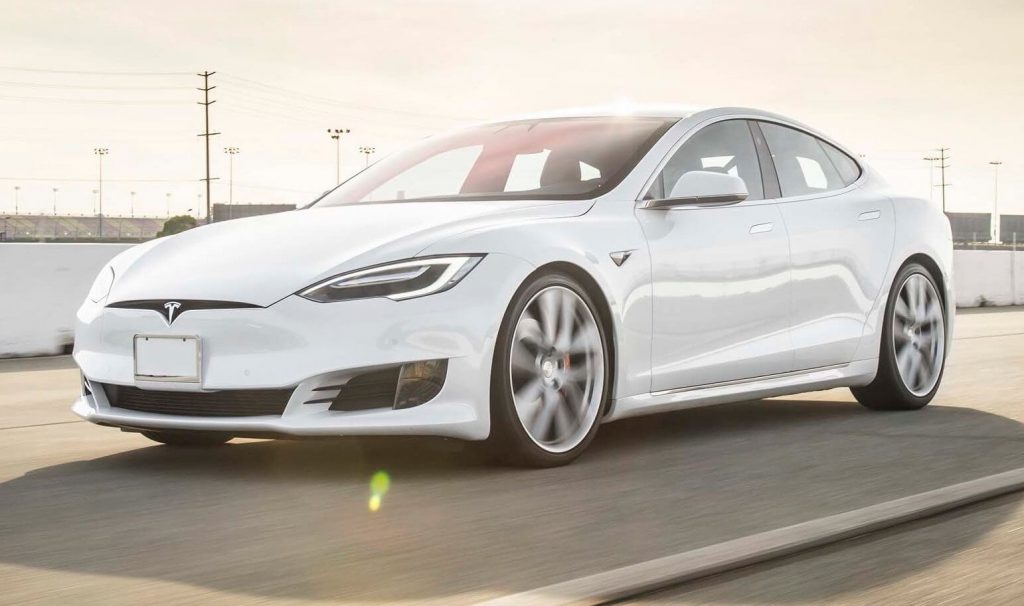
Tesla Model S P100D - the fastest mass-produced car in the world
An entrepreneur from outside the automotive industry was needed. And he appeared – in the person of Elon Musk. Musk invested all the money earned from the sale of PayPal in two companies: SpaceX, which set itself the goal of launching cheap private spacecraft, and Tesla, which was supposed to compete with the three Detroit mastodons. Both ventures seemed like science fiction – space rockets have always been expensive and have not allowed for competition, and a successful competitor to General Motors, Ford and Chrysler has not appeared for a century.
Musk has scored big wins on both fronts. SpaceX is so competitive that it now takes in more private satellite launch contracts than all other similar companies combined (including the mighty Russian rocket industry). And despite skepticism, Tesla has managed to produce several models of electric cars that are in no way inferior to petrol-powered ones. In fact, thanks to its large battery and electric motor, the Tesla Model S P100D has the fastest acceleration in the world – it accelerates from 0 to 100 km/h in 2.4 seconds.
Tesla has refuted claims that electric cars are slow, small, have limited range, and no one will buy them. It is Tesla’s success that has made other car companies rethink their positions on electric cars – something they openly share. Even General Motors has admitted that it is because of Tesla that it is reviving production of electric cars – first with the hybrid Chevrolet Volt and more recently with the all-electric Chevrolet Bolt. Toyota has abandoned its long-standing resistance to the electric car, and Nissan and BMW are among the most committed to the new technology. Volvo has announced that it will switch to all-electric cars within a few years. Even the hero of dieselgate, Volkswagen, has begun to move towards electrification.
But because of the intolerable pollution in China’s big cities, China is currently the leading market (and leading producer) for electric cars and electric buses. While in many places an electric car is a choice, in China it is a necessity – and the share of electric cars is growing and will grow rapidly. China, however, is the largest car market in the world and is largely controlled by Western manufacturers (Volkswagen is number one). To maintain their leadership, they will have to invest heavily in electric cars. And this will have global dimensions.
Image source: Tesla.com





Hey, man, you're way behind on the information!