 EKIP– Expert Club for Economics and Politics A Different Opinion
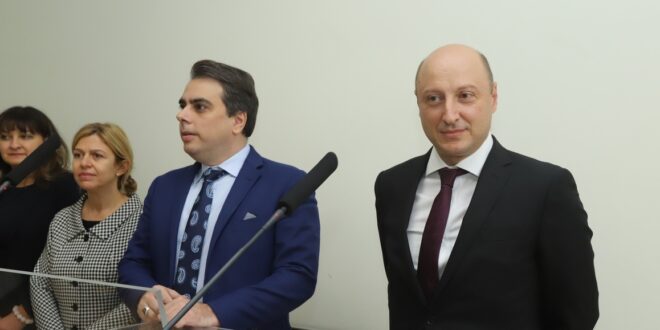
Acting Finance Minister Valeri Belchev "corrected" himself on Friday and revealed that the deficit in his ministry's planned state budget for 2022 will actually be 5.1% of GDP, not 2.9%, as he initially said a week ago. I recall that at that surprise press conference, the minister did not know what the parameters of major new expenditures were that he himself was supposedly planning for next year - such as the increase in pensions. We hoped that at least there would be clarity about the deficit, but it turned out that even there he got the numbers wrong.
Meanwhile, during the negotiations to form a government between the PP, BSP, ITN and DB, it became clear that the incoming regular government will most likely set a deficit between 3.5% and 4.5% of GDP for 2022. First of all, it is absolutely incomprehensible why two parallel budgets are planned. According to the Public Finance Act, the deadline for presenting the draft budget for the next year is October 31. After this deadline was missed, everyone assumed that the caretaker government would not present a budget because it did not want to interfere in the work of the eventual regular government that would be formed after the elections. Suddenly, however, a month after the deadline had passed, the caretaker government decided that it too had to propose a budget. The presence of two competing proposals can only cause chaos and complicate and delay the adoption of the 2022 budget.
But beyond perhaps the most chaotic budget procedure we have witnessed in at least the last 30 years, the bigger problem is another. This problem is the deficit. Both budget proposals set a deficit for 2022 that will be larger or, at best, the same as the one we are expected to end 2021 with. According to the latest forecasts from various institutions, the fiscal deficit this year is expected to be just over 3.5% of GDP. The European Commission forecasts 3.6%, the International Monetary Fund calculated 3.7%. The caretaker government itself in October spoke of figures that amount to around 3.9% of GDP.
The logical question that should arise in the head of every economist seeing these numbers is – based on what macroeconomic assumptions are the two parallel budgets written? What are these assumptions for 2022 that create an expected need for a larger deficit and, accordingly, a larger increase in government debt than in 2021? Let's look at the macroeconomic outlook. This year, GDP growth is expected to reach between 3-4% on an annual basis, and next year to accelerate to 4-5%. As long as the forecasts for 2022 are even approximately accurate and we have GDP growth above 4.1% in 2022, this will be the highest growth since 2008.
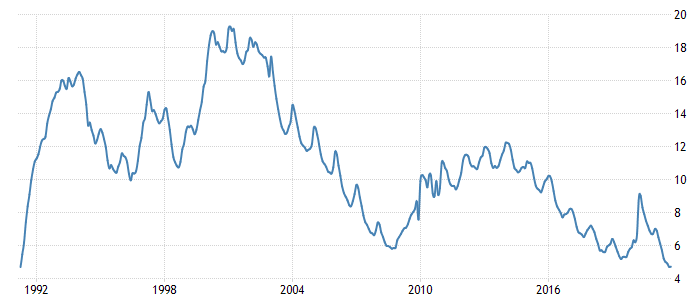
Beyond that, if we look at the unemployment rate, we see that it is currently below 5%. This is a record for the last 30 years. Meanwhile, average nominal wage growth in 2021 returned to its pre-2020 double-digit level. Industrial production is growing at a double-digit pace, retail sales growth has returned and even surpassed the levels recorded in 2019. To top it off, inflation has escalated sharply in recent months and reached its highest value since 2009.
Graph: Unemployment rate in Bulgaria, %
Whichever macroeconomic indicator we take – none of them indicates that we are in an economic crisis. No forecast predicts a deterioration of the economic situation in 2022. All of them predict accelerated growth. Why then is everyone – both the caretaker government and the one being formed regularly – talking about a deficit? And an even larger deficit than expected in 2021? There is no economic logic in this. NRA revenues are at record high levels thanks to the recovery and inflation this year. Revenues from corporate, income tax, as well as social security contributions are growing at a double-digit rate.
In the current situation, the deficit should be sharply reduced, not increased. This is basic economic logic. Running any deficit, let alone a larger one, is extremely risky. Why? First, because if the economic trend unexpectedly reverses and we unexpectedly find ourselves in a crisis, we will have no buffer. We have already deepened a very deep deficit and there is almost no fiscal space - further deepening would risk a fiscal crisis. And second, because deficits are pro-inflationary. That is, a larger deficit increases the upward pressure on prices and can further worsen the current very high inflation. John Maynard Keynes himself, who is the father of deficit fiscal policy, says that deficits are pro-inflationary. This is one of the most fundamental conclusions of his economic theory set out in "The General Theory of Employment, Interest and Money".
When unemployment is at record lows and inflation is very high, the government must cut spending and plan balanced budgets or even surpluses. This is done to start paying down the debt accumulated during the crisis and to prevent the economy from overheating and running into runaway inflation due to too high a level of consumption. In a situation like the current one, even Keynes is “fiscally conservative.”
What is going on in the minds of our politicians then? I am not the only economist in bewilderment. Lyubomir Datsov from the Fiscal Council also expressed the opinion that the 2022 budget should be balanced. The official recommendation of the Fiscal Council itself is that the 2022 Budget should have a deficit of a maximum of 3% of GDP. In my opinion, this is also too high a level (apparently according to Datsov), but at least it is a step towards reducing the deficit compared to the current level. Such are, by the way, the expectations of all international institutions. The European Commission forecasts a 2.8% deficit in 2022, the IMF forecasts 3.0%.
However, domestic politicians have other plans – more spending, more loans, which are in no way justified by current economic data and expectations. Such an approach is even more irresponsible than that of the Borisov cabinet when planning the 2021 budget. An extremely irresponsibly planned budget with the main goal of buying political popularity before the elections. But Borisov could at least justify himself then that we are in a crisis, no matter how irrelevant this is when most of the spending has nothing to do with the crisis itself. When the 2021 budget was written, GDP was still falling and unemployment was the highest since 2017. However, now even such justifications cannot be found.
There is no reason to plan for a budget deficit in 2022, let alone one that is larger than the one in 2021. If the new government, on which so many hopes are pinned, begins its mandate with such an approach, it is a very bad sign. Expectations of an end to vicious policies and the restoration of some responsibility and reason in fiscal policy will prove to be betrayed. Long-term fiscal risks will continue to accumulate. If this is the “change” that Bulgaria’s new political leaders are offering us – no, thank you.




Very good analysis..the bad thing is that none of the "rulers" seem to have read it..