 EKIP– Expert Club for Economics and Politics A Different Opinion
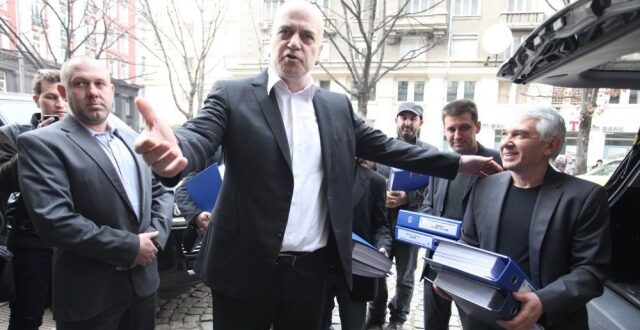
"These numbers can't be real. Do you know anyone who will vote for Slavi?" reads one of the comments under the latest sociological survey by "Trend", which gives "There is such a people" - or "Slavi Trifonov's party", as it is written in brackets and in the survey itself - 16%, making it a solid third political force in the country, after GERB and BSP. Another commenter questions how real the survey is at all, again for the same reason - he also doesn't know anyone who would vote for Slavi Trifonov, respectively, such people should not exist. The only bright spot are the few commenters who themselves come to the conclusion that they live in a bubble.
People who think that Slavi Trifonov has no supporters or is just another short-lived phenomenon in Bulgarian politics, like Yane Yanev, Nikolay Barekov or Vesselin Mareshki, can do themselves a favor and burst their own bubble before it is forcibly burst from the outside. Because Slavi Trifonov's potential ranges from being a surefire third political force in parliament to being a potential future prime minister (in August, Market Links gave "There Is Such a People" 15%, and GERB - 15.2%), although the latter is unlikely. And this potential has a logical explanation.
Slavi's 20-year campaign
The most common questions from skeptics are two: why do sociologists give similar results to "There are such people" and why do all sociologists say that he is winning from the protests against the government. After all, Trifonov is not in the square, so how is he winning?
In practice, Trifonov's campaign has been going on for 20 years, since the broadcast of "Slavi's Show". Initially, the show was dominated by entertainment, but in its last years the trend has reversed and it talks more about politics than anything else. Even in its last years, after the peak of its popularity, hundreds of thousands of people watch Slavi Trifonov every night - data that may surprise many.
Currently, the campaign continues, but not with a show, but with an entire television network, which answers the second question: the one about the protests. Trifonov is not in the square, but every day on his TV channel "7/8" there are live broadcasts of the protests, several shows with current guests on the topic, including "Slavi Trifonov's Evening Show."
All this may escape the people who live in their bubble, simply because in this bubble one certainly does not watch "7/8" TV, if any TV is watched at all. Due to the lack of an adequate rating system in Bulgaria, we can only guess how much "7/8" is watched compared to other televisions, especially considering that the channel is already paid. As far as it can be used as a reference value, a curious fact: according to Bulsatcom data, Trifonov's television was the most watched last New Year, and his show even surpassed Rumen Radev's speech in viewership.
"The Uchindolski Chalgar" and other ricochets
Slavi Trifonov is a frankly hateful figure for a large part of the people in Bulgaria. He is often called the "Uchindolski chalgar", and herein lie the other reasons for Trifonov's popularity: he stands behind those who are often spat upon by the more arrogant voices in society and at the same time manages to convince them that they, and no one else, are the people.
In short, the insults of a “chalgar” actually backfire. The politician Trifonov can never be compared to the far more popular musician Trifonov, so it is normal for the politician to try to get as many of his fans as possible in the other sphere. Many of them are precisely “chalgars”, whatever meaning you put on that word – musical taste, type of subculture or lifestyle.
Without any sociology to support this opinion, most of these people are actually completely abandoned by the political process and parties, which makes them a huge part of the nearly 50% of Bulgarians who simply do not vote. Trifonov reaches them and is the only one who not only does not insult them, but also defends them. They, in turn, trust him because he is an image they have known for years. Thus, “There Are Such People” reaches an electoral stratum that no one else has access to – and that no one tries to reach anyway. It is an open question to what extent the sociological studies themselves capture this phenomenon. Trifonov’s dozens of tours around the country over the years do not hurt either.
In their eyes, Trifonov is a defender of the purely Bulgarian way of life (which, by the way, also includes chalga – undoubtedly the most popular genre of music in our country), without judging them. “United Patriots”, for example, also defend the “Bulgarian way of life”, but not exactly, because they conveniently turn a blind eye to chalga, kulechets, etc., things that undoubtedly exist. Their electoral resource is also an easy target for Slavi.
Trifonov is one of the more successful “people of the people” in politics. Unlike Boyko Borisov, he rarely offends his potential electorate, or even an electorate he knows he will not reach. By inviting various guests to television and broadcasting massively online, he and his team manage to reach more and more people who perceive them as politicians, not showmen. At the same time, Trifonov can easily claim that he has been against every Bulgarian government since at least Kostov, that he has not broken his connection with the people, and that he has not forgotten himself.
And, ultimately: what is Slavi's potential?
Trifonov's party still has a ceiling: about 2.5 million votes, or the number of people who answered affirmatively to two of the three questions in the referendum he organized in 2016: for majoritarian elections in two rounds and for reducing the subsidy to 1 leva per vote. Of course, this ceiling cannot be reached, and some people may find comfort in the fact that this was Trifonov's peak. If he had formed a party immediately, after it became clear that the parties in two National Assemblies had no intention of fulfilling the political will of even such a large number of people, he would almost certainly be the leading political force by now.
Four years later, for much of the political class, the issue has passed and is gone, but not for Trifonov and his scriptwriters, who continue to talk about their referendum every day. Their claim that democracy in Bulgaria is a mockery has serious arguments.
On the one hand, majoritarian elections did not appear on the agenda of any party until GERB decided to try to convene a Grand National Assembly. The subsidy was changed several times, only to return to almost the same level at which it started – 8 leva per vote. Compulsory voting, the third of the referendum questions, passed with smaller but again impressive support (2.1 million votes), is at least in theory a law, but without real consequences for non-voters.
Ultimately, the referendum results were not recognized as binding only because of a missing 12,000 votes. This, along with the court's refusal to register Trifonov's first party, "There Is No Such State," gives him an additional anti-establishment aura.
Trifonov's current potential is around 1 million votes, which, given the weak performances of the BSP and GERB, could even mean a government with the participation of "There is Such a People" - perhaps even in a leading role. Trifonov has already announced on air that he would not even talk to GERB or DPS about a government, but would negotiate with the BSP and "Democratic Bulgaria", and his conditions are clear: direct implementation of the questions from the 2016 referendum.
Trifonov himself would hardly become prime minister, due to health reasons that it would not be appropriate or moral to speculate about.
Last but not least, there is the "issue with the "structures". Trifonov's people quickly managed to create such structures in many places in the country, often taking advantage of the specifics of local politics. Separately, the physical structures themselves have less and less weight for this type of party, which takes advantage of the opportunities of the Internet. "Democratic Bulgaria", for example, has a realistic chance of achieving half the result of GERB, but with ten times fewer structures.
So, in short, Slavi seems to be outside the bubble. Slavi Trifonov missed the best moment to enter politics, but he is about to seize the second most convenient time for it. He is gaining support from the protests, from his television, from those who have not yet forgotten the referendum, and from his halo of an anti-system player. And from the fact that he is the only one who is actively working towards winning votes from the largest electoral contingent in Bulgaria: those who do not go to the polls.
PS In response to the most frequently asked question, "do you know anyone who will vote for Slavi": yes, I do, and far from just one. I will give just one joker: none of them live in Sofia and none of them are represented in parliament today.
PPS Yes, many people are aware of Slavi's connections with the 90s punks. No, they hardly have any electoral weight at the moment.




Whoever wrote the article should be fired immediately.
I have never liked the chalga, and I haven't watched Slavi's Show for many years because it has long since run out. I will definitely vote for him, the man Trifonov, not the Showman! He is a man, not the whore Mareshki, Tsetso or Simeonov, they will no longer be factors in politics, just like GERB. They will be like NDSV, a bad memory!
So far we've been crawling along the bottom, now we're going to dig beneath it, right into the mud.