 EKIP– Expert Club for Economics and Politics A Different Opinion
One of the hot topics being discussed on the agenda of the Ministry of Health, the NHIF, and Parliament is chemotherapy medications and clinical pathways for oncological diseases.
Why is the topic important?
One of the largest budget items of the NHIF concerns the treatment of oncological diseases. The budget part is heavy, due to the fact that the medications for oncological treatment are in large part innovative (they have no equivalent generic substitute), and also that the mortality rate from neoplasms has increased over the last 3 years. In our country, the mortality rate from neoplasms is approximately 55% higher than the average for the European Union. Morbidity is the other criterion that concerns costs. In the years between 2013 and 2015, the average number of people with the disease was 158 thousand people.
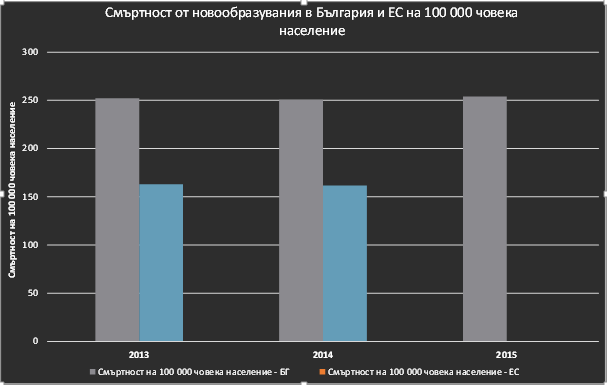
Source: WHO, NSI
What happened?
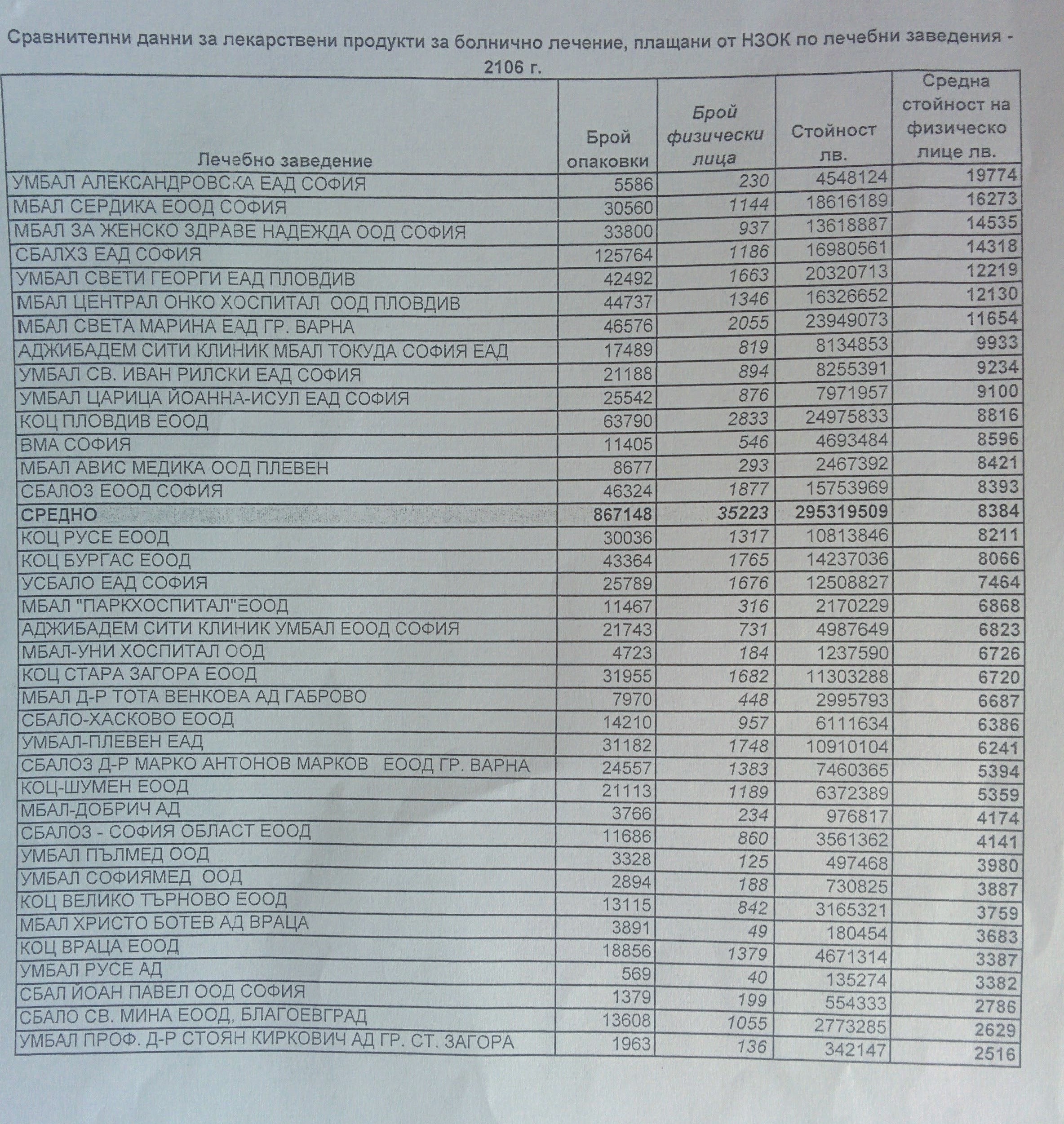
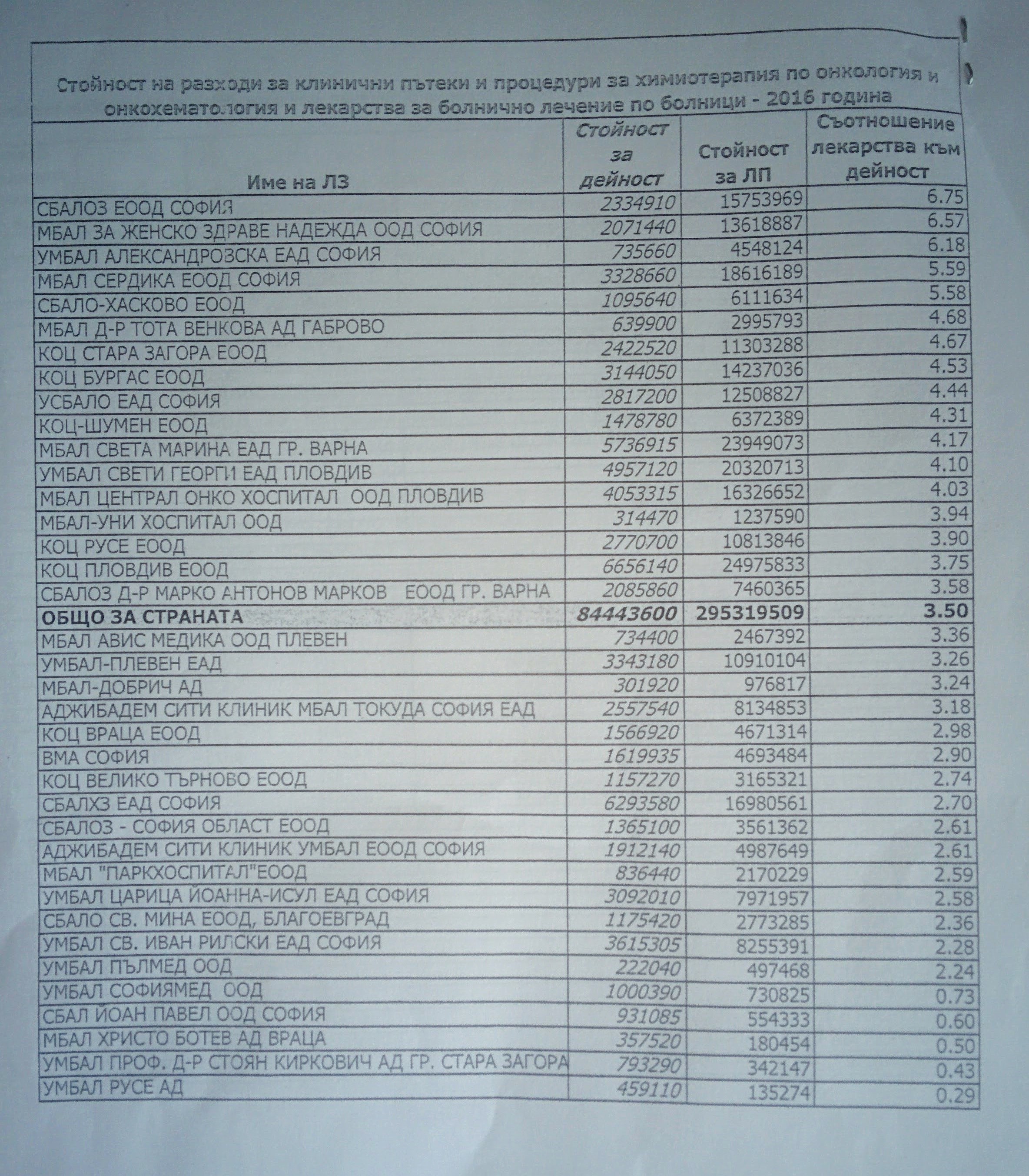
Last Friday, the official data of the National Health Insurance Fund on the costs of medicinal products for hospital treatment paid by the National Health Insurance Fund under clinical pathways and chemotherapy procedures in oncology and oncohematology for 2016 were made public. The average cost of hospital treatment per individual in the country is 8,384 leva. SBALOZ Sofia and KOC Ruse are close to it. The data shows that in 2016, the University Hospital "Aleksandrovska" spent an average of 19,774 leva on the therapy per individual, with the number of people who passed through there being 230. The University Hospital "Prof. Dr. Stoyan Kirkovich" spent the least - an average of 2,516 leva for 136 people. If we make a simple comparison, we will say that in the second hospital they treat more economically efficient than in the first hospital.
However, the comparison in this way seems untenable, due to the fact that medicinal products vary in price and therapy for each oncological disease, but we must say that for certain diseases there are strictly defined standards in treatment, which are missed by some hospitals. UMHAL "Aleksandrovska" uses 3 times more (5586) medicinal packages for therapy compared to UMHAL "Prof. Dr. Stoyan Kirkovich" (1963). As a ratio, UMHAL "Aleksandrovska" uses an average of 6.18 medicines per activity, and UMHAL "Prof. Dr. Stoyan Kirkovich" - 0.43. The most medicines per activity are prescribed in SBALOZ Sofia - 6.75, and the least in UMHAL Ruse. The average number for the country is 3.50.
What is the conclusion?
The lack of a standard in determining treatment therapies is one of the main problems of the system. The second problem is the processing, analysis and reaction to the availability of such data in the NHIF. These are the data for 2016 - it is clear that they are collected by the NHIF, but what analysis are they subject to? Control over medicines is underestimated, and the Fund does nothing about the issue of optimizing funds. This is also evident from the constantly increasing budget for medicines and treatment. The topic of demonopolization is again on the agenda as a partial solution to the problems with control over treatment funds. Milton Friedman describes 4 options for consuming financial resources - the fourth one applies to the NHIF.
- Spending our own money for our own needs. As a result, we are very careful about how much we spend and what we spend it on.
- Spending your own money on someone else's needs. Then we are also careful about how much we spend, but we are not so careful about what we spend it on.
- Spending other people's money for your own needs. Then we are very careful about what we spend it on, but not how much we spend.
- Spending other people's money for other people's needs. In this case, we don't care how much we spend or what we spend it on.





One comment
Pingback: How the demonopolization of the NHIF will help cancer patients | Misl