 EKIP– Expert Club for Economics and Politics A Different Opinion

Author: Kaloyan Pravov
Background
The summer of 2013 was a turning point in modern Bulgarian history.
This year marks the birth and conduct of the last major political campaign of the Bulgarian pro-European democratic civil society. For over 400 days, citizens in most regional cities of Bulgaria demonstrated their defiance against the state, which dared to hand over the security services to a “successful young man” whose media are recognized as unceasing propaganda machines.
Unlike the previous two great liberal causes, namely privatization and Bulgaria’s accession to NATO and the EU, this one was crowned with only partial success. Peevski’s candidacy was thwarted, but he remained one of the most influential figures in Bulgarian politics. The government of Plamen Oresharski and the BSP lost power in disgrace, but no one was held accountable. And brutal high-level corruption reappeared in full glory almost simultaneously, this time taking the form of the “Corporate Commercial Bank” saga.
But how did this happen? Why did total victory elude the reformist forces in our society? The answer is complex and multifaceted and could fit into several volumes, but today I would like to focus on one of the key elements of this phenomenon, namely the disintegration of the Bulgarian liberal community into its two constituent parts – left democratism and the classical right. To this end, I will first identify them and outline the similarities between them, and then I will examine the differences.
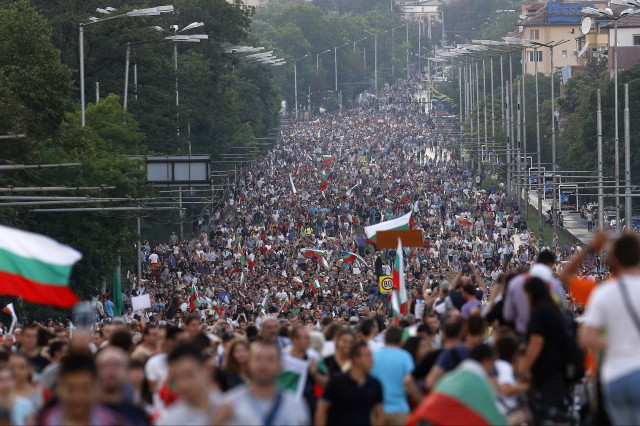
"Alone in the land of prostitutes!" - the common root
Without a doubt, the common father of the two new political movements can be identified as Euro-Atlantic democratism, which found its home in parties such as the UDF (in the 1990s) and its successors, the NMSV and to some extent GERB.
One of the main similarities is the preservation and deepening of Bulgaria's Western orientation, which is perceived as a fundamental political goal. The consensus is that Bulgaria's membership in NATO and the European Union are strategically necessary for our country in the long term. Although there are differences in approach on key European issues, the Bulgarian right does not generate strong Euroscepticism, as is the trend in Europe. This is probably related to another major similarity between left-wing democracy and the classical right, namely the perception of Putin's Russia as a key threat to our national security. This puts both movements in strong opposition to parties with a Russophile bias such as the Bulgarian Socialist Party and Ataka.
The place of liberal democracy
Another key feature of both movements is the strong support for liberal democracy as an adequate form of government in Bulgaria. Neither side has great ambitions for constitutional changes and believes that the current constitutional order needs to be preserved and refined. In this sense, we could not classify the ideas and rhetoric of left democratism and the classical right as “anti-systemic”, unlike, for example, those of nationalist movements.
Last but not least, a common feature of the new ideological movements is that they both seek support from people with the same socio-economic profile. These are most often young people (18-30) or middle-aged people (30-50), reform-minded, usually with a high level of education, living in larger regional cities, including outside Bulgaria.
If we were to summarize the similarities between the new left and the new right, it could be said that the similarities between the two ideologies are many enough to build some kind of political consensus that could serve as the basis for future ideological clashes.
A necessary condition for this to happen is that each of the two sides manages to avoid radicalization and retreat from the basic principles of mutual respect and rational public debate. The left is particularly threatened by taking this path due to the fact that postmodernism and cultural Marxism are at a kind of apogee in the West and there is a danger that they will enter our country with a bang and cannibalize the left-liberal movement.

"My liberalism is much better than your liberalism!" - basic differences
Let's move on to the main dividing lines between the two new political movements, which are very reminiscent of those between Republicans and Democrats in the United States of America.
I mentioned above that the main motivator for both parties is the need for meaningful reforms in the state. A key conflict is the approach to these reforms. The left has aimed to seize political power and reform state institutions according to the European model, including more citizen participation, transparency and “good governance practices”. To achieve this goal, they take over key public institutions from within and turn them to the benefit of advancing their political vision. Where they do not succeed (for example, in the media market, where Delyan Peevski dominates), they create their own competing organizations. However, this direct and firm power approach does not please the right.
The right is skeptical of institutional power by definition and prefers to place the responsibility for implementing one reform or another on the individual.
When faced with the question of how to solve a political problem, it relies more on the market economy than on the creation and/or reform of state institutions. It realizes that politics is a product of public culture and focuses its efforts on shaping public opinion by participating in public debate and educating civil society about the essence of right-wing principles. This, of course, does not mean that the left does not seek to educate and that the right never lobby institutionally. Simply put, these are approaches preferred by both sides to achieving political goals.
The left and right versions of judicial reform
A good example of the above is the cause of “judicial reform”. Without a doubt, the Bulgarian judicial institutions are not functioning well and we all lose from this. The leftist approach to implementing the reform is to undertake policies that try to place in key positions in the judicial system individuals who will fulfill their duties without succumbing to the temptations of corruption. To achieve this goal, they attack those they define as “corrupt” and praise those they define as “non-corrupt” in every possible way.

The right, for its part, sees that the problem does not lie in personal qualities, but in social systems that generate corruption. The solution to this problem is the elimination and/or "privatization" of as many of the functions of the judiciary as possible, so that it works in a focused and efficient manner. For example, the idea of "privatizing the prosecution" was well articulated by Assoc. Prof. Kristiyan Takov.
Attitude towards capitalism
The above example refers us to the next main difference between left-wing democracy and the classical right, namely their attitude towards capitalism and free enterprise. The left believes in the so-called "mixed economy" on the European model. In other words, the state should intervene in every market in order to protect the consumer, regulate the market or punish unscrupulous businesses. The focus is on the efficient spending of the state budget, and not so much on reducing the tax burden. To this can be added the idea that there are "common goods" (for example, natural resources) that are under the protection of the state and whose use should be regulated through central planning and citizen participation.
The right contrasts sharply with this economic philosophy by strongly advocating the ideas of capitalism. It knows that Bulgaria is a developing economy and prioritizes those policies that lead to the fastest economic growth - the protection of private property, deregulation, and low taxes.
Capitalism is understood not as a pragmatic generator of revenue for public programs, as is generally the case in Europe, but as the moral foundation of Western civilization.
An example of this ideological clash is the debate over the utilization of our country's natural resources. The left-wing position, expressed in the green movements, is that these natural resources should not be exploited and that the state should place them under its protection in order to prevent ecological catastrophes. This is opposed by the right-wing idea of green capitalism, which prioritizes the natural market balance between the exploitation of natural resources for the purpose of economic growth and their preservation for the purpose of their sustainable use.

Euroscepticism and Eurofederalism
The final major dividing line between left-wing democrats and the classical right that I will explore in this article is the “globalism versus nationalism” opposition. A fundamental part of leftist philosophy is the belief that people are all the same and that any differences are due to the environment in which they were raised. Logically, their long-term goal of leveling the playing field for all people in the world entails strong support for international organizations like the United Nations and suspicion of national governments and local autonomy.
On the other hand, the right, driven by their affinity for stability and freedom, believe that globalism dilutes and weakens Western culture. In our country, these ideas find expression in the dispute over the role that the European Union plays in Bulgaria's domestic politics. The left is most often associated with Eurofederalism, believing that the EU should become a superstate and that national governments should cede their powers to Brussels. They see the preservation of nation-states and identities as a spoke in the wheel of progress towards lasting peace in Europe. Because of this, attacks against Eurosceptic peoples such as the Poles, the British and the Hungarians are daily and sharp.
An interesting point is that the Bulgarian right, for its part, has not yet offered a strong alternative to deep European integration, although it is fundamentally against the creation of a superstate. For now, it is limited to strong opposition to specific policies that the EU is implementing. For example, defenders of the free market have repeatedly warned about the excessive regulatory burden that the EC imposes on business and about the danger of Bulgaria entering the eurozone, while the conservative right has stood firmly against the policy of unlimited immigration from the Middle East and North Africa. Whether these concerns will be integrated into a more comprehensive right-wing vision of the role of the EU in Bulgarian political life remains to be seen.

The importance of patriotism
Interestingly, this conflict also manifests itself at a more basic cultural and social level. For example, left-wing democrats tend to sharply criticize almost all aspects of contemporary Bulgarian society, classifying Bulgaria as almost a third-world country that needs to be civilized by more developed Europeans. On the other hand, right-wingers adopt a more balanced approach, striving to look realistically at the evolution of Bulgarian society and take into account what has been achieved.
The latter is partly dictated by the right’s natural affinity for patriotism, which is why the new right is often mistakenly lumped together with nationalist movements under the rubric of “rakia nationalism.” This is, of course, a political sham, as organizations like Ataka merely parasitize on the idea of patriotism, distorting its true nature in the service of their Moscow masters. But this topic deserves its own article.
It would be enough to say that the right-wing seeks to revive positive Renaissance patriotism, believing that it is a key element of Bulgaria's sustainable development.
A few words in conclusion
I would like to express the hope that I have managed to capture the essence of these two new political trends clearly enough, even if I have omitted many details. It is worth noting that the phenomena I have described in this article are still in their initial phase of development. It is not entirely clear whether the positions and ideas will look the same in a year, given that the rise of cheap populist anti-system nationalism may distort the natural dynamics of political processes. Two things are certain, however – any legitimate “unification of the right” could not include left-wing democrats, and the mantra “there is no left, there is no right” is completely untenable.
This article was published by "Misul"
Източник на изображенията: Google






quite a watery article