EKIP– Expert Club for Economics and Politics A Different Opinion
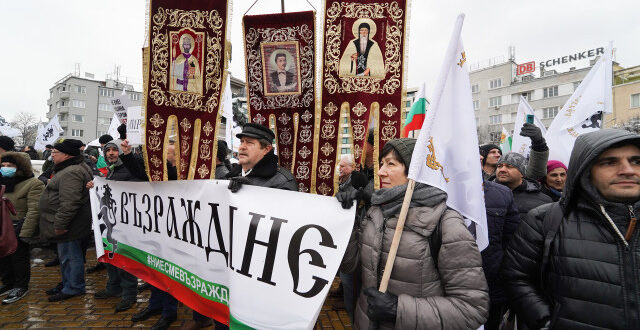
In the photo: "Vazrazhdane" protest against the "Borisov" cabinet
Kilograms of salt are piling up in the clever corners of social media. The anti-vaxxer-fascists will be in the next National Assembly and there, like all the other nationalists so far…they will sell passports and overdo it with stimulants. Or maybe not.
In fact, even mainstream sociologists are already sensing that things are different. One of the Gallup guys rightly stated yesterday that "with the entry of Vazrazhdane into parliament, a new status quo is taking shape, that of the other parties."
In the summer of 2020, I was sitting in the Muzeya bar-restaurant opposite the presidency, together with another well-known political scientist from the same agency. I invited him to congratulate him on the comments he had made in a professionally written article in the newspaper Capital, regarding the campaign against the abolition of the Bulgarian lev and the currency board. Choking on an unfortunate lemon, I tried to explain the Theory of Rearrangement and why the entry of Vazrazhdane into the National Assembly is only a symptom and only the beginning.
I first heard the theory of political realignment from my former boss, Professor Steve Davis. During the Brexit saga, he gained popularity in the UK with his accurate predictions about the future of governments, parties and the process of leaving the EU itself. He also wrote a great book. It tells us that in all countries with parliamentary government, political forces orient their positions along a primary (and at least one secondary) axis of ideological division. In other words, one political issue dominates all others and parties orient themselves around it. Politics is fundamentally binary.
In the United Kingdom, this has been happening since 1671, with a process of changing this main axis of division every 40-50 years. Old political alliances and electoral preferences fall apart and new ones emerge in their place. People who were once allies become enemies and vice versa. These changes reflect serious changes in thinking and lifestyle, as well as the change of generations. Old conflicts are resolved or simply remain in history. Imagine the big issue of lustration in the 1990s, today the territory of a presidential candidate, an aging chalga singer. Impossible!
Davis claims that a new realignment is underway from Turkey to the Scottish Isles. The old division of “more or less a state”, “socialism versus capitalism” is fading away as a conflict on a secondary dividing axis. The new clash is different. No, we are not talking about outdated concepts such as “conservatism versus liberalism”, this was the secondary axis of the outgoing order and liberalism won. We are already talking about “globalism versus anti-globalism”, “national versus international”, “experts versus everyone judges for themselves”. And Bulgaria, as an importer of politics, is also now part of this process.
The rearrangement never starts with the political parties themselves. Before they quarrel over the new divider, they actually reach almost complete unanimity on all important issues. The difference is in the detail, in the presentation of the material, in who will do the same thing with the least theft. Where is the difference between GERB, BSP, Democratic Bulgaria, ITN, PP, the extra-parliamentary nationalists, beyond the different style and taste of the same dish.
We are talking about the big issues of economics, geopolitics, the structure of government. They have been resolved, there is unanimity. Moussaka with or without eggplant.
The new division is unfolding in places far from the noses stuck in conjuncture mini-dramas. Someone decides to change the national currency, close the Maritsa Basin, radically change the educational material. The disputes over the euro, the marches against the Istanbul Convention, the refusal to listen to health spokespeople - have shown for some time that a rearrangement is bubbling here too. According to Davis's theory, these events, as well as the Brexit referendum itself, are symptoms of forming social divisions. The divisions will not go away, even if Britain had remained in the EU or the army had forcibly vaccinated the entire Mezdra. They will be here for the next 40 years.
In general, how long will an inter-party consensus on a key issue for everyone's life last, where 70% of Bulgarians have a different opinion from the parties? Or a consensus where 60% of Bulgarians have a different opinion from the parties? The first is vaccines, the second is preserving the leva. It's not that I didn't try to tell the BSP a few months ago, but since 80% of your voters are against the euro, and this topic will not remain hidden (as certain forces have been trying to keep it since 2018)... there's no way you can continue to have an official decision of the congress to enter the eurozone. Stanishevism is for parties like the DB and the PP.
Instead of dessert, a few words about "Vazrazhdane". For me, the first sign of the rearrangement was the split among pro-market economists on the topic of the euro, the entry of "Vazrazhdane" into the National Assembly is the second. However, this is the beginning. If Kostadinov plays his cards right, he can not only swallow up all patriotic voters, he could eat up the entire terrain of the BSP, especially if they do not understand what is happening. The arrangement of incentives is such that Kostadinov must be an absolute fool if he follows the example of Siderov, VMRO and Simeonov and embraces weekend larp as his credo. That is, for the first time in our country there is a chance at a high level to play a nationalist formation that is not a controlled opposition. It's like imagining the effect of the grassroots MRF.
There are also many obstacles to the above-described bullish scenario for "Vazrazhdane", I will tell them to anyone who is interested. It is possible that others will catch the wave. There are ways to slow down, suppress, stifle at least temporarily the rearrangement. In the long term, however, it is happening and sooner or later we will see the next signs. For example, one such will be the following - the BSP is making a complete change in its policy and messages, in an attempt not to go away with the old division of "socialism versus capitalism". The past is important, but the people who burned effigies of Margaret Thatcher are today drinking their pint and voting for Boris Johnson.
History doesn't wait.
P.P. TEAM will continue to analyze political processes using the Theory of Political Realignment. Expect more from us on the topic.