 EKIP– Expert Club for Economics and Politics A Different Opinion

Part 3 of a series on local referendums against investment projects in Bulgaria – their causes and consequences. You can read Part 1 and Part 2.
The question is... the question
The referendum question in Tran "Are you against the Municipality of Tran, through the Municipal Council, approving development plans defining territories for mining and processing of metallic minerals?" is illegal and violates the Constitution of the Republic of Bulgaria in Art. 12. It states that minerals are exclusive state property. So neither municipal councils nor local referendums can decide on them. That is why in Tran they decided to bypass this "obstacle" and vote on a question regarding the administrative powers of the municipality. It is a legal paradox that after the referendum result, the local residents voted for their Municipality to renounce its rights guaranteed by the ZUT (for approval of PUPs).
Here is the place to point out that the issue should have been rejected by the Supreme Administrative Court as unconstitutional. In my opinion, the court's decision is entirely populist, so that the referendum could have its legitimacy and take place. The argument that Art. 1 of the Constitution indicates that the people of the Republic of Bulgaria are sovereign, with regard to the case in Tran is untenable, because since there is a legitimately elected National Assembly and an acting Council of Ministers and despite the fact that Bulgaria is a parliamentary republic with representative democracy, and in compliance with Art. 12 of the Constitution, local referendums should not consider issues of minerals and their utilization at the local level.
The question of the referendum in Stara Zagora is: "Should the private undeveloped properties in the "Bedechka" neighborhood be expropriated, in accordance with the Municipal Property Act and the Spatial Planning Act, with borders: from the east - "Han Tervel" Blvd., from the west - "Iv. Vazov" St., from the north - the alley to the Trud enterprise and south - "Hristina Morfova" St.? Should a park be built on the territory of the expropriated properties, at the expense of the budget or assets of the Municipality of Stara Zagora?" Confusing, right? And illegal, because it concerns the municipality's budget, which should not be the subject of local referendums.
Such questions give grounds to advocates of direct democracy to claim that local administrations deliberately improve such questions that only formally comply with the letter of the referendum law and thus allow the aggrieved party to attack them in court as illegal.
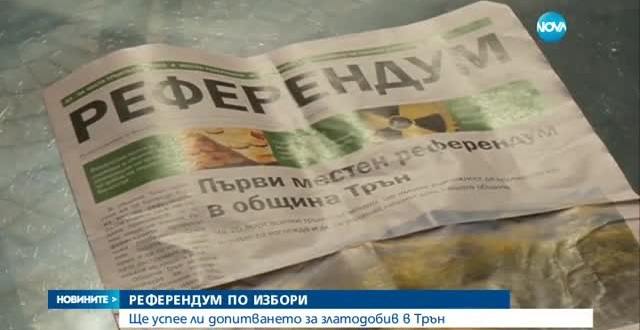
The structure of the crushing 94% score in Tran
When faced with the choice of living or dying, it is abundantly clear that there is only one existential choice. And no amount of rational argumentation to show that the implications of apocalypse and horrific death from mining will dissuade them from doing so. Not to mention the benefits, which are downplayed or even mockingly dismissed. Some of the locals want to “preserve nature, even if it means staying poor.” The extension of this line is that “I can go hunting in peace.” This is what actually happened in Tran – or at least that was how the locals, who had not decided whether to vote or what to vote for in the local referendum, were convinced to cast their ballots with a “Yes.”
The "Yes" in the situation in Tran is quite delicate. The adopted question (which according to the Referendum Act, in short) must be answered with "Yes" for the referendum to be valid. Great. But according to observations and testimony from the investor, what happened in the days immediately before the vote was that the opponents of the mine campaigned around the municipality that "Yes" meant a vote for the mine.
And the question itself, to put it mildly, is confusing: "Are you against the municipality of Tran, through the municipal council, approving development plans defining territories for the extraction and processing of metallic minerals?"
Another significant moment of the election day is that by noon the voter turnout was around 10%. Completely in line with what was expected – local referendums, although they “fire up” people, have so far hardly motivated them to express their position on something that few consider important. Yes, there was a campaign, led only and mainly by the Initiative Committee “Tran”, which pushed the theses about the upcoming apocalypse from mining activities with elements of local chauvinism (the people of Tran are known for their difficult characters). But the massive and somehow organized voting after 2:00 p.m. leaves us with the impression that those who expressed their position at the end of the election day have found additional motivation. There are rumors of intensified requests from the organizers of the referendum to prominent people who can influence individual groups in the places.
An important element of the "crushing" result was the investor's non-participation in the campaign before and during the local referendum. His withdrawal was a clear sign that he did not want to participate in a game with a predetermined outcome due to manipulation. His disadvantageous position was to stand on the side of the law (Constitution, Art. 18 and the Minerals Act) and use facts and arguments against irrational suggestions.
Investments and/or environment
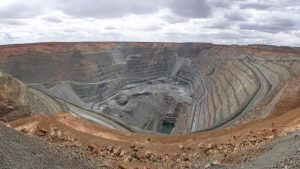 Модерното разбиране за устойчива тежка индустрия, в т.ч. и минна, не противопоставя нейната дейност на доброто състояние на околна среда, развитието на туризма, други бизнеси и т.н. С развитието на технологиите, напредването и внедряването на иновациите и увеличаването на знанието за процесите минните дейности по места коренно са се подобрили. Има такива примери на стари наши рудници, които попаднаха в отговорни ръце след приватизацията през 90-те години на ХХ век. Тогава те бяха пред фалит, поради лошото стопанисване, конюнктурата на пазарите и изоставането в технологично отношение. Но близо 20 г. по-късно „Асарел“, „Елаците“, „Челопеч“, кариерите на „Каолин“ ЕАД и от последно време рудниците „Мадан“ и „Златоград“ са модерни препработвателни комплекси и емблема на модерния български рудодобив.
It may sound apologetic, but the recognition they receive nationally and internationally is a guarantee of the quality of their investments and their responsible management.
Moreover, mining companies are an integral part of the development of the local community. With strategic and targeted social investments, places like Panagyurishte, Chavdar, Chelopech, Zlatograd are becoming pleasant places to live and raise families. And more – Panagyurishte is something of an emblem of Bulgarian history, mining industry, and recently – of spa, historical and cultural tourism, as well as host of the second most important table tennis tournament in Europe, which regularly brings together the world’s elite in our country. These places can be easily found on the map and visited to gain personal impressions of the impact of the mining industry on the communities there.
These are examples of the ways in which the mining industry does not harm the environment, because no one will want to live in a dirty environment with increased mobility of the workforce, just as no one will come to see churches and historical landmarks if there is a risk to their life and health.
The modern development of Stara Zagora does not involve building up every plot or park. Investments in construction create added value only for investors, because such projects are massively implemented in our country in a way that the focus is mainly on the specific plot and its interaction with neighboring ones, and the impact on the urban environment and infrastructure is not taken into account. In the case of Bedechka Park, it is about an already established park and massively compensated owners. As the park, with very little effort from the municipality and financing, as well as attracting the retail chains that have properties there and using civic energy, will become a favorite place for various outdoor activities and the unique biodiversity will be preserved. As for the compensation of the owners, in my opinion, there are ways to conduct a detailed due diligence of the compensation procedures that began in the 1970s until now, in order to be able to show who has real claims to land and what.
And Velingrad?
 Да очакваме ли и местен референдум против проекта за волфрамова мина и там? Това не прогноза, а логика. Против мината, очаквано, се обявиха хотелиерите в града. Все пак е Спа-столица на Балканите, каквото и да означава това, и тяхното разбиране не допуска съвместното развитие заедно с модерна мина. Затова и кампанията им започна повече от година преди да се започне ОВОС на проекта (по подобие на Трън). Интересното тук е, че в защита на местния изконен поминък се обяви вторият човек в ГЕРБ – г-н Цветан Цветанов. Можем да гадаем за неговите мотиви, но той вече има изградена теза за вредата от съвременните мини без самият той да е стъпвал в такава. И застъпничеството за хотелиерския бизнес във Велинград означава, че това са радетели за ниските заплати на местните хора, които по този начин могат да се държат в подчинение.
Against the backdrop of the relaunched populism at the national and local levels after the summer holidays, campaigns against mines and other large investors will become more frequent. No, this is not an apocalyptic scenario of a crisis communications specialist who wants to offer his services by intimidating his clients. This is the logic of things. The things that local activists will try to move only to achieve their goals – blackmailing or driving out investors.
On the other hand, with regard to the mining industry, the government will support the implementation of the Mining Strategy in words, but when things come down to new projects on the ground, then the long road of procrastination, populism, and political (and green) racketeering begins.
Instead of an epilogue
So far, we have had two local referendums, the results of which and the ways in which they were initiated and conducted demonstrate both similarities and differences between them. The main common denominator between them is not the desire to protect the environment, but populism. And this is the most frightening thing for the political and market development of our country.
But isn't there a paradox in the author's theses?! On the one hand, he defends the private initiative of an investor in a mining project, and on the other - he sides with the defenders of the park and is against construction investments. There is no paradox. The referendums in Stara Zagora and Tran were provoked with populist motives and their goal was to protect those interests that are the noisiest and supported by the status quo.
In Tran, a small group of owners of houses used mainly on weekends, supported by aggressive municipal councilors, managed to instill fear of the mine among the majority of the small local community there. In Stara Zagora, the ongoing processes of acquiring properties in Bedechka Park in recent years and the deliberate neglect of its management, in order to show its public unsuitability to be a … park, led to the start of construction activities in its southern part, but also to the organization of citizens for its preservation.
Yes, it is difficult to compare Tran and Stara Zagora, the protection of Erma River on the one hand (which will in no way be harmed by possible future mining activities) and Bedechka Park on the other. But in the spirit of populism and speculation with local referendums in the absence of quality information that lies behind the answer to the complex and illegal questions with "Yes" or "No", the common features are starting to become apparent.
That's why Tran will continue to decline and young people will move to Pernik or Sofia, even if they return to their hometown for weekends and holidays. The reality is that they missed a golden chance for sustainable development and a better life.
And Stara Zagora will continue to struggle in its quest to satisfy both sides. A compromise for the future of the park seems to be the only possible solution. But is this equally acceptable to each of the parties involved?
Image sources: Nova.bg, Investor.bg, Monitor.bg






The task pursued by Mr. Kiryakov in this text - we ignore the inaccuracies and distortions in it - is deeply anti-human and anti-democratic. It speaks of the shock and panic of the predatory native backstage, accustomed to viewing itself as an institution above the law. And in fact, the victory in Tran marks the masculinization of civil society:
https://m.offnews.bg/news/Analizi-i-Komentari_65/Ne-si-li-poiskash-niama-kak-da-ti-dadat_661982.html