EKIP– Expert Club for Economics and Politics A Different Opinion
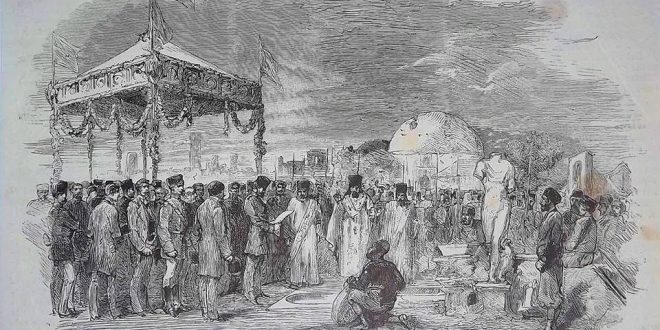
On October 5, 1879, the Governor-General of Eastern Rumelia, Prince Alexander Bogoridi, laid the foundation stone for the restoration of Stara Zagora.
The city was almost completely plundered and destroyed by the advancing Ottoman army of Suleiman Pasha during the War of Liberation, and its inhabitants were subjected to mass extermination, in which nearly 8,000 Bulgarians died.
The scale of the destruction put the tens of thousands of people returning from Stara Zagora after the war in a housing crisis. Local residents settled in neighborhoods abandoned by the Turkish population, where several families were forced to share a room. The crisis deepened when the Turkish residents of the city returned, finding their properties occupied by their fellow citizens.
The leaders of Stara Zagora saw the situation as an opportunity to reshape the city in a modern way through a new urban plan, instead of restoring its old impractical oriental appearance. Initially, the proposal to buy all the properties met with widespread civil resistance, as the local population was strongly attached to their property. However, supporters of European urban planning did not give up and carried out an extensive explanatory campaign, including city-wide meetings and neighborhood gatherings, which ultimately yielded results. A compromise was reached and the public instructed the city administration to form a special commission to assess the value of the properties, then to distribute them into four categories according to their pre-war importance.
The Czech technician Libor Bayer was hired to prepare the new urban plan, and the quality assessment of the plan was the work of the Italian architect Paolo Montani. On October 5, among the ruins of the central square, the foundation stone of the new Stara Zagora was laid and its reconstruction began.
"Before the collapse, the city of Stara Zagora had up to 4,419 homes with 25,460 inhabitants, after the collapse, 1,089 homes with 10,650 people remained. This was written and preserved in this foundation stone for the remembrance of posterity."
– Act for the restoration of Stara Zagora of 5.10.1879, published in the “Report of the Archaeological Society of Augustus Trajan”, 1915