EKIP– Expert Club for Economics and Politics A Different Opinion
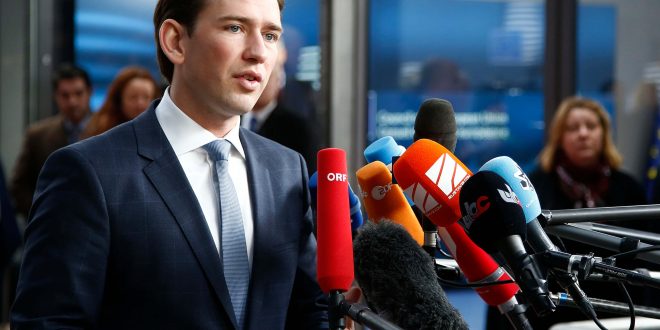
Is 31 a lot or a little? That's the age of People's Party leader Sebastian Kurz, the winner of yesterday's parliamentary elections in Austria, who will most likely receive a mandate to form a government from the president of the Alpine republic.
The Greens have been represented in the Austrian parliament for 31 years. That is, they were. Until yesterday. Starting today, they have 5 years of extra-parliamentary activity ahead of them. Well, it might be less, in case the Austrian legislature does not serve out its full term, which is happening more and more often there.
But let's get out of the overture and see the main news, which is that
The right won these elections.
That's it, these are the facts – all the parties to the right of the center increased their results. First of all, of course, these are the conservatives of the People's Party (ÖVP). After them, we can't help but mention the populists of the Freedom Party (FPÖ), who, despite the many necessary caveats, pass for a right-wing party. And even the cool and strongly pro-market liberals of the NEOS – and they win, albeit only by a small margin. And let's not forget the green fossil Peter Pilz, who, being the most right-wing on the left, also won.
On the other side are the Social Democrats, whose result is almost identical to that of the last elections in 2013. But it is perceived as a loss due to the inability of the new leader and still Chancellor Christian Kern to set a direction for the seemingly aimlessly wandering red ship.
The Greens are also on the losing side. After a series of internal disputes, the request of their youth organization to participate in these elections in a coalition with the Communist Party of Austria (yes, there is one), and the inability to retain one of their most important figures in the person of Peter Pilz. Who, after not receiving the 4th place he wanted on the Green list, sent them to hell, went to the elections with a hastily formed party bearing his name, and thus guaranteed his parliamentary participation.
Now someone will quite rightly ask what is the reason for the political shift that led to the press on the right?
Campaign under the banner of migration
The answer is quite simple and unambiguous. We should not have a shred of doubt that yesterday's results are mainly due to migration issues. Their correct interpretation shows synchronization between the public opinion formed as a result of the 2015 migrant crisis and the political configuration expressed by the voters for the next 5 years.
It also shows that the attempt to make (successful) policy without taking into account the fears and moods of the people, to act in stubborn opposition to the silent majority, has clearly lost.
In a poll conducted on election day, 38% of Austrians said that “Immigration, asylum and foreigners” was the most important set of issues that the next government should address. Education was second most important to people (18%), and taxes came in third (17%).
Kurz's recipe here was simple: 1) introduce an upper limit on the number of foreigners that Austria accepts on an annual basis, 2) close the "Balkan route" and 3) uphold the sovereign right of each country to decide whether to allow someone into its territory or not.
The failure of the left came along the same lines, because neither the Social Democrats nor the Greens were able to convince the wider masses that they had adequate solutions in the field of migration. This is especially visible with the Greens, whose agenda in recent years has been limited to strange battles for social justice and statements like "integration is from yesterday, today we just have to accept differences and encourage them."
If we add to this their excessive, even for Austria, anti-market behavior and their almost complete withdrawal from the fundamental topic for them - environmental protection, then the voter turnout is more than understandable.
The party I sympathize with in Austria – NEOS – managed to successfully turn the corner at the very end of the campaign, copying 1 to 1 the 4-door policy of the German liberals from the FDP. In other words: there are 3 doors to enter the country: asylum, temporary humanitarian status and knowledge and skills needed by the Austrian economy. Anyone who does not fall into one of these 3 hypotheses must leave through the 4th door.
Ok, but what happens next?
Coalition games – color games
We have 3 parties with very similar results. People's Party with 31.4%, Social Democrats with 26.8% and populists from the Freedom Party with 26.3%. It is clear that whatever coalition is agreed upon, it will be between 2 of them.
The Social Democrats have lost their first place, and it is questionable how well they will be able to defend their second place – the "blues" from the Freedom Party are literally breathing down their necks with only a 0.5% difference.
This is not good news for the “grand” red-black coalition. It has been in place for too long, leading to too much convergence between the left and right in the center, leaving too caloric a breeding ground for populists at both extremes of the political coordinate system.
Against this background, the blue-black coalition between the People's Party and the Freedom Party is not only arithmetically possible, but also, in view of the results, almost imperative.
This means long and exhausting negotiations, in which Heinz-Christian Strache, the leader of the Freedom Party, will be waiting for his golden hour. On the one hand, he can negotiate calmly with Sebastian Kurz, but all the while he can threaten with the wild card that he might form a coalition with Christian Kern's Social Democrats. This is, of course, only one side of the coin, because on the other hand, Strache has numerous functionaries who have been waiting for 11 years to come back to power. It would not be surprising if they still push him to be more accommodating.
Such a step will also be a challenge for Kurz, who will have to do everything to avoid repeating the two main mistakes of the last black-blue government (2000-2006): first, to make sure that the personnel offered by Strache are truly reliable, and second, to prevent cases of outright corruption such as the procurement of Eurofighter fighter jets.
Reconciliation of electorates
The difficulties here are predetermined, since the People's Party is voted for by better educated, and therefore better-off people: entrepreneurs, well-paid employees and the administration.
The Freedom Party, on the other hand, is voted for by the working class (yes, it has long stopped supporting the Social Democrats), people with lower incomes, and the poorest members of society in general in terms of education. This is a group that relies heavily on serious state intervention to improve its situation. Such are Strache's messages: a welfare state - yes, but only for our people and in no case for foreigners. To what extent this will be compatible with Kurz's promises of less state, more market and personal responsibility, remains to be seen.
Europe, the EU and the Eurozone
Convergence on European issues will not be easy either. Sebastian Kurz's People's Party is strongly pro-European, and he has always presented himself as such. On the other hand, Strache's populists have always sought to attract an anti-European vote, and last year they even tried to ride the Brexit wave, but without much success. Since then, his messages regarding the EU have been significantly softened, and this is normal, since in Austria there has always been a statistical majority of 2/3 supporting the country's membership in the EU. The Freedom Party's decision to take on managerial responsibility goes through consideration of the will of these people.
Not least in this regard is that with the Social Democrats' withdrawal from power, Emmanuel Macron's idea of budgetary (and tax) synchronization in the Eurozone loses another ally. Personally, I expect Sebastian Kurz to be very cautious here and to act in sync with the emerging equally cautious German policy.
I end with optimism.
Finally, I recall one of my favorite Austrian proverbs: “it is never eaten as hot as it is cooked.” In other words, I do not expect any major relocations, nor would I be particularly alarmed by the promised “Visegradization” or “Orbanization” of Austria.
It has been and will remain an “island of the blessed”, and this will not change even the possible black-blue coalition. Moreover, there was already one once, and it led to many meaningful liberalizations in the economy. It also led to the inevitable unmasking and melting of populism – in 2000 the Freedom Party entered the government with 28%, and in 2006 it came out with only 11%.
I expect something similar to happen this time, but until then, I'll let them enjoy the black-and-blue rhapsody.