EKIP– Expert Club for Economics and Politics A Different Opinion

Author: Assoc. Prof. Dr. Hristian Atanasov
The possession of weapons by Bulgarians during the Ottoman rule is not an unexplored or neglected problem by historians. However, it hardly figures in the mass consciousness, with the exception of the image of the haiduts, who in most cases are presented as rebels against the authorities and "people's champions". In fact, the carrying of weapons in the Ottoman state by conquered nationalities and non-believers has at least two sides.
The first is the mass, unregulated armament, against which the Ottomans took legal measures and actions – disarmament orders, confiscations and so on. This can also include the legal carrying of weapons by groups of the population who performed some security functions – for example, the derbendzhii (guardians of mountain passes), who often found themselves on the edge of the law with their actions and there are quite a few registered cases in which they attacked those whose safety they were actually supposed to guarantee. This side of the issue will not be considered in this material, it will remain the focus of a subsequent publication. In this case, I will focus on the less known to the general public the carrying of weapons by Bulgarians in the service of the Ottoman state. As we will see, this is also not to be ignored and is an issue that is already far more engagingly occupying the minds of Bulgarian historians.
In reality, even during the conquest, the Ottomans used the military potential of the local Balkan peoples. There are known cases of Christian spahis who were part of the Ottoman army and whose duty was to join the army in the event of hostilities. In addition to them, there are several groups of subjects whose status places them in the military category of the empire's population. Here I will mention only the so-called voynuchs. These are paramilitary Christians (mostly Bulgarians) who, even before the Ottoman invasion, were included in the "military group". In the 1470s, the voynuch institution was established, with which they were pragmatically incorporated into the Ottoman military organization. Thus, the conquerors managed to use the combat experience of the conquered population, especially since in the early years of the state's existence they also felt a shortage of Muslim fighters. According to Krastyo Yordanov, one of the modern researchers, by the beginning of the 16th century. Voynuks participated in military campaigns on a par with the Spahi cavalry as jebelii – soldiers in armor and full combat equipment (Quote from: Yordanov, Kr. Command and control apparatus of the voynuk institution in the Bulgarian lands under Ottoman rule in the 15th–16th centuries: hierarchical structure, functions and personnel composition. – Historical Review, 2012, vol. 3-4, 33-34). In the following centuries, voynuks were used by the Ottoman army as auxiliary formations serving in the convoy, and in peacetime they were responsible for looking after the horses in the state stables. In fact, this category, although no longer performing effective military service, was preserved, after many transformations, until the end of the Ottoman Empire.
After the proclamation of the Tanzimat (in 1839), which marked the beginning of the Ottoman “perestroika”, a whole “discussion” was conducted among the rulers as to how justified the inclusion of Christians in the ranks of the army was. In general, there are several examples of the involvement of non-Muslims in the Ottoman naval forces, as well as in the land forces, but the Sublime Porte remained cautious. Initiatives in this regard were inconsistent and contradictory. For example, in 1848 it was decided to attract Christians to serve in the army, but in view of the revolutionary events in Europe of that year the idea was abandoned. Bulgarians in particular were certainly included in the composition of military formations. Thus, on the initiative of the Polish emigrant Tchaikovsky, in late 1853 - early 1854 in Edirne and Constantinople, a “Polish” military unit was created, the so-called “Cossack Alay” ( kazak alay). According to historian Alexander Zlatanov, when it took the oath in Edirne on January 23, 1854, out of the total six squadrons, three were composed entirely of Bulgarians.

Digital object 1. New Cossack squadron, gathered in Constantinople, 1853. Source: Zlatanov , Al. The Cossack Regiment of Sadak Pasha. Proceedings of the Institute for Historical Research, Volume XXXII . Poland and the Poles in the New Bulgarian History (mid-19th – mid-20th centuries). – In: Materials from the International Scientific Conference, held on March 20–21, 2014 in Sofia. Publishing House of the Bulgarian Academy of Sciences, “Prof. Marin Drinov”, Sofia, 2015, p. 71.
It is interesting that these formations were sent against the detachments of Panayot Hitov and Philip Totyu, who came to Bulgaria in the late 1860s, and there were cases of both clashes and battles, as well as the crossing of Bulgarian fighters from the "Cossack Alaia" to the Chetnik side.

Digital object 2. Adam Mickiewicz and Sadak Pasha [ Tcheikovski ] in a camp near Burgas, 1855. The banner of the unit is visible at the top left. Art. P. Sukhodolski. Source: Zlatanov , Al. The Kazak Regiment of Sadak Pasha…, p. 7 2 .
In addition to the Ottoman army, in the 1850s and 1860s, Bulgarians also found themselves in other Ottoman security services. As early as the 1840s, the Gendarmerie Directorate ( Zaptıye Müşiriyeti ) was established and its first regulations ( 1846 Tarihli İlk Zaptiye Nizamnamesi ) were promulgated. Thus, the institute responsible for internal security in the Ottoman state at the central and local levels was organized in a new way. It is known that Bulgarians from the Lozengrad region were recruited into the ranks of the Ottoman gendarmerie.
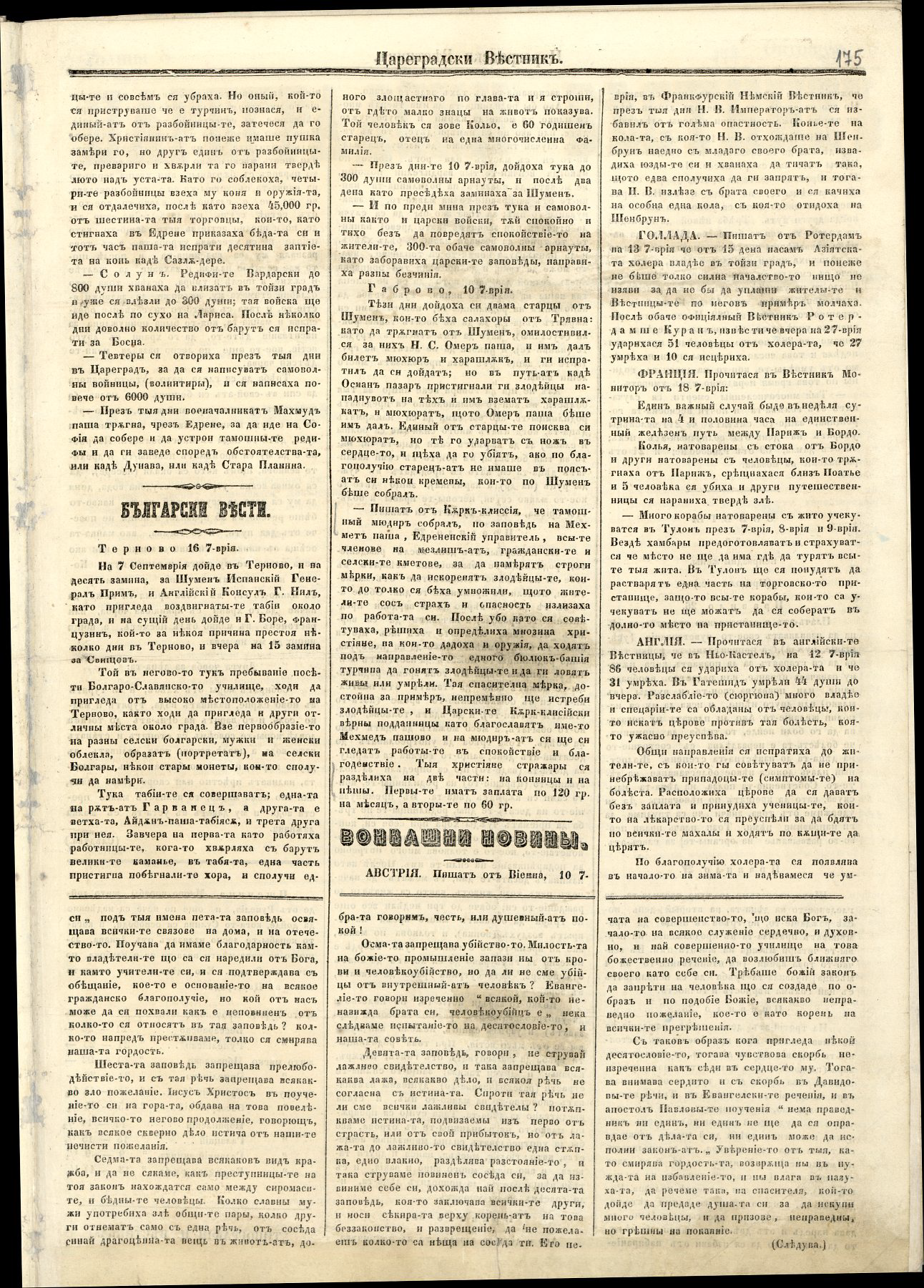
Digital object 3. Letter from Lozengrad, Tsarigradski vestnik, III , 140, September 26, 1853. (The original is kept in the National Library "St. Cyril and Methodius" ( NBKM)). Source: Atanasov, Hr. Bulgarians in the Ottoman Gendarmerie? New data on Vidin from the 1860s. Scientific conference with international participation on the topic: "Modernization trends in economic and cultural life in Vidin and Timoshko regions (XVIII–XX centuries)", city of Vidin, October 24-25, 2018. In press.
For example, in a letter from the city of Lozengrad ( Kırklareli ) in a Renaissance newspaper we read: They write from Kirk-klisia that the local mudir [ i.e. governor ] gathered, by order of Mehmed Pasha, the Edirne governor, all the members of the mezlis [ i.e. council ] , the civil and village mayors, in order to find strict measures on how to eradicate the villains, who had multiplied to such an extent that the inhabitants went about their business in fear and danger. Then […] having consulted together, they decided and appointed many Christians, to whom they also gave weapons, to go under the direction of a certain byulukbashi [ company commander ], a Turk, to chase the villains and catch them alive or dead. This saving measure, worthy of an example, will certainly exterminate the villains, and the loyal subjects of the Tsar's Kirk-Klisia, blessing the name of Mehmed Pasha and wearing their uniform, will go about their business in peace and prosperity. These Christian guards were divided into two parts: horsemen and footmen. The former have a salary of 120 groschen per month, and the latter 60 groschen.
The same procedure was followed in Vidin, where there are preserved documents showing that local Bulgarian Christians joined the ranks of the Ottoman gendarmerie.
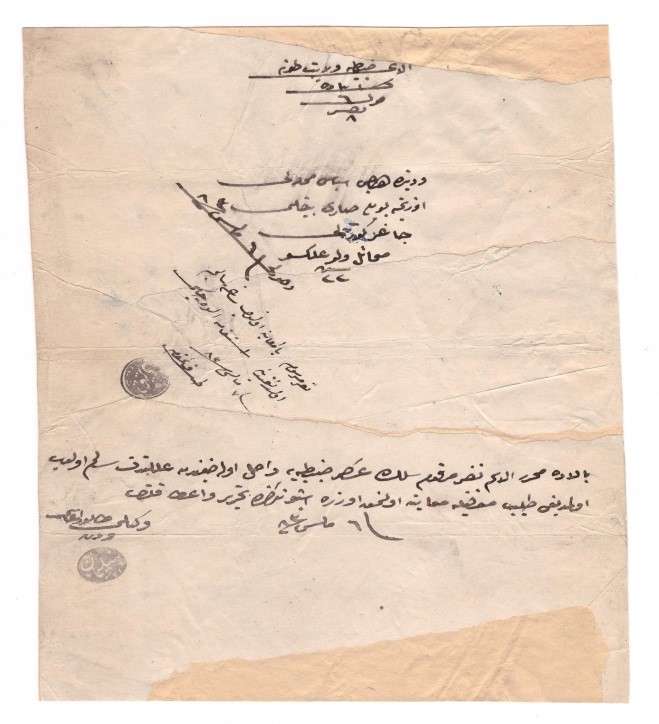
Digital Object 4. Medical note dated 18 May 1867, certifying that Mihail, son of Alexi , from Vidin is healthy and can serve in the gendarmerie . NBKM, Oriental Collections, OAK 16/30. Source: Atanasov, Hr. Bulgarians in the Ottoman Gendarmerie?
Why did it come to the point where Bulgarians became Ottoman gendarmes? First of all, Vidin is close to the Serbian border, and in addition, since April 1867, the aforementioned revolutionary detachments (of the voivodes Hitov and Totyu) began to pass through Bulgaria, and probably the entry of Bulgarians into the police was also intended to have a political effect. The Sublime Porte wanted to attract the Bulgarians to its side and guarantee their loyalty.
Moreover, it seems that the local Ottoman authorities felt a need for Bulgarian policemen, both because of the proximity to Serbia, which was a prerequisite for insecurity, and because of the ethnic composition of the area, in which Bulgarians predominated. The lack of Muslim candidates for gendarmes, specifically in Vidin, is documented in a draft letter dated 27 February 1877. In it, the Ottoman Ministry of the Interior ( Dahiliye Nezareti) was asked whether 30-40 Christian policemen could be enrolled because there were no willing Muslims in the area.
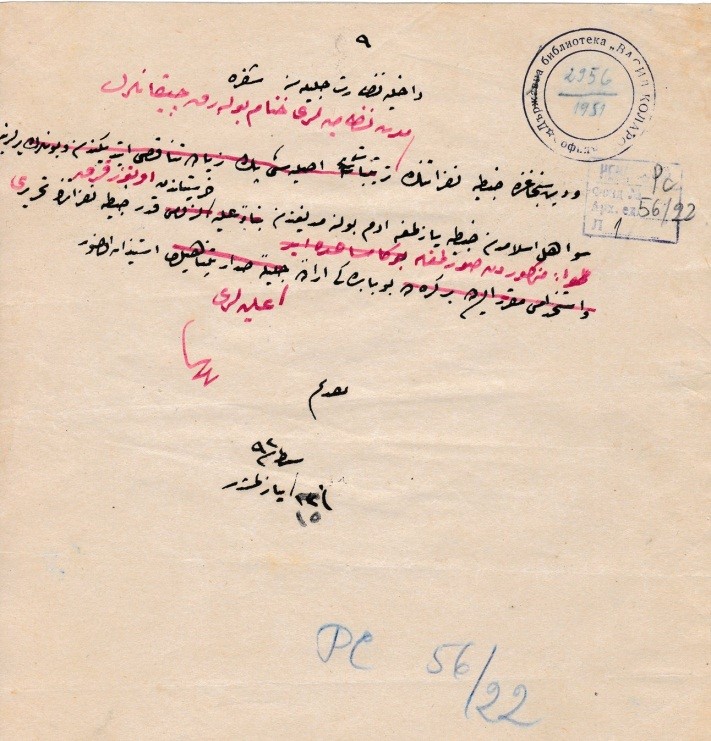
Digital Object 5. Draft of a letter to the Ministry of Internal Affairs dated February 27, 1877. NBKM, Oriental Collections, RS 56/22, l. 1. Source: Atanasov, Hr. Bulgarians in the Ottoman Gendarmerie?...
It is more than curious that the letter was sent relatively soon after the April Uprising, after the war between Serbia and the Sublime Porte (1876) and immediately before the Russo-Turkish War, when distrust of the Bulgarian population must have reached its peak and therefore it is normal for such a question to be asked. It is not known what the Porte's response was or whether one was sent at all.
Conclusion
Obviously, the Bulgarians had a long and diverse relationship with the Ottoman army and internal security services, and the bearing of arms was not at all alien to them. During the invasion, they fought against the Ottomans, but after it they also took part in their conquests against other Balkan and Central European countries. In this respect, the institution of the military has deep roots.
After a certain interruption in the 17th and 18th centuries, and more noticeably from the mid-19th century, Bulgarians again became part of the Ottoman army. This apparently happened through the “Cossack alaya” of the Pole Tchaikovsky. In general, the policy of involving Christians in the ranks of the army was inconsistent. The Porte took encouraging initiatives, but often abandoned them due to the current situation, either internationally or domestically. In the end, the Christians never managed to fully gain its trust, and consequently, it integrated them to a greater extent into its armed forces.
The same applies to the issue of Bulgarians serving in the internal security units of the Ottoman state, which were created after the Tanzimat. The law does not prohibit it, but it does not explicitly allow it either. In view of the specific situation in the Vidin and Lozengrad regions, Bulgarians joined the gendarmerie, although it is not very clear to what extent this was a mass practice. The Porte was probably trying to attract the local population to its side through this act and use it more fully to further its interests. Especially in Vidin, this probably happened during the time of Midhat Pasha, who opened the doors to Bulgarians not only for service in the gendarmerie, but also included them en masse in the local government. In the Lozengrad region, it was a fact much earlier. Undoubtedly, their involvement in the ranks of the police was not selfless and had a propaganda purpose. Especially after the revolutionary activity of the Bulgarian emigration in Romania and Serbia intensified and the bands of Philip Totiu, Panayot Hitov, and then Stefan Karadzha and Hadji Dimitar entered the country. In any case, the facts presented are such and they further enrich and nuance the complex picture of the interaction of the Bulgarians with the Ottoman authorities in the period after the reforms until the Liberation of Bulgaria in 1878.