EKIP– Expert Club for Economics and Politics A Different Opinion
The market process played an important role in the development of Bulgarian society before the Liberation. It steadily penetrated even into spheres and areas that were perceived as isolated from it. Its spontaneous manifestations left an imprint on educational work, cultural institutions and social life. Read through the prism of voluntary exchange, supply and demand, many aspects of the self-organization and behavior of the Bulgarians of that time become understandable. And as will be seen from the exhibition, thanks to the market, Bulgarians also became better people. [*]
School and market; market at the school
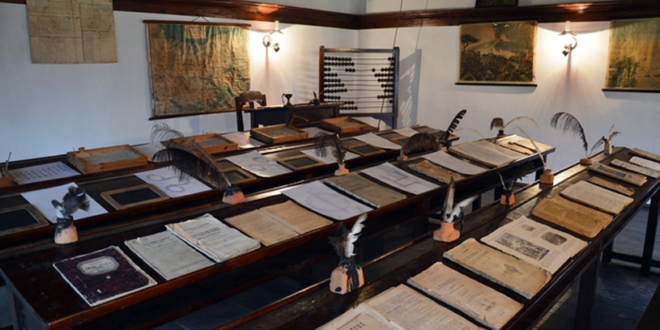
The creation and successful operation of schools during the Revival period was deeply rooted in the market. Bulgarians became richer and were able to build school buildings, buy textbooks, pay teachers, etc. There was a demand for knowledge and for trained people to provide it. The Bulgarian teacher before the Liberation was dependent on the arbitrariness of local chorbadjis. The teachers' salaries were often delayed, and many of them lacked job security. From the point of view of market mechanisms, these facts mean that in a certain period the supply of teaching labor exceeded the demand, which created problems for educated Bulgarians. However, the situation changed in the early 1870s. In his memoirs, Todor Naydenov wrote, "In that dark era, a teacher was such a valuable rarity that the village that was honored with the privilege of having a teacher, even for one year, was considered the happiest." The demand for teachers is becoming extremely high, and for this reason, teachers do not stay in one place for very long. They can now negotiate better salaries and working conditions.
In educational work, some teachers create specific markets. The Bulgarian National Revival schools are known for the fact that teachers do not stand on ceremony with their students, beat them for various offenses or impose humiliating punishments. The Kyustendil teacher Nikolay Tondzharov decided to apply an interesting market method in punishing bad deeds and rewarding good behavior. When a student does something commendable, he receives a piece of paper with the letter N (award) written on it. In the event that the same student is caught in some offense, instead of being beaten, he “pays” for his offense with the award paper and thus gets rid of the beating. If he has nothing to pay, the student is punished in the traditional way. As a result of the creation of this market, physical punishments decrease “significantly” according to the memories of contemporaries. A similar practice of buying off has also been registered in Kazanlak.
Another aspect of the activities of the Revival schools is related to their role in the market for bringing together married couples. This is one of the most complex markets, which the Nobel laureate in economics Gary Becker draws attention to. In traditional Bulgarian society, the choice of a marriage partner is made by the parents. The girls' schools, which were opened before the Liberation, also served to demonstrate the positive qualities of girls. In 1845, the Karlovo priest, butler Hristo P. Vassilev, opened a private girls' school. He recommended to his assistant M. Tantilov a girl for a wife from among his students who was of "great virtues". And in the words of the biographer of the Karlovo priest, in the following years "almost all candidates interested in marriage resorted to the valuable advice of Father Butler on the character and behavior of virgins". Thus, girls' schools support the functioning of the marriage market, because they provide adequate information about the qualities of a potential partner.
Usury and culture
Since ancient times, lending money at interest has aroused strong moral discontent among philosophers, religious leaders, and others. Nevertheless, usury has become an element of market relations.
During the Renaissance, there were almost no credit institutions in the Bulgarian lands. The first joint-stock company engaged in lending was founded in 1849 in Sliven. The annual interest rate on loans was about 21%. Its activity was very limited in scope. The demand for loans grew in parallel with economic development and created favorable conditions for the emergence of unorganized usurious credit. Information about usurious activity covers all representatives of Bulgarian society. For example, the Kazanlak teacher Manol Statelov gave money at interest. He lived and supported himself thanks to material gifts from his students, and he gave almost all of his salary – about 3,000 groschen per year – at interest. Money at interest was given by soup cooks, municipalities, guild organizations and everyone who had free capital. Usurers were disliked because they demanded “excessively” high interest rates and were believed to be ruining entire villages.
Usury in itself cannot be defined as evil. It is a tool that facilitates the existence and activity of community centers, which are important cultural centers. There is a lot of information about usurious community centers before the Liberation. In 1872, the Gabrovo community center had a capital of 25,000 groschen, which was lent at an interest rate of 12%. This allowed the community center to develop its cultural and educational activities and to maintain a boarding house for incoming students at the Gabrovo High School. Gabrovo residents are no exception in terms of financing community center activities. Community centers in Zheravna, Tryavna, Stara Zagora, Sliven, Svishtov, Karnobat, Karlovo, Pirdop, Kukush, etc. gave out money with interest. It is no coincidence that in 1871 the periodical press discussed the idea of establishing a bank for Bulgarian community centers. Incidentally, community centers also use gambling, which is also considered a moral vice with harmful consequences, for social purposes. They organize lottery games, the proceeds from which support their noble activities.
Social life
The market has a direct impact on the way Bulgarians dress. Before the advent of capitalism, clothing was regulated by the state, it was a symbol of social status. Certain colors and clothes were reserved for specific categories of people. As a result of the penetration of the market among Bulgarians, some interesting trends have been observed.
From the end of the 18th century, the first information is that priests in some parts of the Bulgarian lands deliberately dressed poorly. This is strange at first glance, because the sources indicate that the practice was adopted by wealthy priests. Two reasons can be given for the change in clothing. First, this way it does not attract the attention of robbers, who were not uncommon. Second, it avoids the danger of increasing personal taxes imposed on clergy. The enrichment of priests in the 19th century is an indirect result of the spread of market relations and the slow enrichment of Bulgarians. The presence of legal and illegal robbers forces church officials to conceal their real financial situation.
A change in dress, brought about by market relations, can also be found among business people. The wealthy beglikchii from Koprivshtitsa (tax collectors) and the kurdzhii (traveling merchants) from Gabrovo prefer to dress as Turks when doing their work. In this way, without undue patriotism, they impress upon everyone they meet that they are representatives of the dominant nationality and that they would not hesitate to defend themselves against any attack with weapons.
And a few words about slavery
Too often, the entire period from the fall of Bulgaria under Ottoman rule to the Liberation is defined in the public sphere as "Turkish slavery". At least as far as the Renaissance (18th-19th centuries) is concerned, the term slavery is not accurate in defining the situation of the Bulgarians in the Ottoman Empire. The Christian population in the Sultan's state is not equal to the Muslims, but the Bulgarians are not slaves. Still, there is slavery in the empire. The spread of market relations in the primitive institutions of the Ottoman state makes it possible to trade in human beings.
In his memoirs of his visit to the Holy Sepulchre, Mikhail Madzharov wrote that there were Turkish merchants in Cairo who kept black slaves. In his words, “The price of this human commodity depended on age, beauty, or health.” Blacks were brought from Sudan and freely imported “like any other commodity.” The slave trade also included Caucasian girls. Mikhail Madzharov’s father had a partner – Doncho Palaveev – who offered to buy “two black girls and take them to Koprivshtitsa to be servants.” Ultimately, the Bulgarian merchant refused the offer to provide cheap labor. The reasons were both practical and ethical. Apparently, market relations showed the wealthy Bulgarians of the Bulgarian Renaissance where the boundaries were that should not be crossed. Trade in human beings was one of them. Therefore, immediately after the Liberation in Art. Article 61 of the Tarnovo Constitution (1879) states: " No one in the Bulgarian Principality may buy or sell human beings. Every slave, regardless of sex, religion, or nationality, becomes free upon entering Bulgarian territory."
Where does the guidebook lead?
Against the backdrop of major historical processes, events and personalities, Bulgarian history seems insignificant, provincially dramatic and sentimental. A journey through its lesser-known and popular episodes shows that it can and often is truly interesting. With the emergence of the Bulgarian nation, market forces shaped and rationalized its development. These forces have a positive effect not simply because they lead to enrichment. Even when their manifestations are laden with “negative” moral assessments, they actually make Bulgarians more human: they reduce violence, help find a marriage partner, contribute to cultural progress and show what should not be traded.
[*] This is only the beginning of the journey into Bulgarian history. If you wish to delve further into its depths of the last two centuries, you can continue with my recently published book "Past Unfinished. Missed Lessons from Bulgarian History".