Macroeconomic Monitor
Начало / 2022 (страница 3)

2022

Social divisions and rearrangements – to the aid of political analysts

Bulgarian sociologists have discovered the political realignment[1]…at least in France. In Friday’s Panorama on April 15, Boryana Dimitrova (Alpha Research) practiced explaining how strange it is that the two largest parties in the country of baguettes are respectively globalists (Macron) and anti-globalists (Le Pen). She even dared to use the correct …

More »

We'll make everyone mad.

On October 29, 1940, from the rostrum of the XXV Ordinary National Assembly, the deputy from the government majority, Gavril Lenkov, declared: "if it is necessary to enrage the speculators in Bulgaria, we are ready to legalize this sanction." The context of his threat is important. After the start of World War II in September 1939 ...

More »

Inflation fuels realignment and expands the Russian model of capitalism in our country

The historical realignment[1] in the political philosophies of parties across the Atlantic and in Europe is in full swing – hawkish socialists against Russia, pacifist and isolationist conservatives, right-wing protectionists and left-wing defenders of free trade and international agreements, modern left-liberals against local heavy industry and covering up blue-collar unionists and modern right-wingers in …

More »

What can the government do against inflation?

The inflation crisis in the country (and the world) is deepening and looks set to continue to deepen in the coming months. The war in Ukraine and the economic sanctions imposed by the European Union on Russia have reinforced the already strong inflationary trends and are leading to a shock increase in the prices of a number of raw materials – food, energy and industrial (for …

More »

The reshuffle after the arrests in Bankya and the GERB glue

Boyko Borisov and his power apparatus are the main obstacle to the ongoing processes of political realignment in Bulgaria[1]. For and against the Gerbadzhi domination is our, local division, which even today manages to unite in one camp forces with opposite attitudes to the new main dividing line in countries with a Western-style policy …

More »

The financial coup in Bulgaria of 1947

The year 1947 in Bulgarian history is associated with the implementation of an important monetary reform. It is part of a chain of profound and comprehensive changes that led to the establishment of a Stalinist economic and socio-political model: nationalization of industry, adoption of a new constitution, elimination of the parliamentary opposition, collectivization of agriculture, etc. The important lessons …

More »

"Book rags without any value"

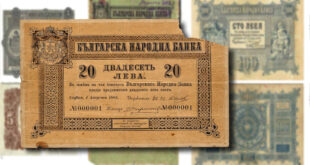
In 1928, with these words, the Bulgarian economist G. Toshev characterized paper money in conditions of inflation. His definition was the result of the experience gained during the First World War (1914-1919) and after it. This was the first clearly outlined inflationary wave in the history of post-liberation Bulgaria. The monetary system of …

More »