EKIP– Expert Club for Economics and Politics A Different Opinion
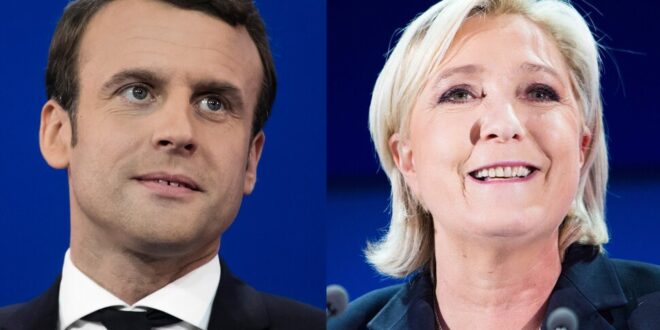
Bulgarian sociologists have discovered political realignment [1]…at least in France . In Friday’s “Panorama” on April 15, Boryana Dimitrova (Alpha Research) practiced explaining how strange it is that the two largest parties in the country of baguettes are respectively globalists (Macron) and anti-globalists (Le Pen). She even dared to use the correct term with its full name – “political realignment”.
Although she peppered her speech with the smart-ass political scientist's favorite boomer clichés about "the choice between East and West" and "dangerous extremists," Dimitrova has sensed several important changes in public thinking. The first is that the battle is no longer so much on the economic level, the choice is not so much consumerist - "here there is McDonald's and Chanel, and there there is McDonald's and Chanel," she says. In other words, the old division of more or less the market, on which the proxies for Western consumer goods are based, has been exhausted, satisfied at least to some extent.
And the second is that political ambivalence along the lines of globalism/anti-globalism (which it confuses with East/West) can no longer be ignored. It will be increasingly difficult for Sergey Stanishev's BSP or Boyko Borisov's GERB to exist, which both serve the globalist forces and gather support from the populist Ganya. The mastery of the yuppie lobby with NDSV roots, who are the most aggressive admirers of everything Euro and Brussels, but who also spin the money of the Russian arms industry and open branches of KGBbank, will also remain in the past. This was possible in the world between 2001-2015, before the start of the rearrangement. The world in which Putin traded dogs with Merkel, Bush, Boyko, etc. The last phases of the previous division are the most peaceful in terms of ideological conflicts.
At the end of the interview with the renowned sociologist, analysis turned into open activism by talking about “ideological leadership” – i.e. the pro-globalist forces in the ruling coalition (PP and DB) to somehow seize the initiative from the moderately anti-globalist forces (BSP and ITN). Here it is interesting to emphasize again the specific moment in the process of rearrangement in which we find ourselves – we are governed by a coalition composed of parties falling on both sides of the new dividing line. As the rearrangement matures, such a situation can only be temporary. The construction continues to stand strong because of the glue of the common enemy GERB, because of the special tasks set for ITN and because of the need for life-giving forces, obtained solely and only through access to power [2].
It would be useful to address the East/West opposition thesis itself. In essence, this is a rhetorical argument – “if you don’t agree with us, then you’re a Putinist”. A version of the same thing is used in the US, only instead of a Putinist, the bad guy is (for example) a “racist”. We have a textbook example of a false dichotomy, of a fictional contrast. In Bulgarian society, there is a relatively small and, moreover, mainly theoretical, appetite for anything resembling the dark, dictatorial Russian regime or its proxies – Dimitrova’s own sociology shows it and she happily cites the data in Panorama while contradicting it in her narrative, scaring us with the shadow of Uncle Vova [3].
The alternatives favored by a larger majority of Bulgarians of working age are more similar not to what is coming from Moscow, but to what is visible from the much closer Budapest, Warsaw, or even Bucharest. Bulgarians today are much more likely to accept someone like Orban (if they are pro-Russian) or someone like Kaczynski/Duda (if they are anti-Russian) as a model leader than to dream of our Lukashenko. Putin is simply an easier puppet enemy when you fight him in the BNT studio.
The sentiment is more anti-today's West than pro-today's East. At least because the West has decided to interfere more in Ganya's life, while the East does big business with current and former rulers.
Let's return to the new division in which our own political commentators are getting stuck like ducks in a mud puddle. The anti-globalist position that many of them are trying to fight against does not fit into their outdated understanding of the world since the early 1990s. Ms. Dimitrova herself has to some extent subconsciously understood this and even expresses her sadness about this issue at the beginning of the interview.
Her East/West is an unhelpful division for today’s political world, because the same people who dislike Biden, Washington, and the New York Times may like Trump, Musk, and the Navy SEALs. The opposition is much more between “Biden’s America” versus “Reagan’s America” [4] than between the Russian and Western models. We may be in the process of forming some new, clearer alternative model outside the hegemon, but Russia is unlikely to be its center. Our gaze should be both further east and closer to home for such models [5].
Politics does not begin and end with the big UDF protest. The world is significantly more complex than someone's youthful memories of the beginning of the Transition 30 years ago. Boomers will have to catch up quickly.
[1] You can read more about the rearrangement in our other publications – HERE, HERE, HERE, HERE, HERE and HERE.
[2] Political skill consists in timing when the resources of power begin to have less marginal utility than leaving the coalition.
[3] Dimitrova correctly notes that mass Bulgarian Russophilia is much more determined by proximity to culture, history, and some form of civilizational understanding, rather than by the regime itself.
[4] Reagan's campaign used the Make America Great Again slogan before Trump
[5] The view from the Far East is actually quite frightening at this stage, and Macron is even more active than Orbán in developing alternatives.