EKIP– Expert Club for Economics and Politics A Different Opinion

The Bulgarian energy sector is in a special state, which according to Assoc. Prof. Krasen Stanchev [1] can already be called a crisis, while according to former Prime Minister Ivan Kostov [2] it is pre-crisis. The facts are that Bulgaria is still a significant producer and exporter of electricity, but, due to foreign policy circumstances, a significant share of our energy sector is expected to close in the coming years without any clarity on adequate replacement capacities. This is precisely what could lead to the situation formulated by the former Prime Minister, in which the supply and consumption of energy diverge significantly, followed by interruptions in supply and a real crisis.
In fact, Bulgarian energy is caught in the perfect storm created by the political realignment in European politics, which precedes by several years a similar and still nascent process in Bulgaria [3]. In other words, the ideological cleavage between the European left and right is not just being reversed once again, but is also being rearranged along the globalism-localism axis, which has been forgotten since the beginning of the last century, while in Bulgaria the political spectrum is in half-disintegration. In such a situation, Bulgarian governments cannot take a clear position in the developing European policies on the issue of the Green Deal and remain passively lost in translation, threatening the very existence of the energy sector in our country.
The Green Deal and energy are an interesting aspect of the political realignment of the Old Continent, as the climate agreement is largely reminiscent of the European Coal and Steel Community Treaty – but with a completely reversed ideological pole. In the early 1950s, leading European countries dominated by Christian Democratic right-wing politicians such as Schuman and Adenauer sought a way to supranationally unite the steel and coal industries as central to each country’s economic and military power and thus make future military conflict unthinkable [4]. Adenauer, Schuman and to some extent Churchill saw economic entanglement as an irreversible process without focusing particularly on regional economic interests in the three countries.
On the other hand, the left-wing parties in power in Britain, the United States, and much of Scandinavia were proud of the growing state control over the economy, the increasing taxation and redistribution, and the direct nationalization or indirect regulatory management of key industries such as coal mining and steel, and while they generally agreed with the international march of fraternal socialism, they saw little political benefit in subjecting newly "taken over" industries to some vague supranational institution. For example, the National Executive Committee of the British Labour Party in 1950 adopted a foreign policy statement entitled "European Unity" which argued that "in every respect except distance Britain is closer to our compatriots in Australia and New Zealand on the other side of the world than it is to Europe." [5] Delegates to the committee spoke out strongly against the European Coal and Steel Community, using socialist rhetoric and arguments. For example, the delegate of the National Union of Automobile Workers, R. Edwards, asks the question: “Does the Schuman Plan develop workers’ control over the main European industries or does it develop capitalist control and cartel agreements that have always harmed the working class?” 5 Equally eloquent is the British MP Hugh Dalton 5:
" There are some who promote the idea of a federal Europe of which Britain should be a member. The Labour Party has almost unanimously rejected this view. We are not prepared to join a European federation because we are not prepared to hand over to a supranational body decisions on matters which we consider vital to our national life; such matters as the extent of socialisation, the means of maintaining full employment, or the distribution of wealth through a policy of fair shares ."
Although the attitude of European Christian Democrats towards the EU in the following decades was dynamic, the pursuit of ever deeper economic integration through free international trade, privatization, deregulation and liberalization de facto created today's liberal international economic system. Socialists, on the other hand, remained focused for at least another 20 years on attempts to preserve and further develop state control and ownership of key industries, which they often combined with skepticism towards free trade and the reduction of tariffs in order to stimulate trade, production and the protection of citizens, especially as consumers of goods and services.
The poles seem completely reversed today – the supranational Green Deal is most aggressively advocated by the globalist ideological camp, in which the leaders are former socialists and today's greens, while the skeptical movement is led by localists and nationalists, represented mostly by former right-wing and conservative politicians.
The irony is that the Green Deal pursues goals that are completely opposite to the socialist ideology of the time – the elimination of labor-intensive energy and industry on the territory of Europe and the creation of a union economy dominated by layers of bureaucrats and white-collar workers in services, while the blue-collar workers of the working class have social security numbers printed on them for access to an unconditional basic income and, more recently, vaccination.
The de facto globalists believe that Europe can be a prosperous continent, supported almost entirely by the ecological service sector and a centralized supranational bureaucracy, while the “dirty” industry and mining are exported far abroad (any resemblance to European beliefs of the 17th-18th centuries is not accidental). As we have seen in the sociological profiles of Brexit, the globalist left has lost its traditional voters in the working-class and former industrial regions and is concentrated in the large metropolises, developing the service sector and importing everything else “from outside”.
On the other hand, right-wing politicians advocating national subsidiarity have been abandoned by their former corporate sponsors and naturally find a haven in voters also abandoned by the left-wing globalists – the former industrial and energy-intensive regions are shaping up as their new electoral bastions. Today, they say that blue-collar workers must be protected by preserving European industry, retaining labor-intensive energy and mining, and balancing trade relations with third countries.
Against the backdrop of the already reversed European ideological and political poles, the process in Bulgaria seems slow, chaotic and hitting almost unavoidable economic obstacles. The only formation that has carried out a timely rearrangement is Democratic Bulgaria - at least parts of the DB openly advocate the need for almost all of Bulgaria's energy sector to be closed, for national energy resources not to be used and for a switch exclusively to solar energy (wind kills birds, and hydroelectric power plants - fish), and when it does not shine, the necessary energy to be imported from outside. Democratic Bulgaria exclusively protects the interests of those working in the service sector in Sofia, for whom industries such as metallurgy, mining, resource-intensive tourism and mechanical engineering are unnecessary - the working Sofia IT people will import all their consumer goods, and those living in the countryside may limit themselves to hosting guest houses in which the white collar workers of the metropolis will rest during the weekend. Not entirely electorally sincere, similar positions are also taken by the Movement for Rights and Freedoms, although they are motivated by political needs internationally (full support from ALDE/Renew) and business needs nationally (positioning companies in the supply chain for the Green Deal).
At the opposite pole are Vazrajdane, BSP and, after leaving power, to some extent GERB. For them, the current blue-collar workers are a priority, for whom any transformation will be painful. GERB did not dare to submit the Recovery Plan before the elections, realizing that any preservation of the Maritsa Basin would be unacceptable to the EC, and anything acceptable to the EC would create an electoral catastrophe in several Bulgarian regions. Vazrajdane and BSP, on the other hand, openly advocate that Bulgarian coal and nuclear energy continue to operate as long as possible, with the number of people employed there not only not decreasing, but even increasing.
Kiril Petkov's formation tried to follow the globalist energy ideologisation, but its positioning in this niche clashed head-on with the election victory – talking about abandoning national energy resources is much easier when you are not in power. Today, Assen Vassilev is desperately trying to find a solution that preserves jobs in the Bulgarian energy sector and satisfies the EC's aspirations for deindustrialization. Unfortunately, the Finance Minister has stumbled in completely unrealistic directions – the construction of 2 GW/h of geothermal energy capacity and the replacement of the proposed 1 GW/h gas-hydrogen power plant with waste incinerators.
Vassilev is about to discover that the production of electricity from geothermal sources requires water with an extremely high temperature [6] (107-182°C), which does not exist in Bulgaria (the hottest spring in Sapareva Banya is 103°C), and all of Sofia's garbage is enough to produce 20 MW/h of electricity with the current capacity of "Maritsa-Iztok" of 3000 MW/h. The field for ideological and managerial maneuvering of Petkov and Vassilev is also limited by the enormous influence in the government of Deputy Prime Minister and Minister of Ecology Sandov. As Krasen Stanchev pointed out, he is among the forerunners of the activist-former government tandem that has liquidated the development of potential local energy sources in our country over the past decade – a moratorium on exploration and extraction of natural gas through hydraulic fracturing [7], several refusals to explore the extraction of methane hydrates from the Black Sea [8], and the expansion of protected areas for birds over all territories suitable for investment in wind energy, mainly along the Black Sea coast and the high parts of the mountains [9].
Petkov and Vassilev, who want to do a lot but have no desire to position themselves as globalists, cannot give either the EC or the Bulgarian people and business a satisfactory answer as to what can replace half of the Bulgarian energy sector, which is under real threat of liquidation in the next 10 years.
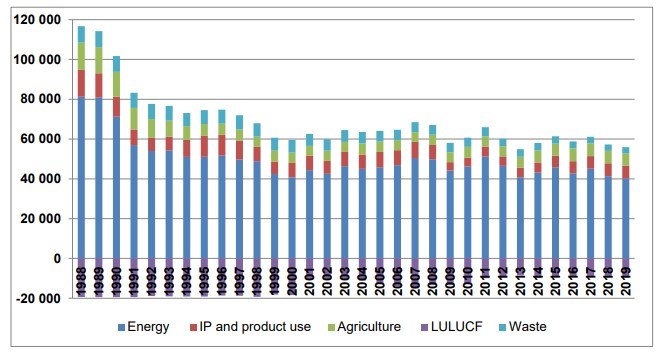
Perhaps the most interesting fact in this matrix is that the price of deindustrialization and carbon neutrality was already paid by the Bulgarian people in the 1990s, when the communist industry collapsed under market pressure and corrupt state governance. Even without closing its coal-fired power plants, Bulgaria is likely to meet the EC climate targets around the set deadline, therefore the transformation of the Maritsa Basin can be postponed for decades with the simple argument – in Bulgaria we deindustrialized and decarbonized long before it became fashionable in Brussels (as can be seen from the following two graphs from the National Greenhouse Gas Emissions Inventory Report) [10]:
Графика 1: Total GHG emissions in Gg CO2 eq. for 1988 – 2019
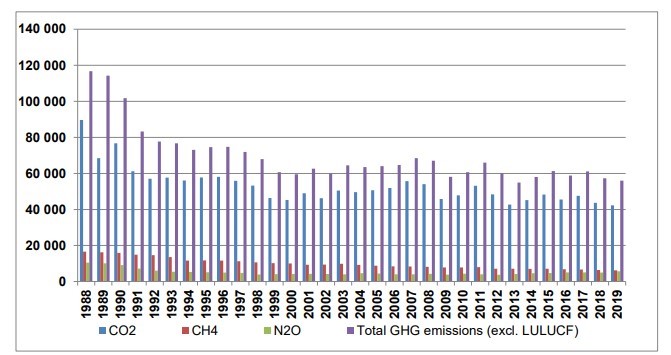
Figure 2: Total greenhouse gas emissions in CO2-eq. per IPCC sector 1988-2019
Such a diplomatic delay could buy time for both globalists and their opponents, during which the visions of both camps could become realistic proposals for voters - Romania and Central Europe developing sufficiently powerful energy systems that we can import the electricity we need from them while working in skyscrapers/receiving a basic income, or developing local energy resources through solutions unpopular with Brussels - capturing CO2 from coal-fired power plants, extracting gas using the hydraulic method, extracting methane hydrates from the Black Sea, and allowing the construction of wind farms in protected bird areas along the Northern Black Sea coast.
Without such a postponement, not only may Bulgarian electricity not survive the European political realignment, but there may not be enough European electricity around that we can import.
[1] https://www.bloombergtv.bg/a/15-shows/101976-nay-opasna-e-krizata-s-tsenata-na-energiyata-spored-krasen-stanchev?fbclid=IwAR2BOg1O5-lP9dLZ-K7uw0wzeTL4wU2_-T4N_kuuum9dTCU-r4nZM9_VQbc
[2] https://bnr.bg/post/101580922/ivan-kostov
[3] You can read more about the rearrangement in our other publications – HERE, HERE, HERE, HERE and HERE.
[4] https://www.gresham.ac.uk/lecture/transcript/download/from-the-european-coal-and-steel-community-to-the-common-market/
[5] https://www.researchgate.net/publication/262254109_The_Labour_Party's_Changing_Relationship_to_Europe_The_Expansion_of_European_Social_Policy
[6] https://www.nrel.gov/research/re-geo-elec-production.html
[7] https://www.mediapool.bg/parlamentat-nalozhi-bezsrochna-zabrana-za-shistoviya-gaz-news188568.html
[8] https://frognews.bg/novini/skandal-gerb-propusna-posledniia-vlak-dobiv-priroden-gaz-cherno-more.html
[9] http://natura2000.moew.government.bg/Home/Map
[10] http://eea.government.bg/bg/dokladi/unfccc