EKIP– Expert Club for Economics and Politics A Different Opinion
Author: B. K. Marcus, fee.org
Excited men in colorful rags gathered outside the best houses in the city and demanded to be let in. Some of them disguised themselves in pseudo-luxury clothes, as a mockery of their unwelcome hosts, while others blackened their faces or dressed like animals. If you tried to keep them outside, they would smash your windows, break down your door, and take their own food and drink. If you offered your hospitality to this crowd instead, your disguised guests would drink your best liquor and demand a cash tip for a loud song in front of your family.
Here is the authentic Christmas as it was celebrated for over a thousand years: from the last days of Rome, through late medieval London to 18th-century New York. No Santa Claus, no Christmas tree, no wreath or holly or mistletoe. And no more trace of the Holy Family than you see at any other season. “It was like a little Halloween today,” writes historian Stephen Nissenbaum in The Battle for Christmas, “when for one night children would venture into the houses of neighbors and even strangers, ask the elders for a gift and threaten them with punishment (mischief) if they failed to provide one.”
But unlike modern Halloween, traditional Christmas involved a real threat: the costumed forgivers were not little children, but young men from the lower classes; drunk and demanding more booze. How did this annual ritual of noise and blackmail turn into a silent night, a holy night?
This transformation is not a religious conversion from pagan revelry to pious observance, despite centuries of efforts by church authorities. The modern, family-oriented Christmas is younger than the Industrial Revolution, and like that revolution, it is partly a cause and partly a result of commercial capitalism.
The clash of Christmas cultures
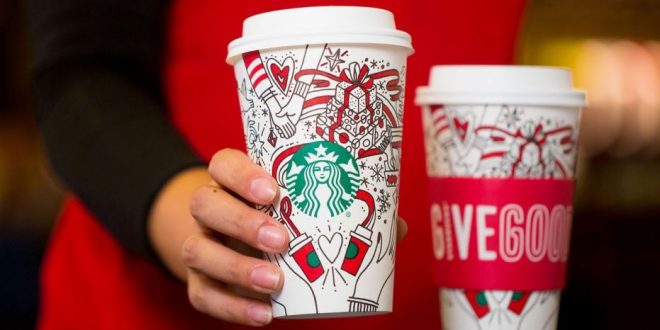
During the 2015 holiday season, I sat in my usual corner at my local Starbucks watching customers take their orders. Sometimes the paper cups had their names written in black marker; sometimes the barista had drawn a smiley face for her favorite regular. But then I started to see "Merry Christmas" written on the blank red background of the cup. I was surprised the first time I saw it. This seemingly Christian greeting had disappeared from national chains as America became more culturally diverse and American society became more sensitive to potential cultural "offenses." How, in the age of the cross-cultural greeting "Happy Holidays," did some emerge who received more specifically Christian greetings with their Yuletide cappuccinos?
Here's what was happening:
Customer: "I would like a large pumpkin spice latte."
Barista: "Can you tell me your name, sir?"
Customer: "Congratulations – H-E-S-T-I-T-A –Christmas."
Barista: "Thank you, Mr. Christmas! You owe $5.65."
This conversation turned out to be part of a national protest by Christian evangelicals led by self-described "social media personality" Joshua Feuerstein. The protest was against the lack of Christmas decorations on Starbucks' holiday cups. Every November, the famous coffee chain replaces its usual white and green cups with red, holiday-themed ones. In the past, these red cups have featured snowflakes, winter landscapes or other images related to the end of the year and the Christian Christmas. However, when the red cups appeared undecorated in 2015, Feuerstein posted on Facebook: "Starbucks removed Christmas from their cups because they hate Jesus."
"Instead of just boycotting," Feuerstein said in a video attached to his post, "why don't we start a movement?" He walked into his local Starbucks, ordered a cup of coffee, and told the barista it said "Merry Christmas." "Guess what, Starbucks — I tricked you into writing "Merry Christmas" on your cup!" The video has been viewed millions of times and shared by hundreds of thousands of sympathetic viewers.
Feuerstein's campaign is just another Christmas debate. It's become an unofficial tradition in America that as the night grows darker and the temperature drops, there must be a public exchange of wit in the ongoing culture war over the season and holiday greetings. The reasons are varied. The most important winter holidays have become either too secular or too distant or too politically correct or incorrect and always: too materialistic.
Implicitly present is the accusation that our holidays have been corrupted and the traditions that accompany them destroyed.
But older than most modern Christmas traditions is the struggle over how to celebrate at the end of December—or whether to celebrate at all. Feuerstein and his many followers seem to believe that the failure to explicitly observe Christmas is an attack on Christianity. But there was actually a period when some of the most fervent Christians in America opposed the celebration of Christmas.
The Traditional Enemies of Christmas in America
During the first two centuries of the settlement of New England, Nissenbaum writes, there was no official celebration of Christmas.
"The holiday was systematically suppressed by the Puritans during the colonial period... In fact, it was illegal to celebrate Christmas in Massachusetts between 1659 and 1681."
Why was there such hostility towards Christmas from devout Christians? According to the Puritans, Christmas was not actually a Christian holiday.
"It was not until the fourth century that the Church officially decided to celebrate Christmas on December 25. And this date was chosen not for religious reasons, but simply because it marked the approximate arrival of the winter solstice - an event that had been celebrated long before the spread of Christianity. The Puritans were right when they pointed out - and often pointed out - that Christmas was nothing more than a pagan holiday covered with a Christian veneer."
When you consider how Christmas was celebrated for over a millennium - with drunkenness, intimidation, and outright invasion of property - you can more easily understand the Puritan antipathy towards the holiday.
But over time, opponents of this carnival Christmas found that they could not suppress the holiday.
The Puritan attempt to ban Christmas was part of a broader campaign to impose a particular understanding of biblical religion in England and America, but it also had a more practical and secular purpose: to disperse the crowds that gathered in public to perpetuate their unusual version of the celebration.
In the early 19th century, another group of wealthy and powerful men attempted to turn the holiday into their own social agenda. Whether their efforts were ultimately successful had less to do with their specific goals than with how well their invented traditions served the emerging commercial culture of industrial capitalism.
The creation of tradition
In 1975, a small group of artists from Boston were looking for an alternative way to celebrate New Year's Eve, avoiding the usual emphasis on drunken revelry. Their solution was called "First Night" - a gathering of performers and audiences to welcome the New Year without alcohol. The event was a success, and nearby communities soon adapted it as well. By the end of the 20th century, the custom had spread to more than 250 North American cities. In 2006, First Night attracted more than one million visitors.
A century and a half earlier, wealthy New Yorkers pursued a similar mission: to offer an alternative to Christmas, which historian Susan G. Davis calls "a riotous celebration, racial violence, and cheerful outrage for neighbors and the public."
The combination of "the usual Christmas extravagance" and the seasonal unemployment that still occurred in an economy based largely on agriculture, Davis writes in Parade and Power, made the winter holidays noisy, drunken, and threatening in the eyes of respectable people of those times.
Some of the respectable decided to create a modern alternative to the traditional Christmas. The Knickerbockers (the name derived from a pseudonym used by the group's most famous member, Washington Irving) were "a small group of antiquarian, New York gentlemen" who, according to Nissenbaum, "felt they belonged to the patrician class whose power was under siege," especially during the annual winter riots.
Like the artists of First Night, the Knickerbockers believed that the solution was not to ban the undesirable activity, but to create some competition for it. Unlike First Night, the Knickerbockers' alternative Christmas was to be celebrated not in public but at home, not among crowds of strangers but with family.
This attempt to invent a new home-based Christmas celebration took several forms, but the one that captured the public imagination was the “family Christmas,” which focused on young children, gifts, and a new patron saint of giving: Saint Nicholas.
The general perception is that the American Santa Claus, now a global figure, is "a creature of ancient Dutch folklore," as Nissenbaum puts it, "who made his way to the New World with immigrants from Holland." However, Santa Claus is actually the creation of Anglo-Saxon Protestants, and more specifically, Clement Clarke Moore, author of "A Visit from St. Nicholas." Better known as "Twas the Night before Christmas," the poem was first published on December 23, 1823, and is, according to one New York historian, "perhaps the most famous poem ever written by an American."
The rediscovery of childhood
Santa Claus had predecessors, most notably the historical Saint Nicholas (known in Dutch as Sinterklaas), but before the 19th century, there was no widespread tradition in America of giving Christmas presents to children - partly because today's idea of childhood itself is quite late.
In pre-modern times, most children were treated as proto- or mini-adults—not yet fully formed, but not fundamentally different from adults. There is no consensus among historians about the attachment of parents to their offspring in an era of high infant mortality, but if we set aside this historically contentious issue, we can see that parental duty was usually understood as an obligation to prepare children for adult life as quickly as possible.
It was only in the early period of capitalism, with the rise of a large middle class, that the idea arose that children should be separated from the world of adults and work – as well as from that of drunken revelry. Western attitudes to child-rearing had previously focused on the concept of seeing children as little savages who needed to be civilized, while the modern bourgeoisie, influenced by the writings of John Locke and Jean-Jacques Rousseau, began to see children as fundamentally innocent, who needed to be protected, protected and nurtured.
The increase in general wealth and the privacy of individuals, resulting from the growing market economy, created a new divide in the minds of the middle class: a division between the corrupt sphere of public life and the protected comforts of the home. The new icon, Santa Claus, offered New Yorkers, Americans, and eventually the world, a figure who ritualized this newfound domesticity and gave birth to a new generation of parents who began to believe that their childhood memories of Christmas were part of a timeless tradition.
The price tag is removed.
What is not perceived as eternal is the commercial revolution that made all this possible. Memories of a simpler time before it are recent and not entirely accurate. With the spread of industry, urbanization, and immigration, the desire to return at least once a year to the world of pre-industrial craftsmanship, non-monetary exchange, and quiet family ties increased. Nissenbaum writes of the tension between the new economy and the new Christmas:
"Perhaps the very speed and intensity with which these essentially new rituals are presented as timeless traditions shows how powerful the need was to keep the connection between family life and the commercial economy hidden from view – to protect children (and adults) from unpleasant realizations about the world they were creating."
As merchants revived Saint Nick to promote their stores and mass-produced products, a counter-image of Santa's workshop became well-established: devoid of any machinery or modern forms of production, only hand tools and craftsmanship. The gifts exchanged on December 25 were mostly store-bought items; but without price tags and wrapped in paper, presented as existing outside the commercial-capitalist sphere.
Even the Christmas tree, another seemingly ancient folk tradition, was actually introduced in the 19th century. "It first entered American culture as a ritual strategy," Nissenbaum writes, "designed to deal with what was already there...a holiday characterized by a profane materialism that produced a generation of greedy, spoiled children." "The Christmas tree makes gift-giving less one-sided. The Christmas tree becomes a locus not only of surprise and gratitude but also of mutual generosity—the center of material exchange, "a tempered vessel in which economic relations simmer." The meaning of Christmas, according to the tree-centered ritual, is not material gain but gratitude and generosity.
The season of light
Current holiday rituals can be seen as a dance between capitalism and the ongoing cultural double standards in commerce. The world of economic production and exchange creates the need for our consciousness to escape the market - and the market itself responds to this demand.
If we need this annual hiatus to be more spiritual, less materialistic, to spend more time with loved ones, commercial culture will adapt, even with seemingly non-commercial solutions.
Celebrating the winter solstice as a holiday honoring the birth of one’s savior is a tradition that goes back thousands of years. But that has never been the way most people have celebrated the season, despite what our selective memories might suggest. The drunken revelry in the streets, now confined to New Year’s, is a much older tradition than the Christian Christmas that the church seeks to counter by celebrating the Nativity of Christ. Religious Christmas may be more peaceful, more delightful, and certainly more sublime, but it loses out to older and more popular forms of vulgar merriment.
When religious authorities tried and failed to control the noise and chaos of this festive season, modern capitalism succeeded in replacing the winter carnival with its own invented tradition: the Domoshor Christmas, established in the 19th century, uniting Christian and some pagan symbols, around two other historical innovations: the modern family and modern childhood.
For millennia, people have wanted to spend the darkest part of the year celebrating in a way that deviates from the usual rules and routines. In the agrarian age, this meant gluttonous indulgence in meat and alcohol. In the context of an ossified social hierarchy, it meant turning the ranks, the rich serving the poor. In a commercial age, where mothers and fathers head off to their separate workplaces while children are sent off to school, it meant spending the holiday together in leisure time, demonstrating a mutual generosity that is ritualized to disguise its capitalist origins.