EKIP– Expert Club for Economics and Politics A Different Opinion
Media appearances in August covered the presentation of our new study against the restriction of cash payments, healthcare, whether a new economic recession is coming, and the accuracy of drug tests used by the traffic police.
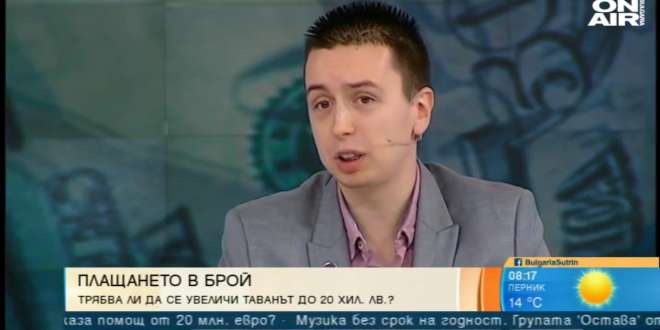
The latest economic analysis of the EKIP - "Regulations on Cash Payments and Their Effects" presents evidence that limiting cash transactions has no tangible effect on the size of the shadow economy. Based on the data and arguments presented in this analysis, the EKIP recommends the removal of the current cash payment ceiling of BGN 10,000 and the complete elimination of the "Law on Restricting Cash Payments".
The author of the report, Georgi Vuldzhev, told bTV that a number of countries in Western Europe – Austria, Germany, the Netherlands – do not have a ceiling on cash payments, but despite this, the size of the shadow economy is very small. Counterexamples are Greece, Italy and Spain, where restrictions on cash payments are very strict, but these countries suffer from a much larger shadow sector.
Stoyan Panchev told the Bulgarian National Radio that limiting cash payments does not contribute to the fight against the shadow economy, the financing of terrorism and criminal activity, and tax evasion. He pointed to the conclusion of the European Commission, which supports this thesis. The report was also covered by a number of online media outlets – “Economist” magazine, Duma newspaper, Mediapool, Blitz.bg, Fakti.bg, and others.
Georgi Vuldjev commented on the proposal of Social Minister Biser Petkov to implement a new methodology for determining poverty. According to him, the changes in the methodology are rather positive and will help to calculate the poverty line more accurately. This will also achieve some improvement in the efficiency of the state's social policies. Vuldjev also commented on the concerns about the looming recession and said that the state has no way to counteract it. "This is a global trend. We are heading towards a recession, especially in Europe, as a slowdown in industrial production and increasingly weaker exports are observed in a number of key countries," he added.
Health economist Arkadi Sharkov told Bulgaria ON AIR that the lack of information in the healthcare system is a major problem. Currently, every decision is being made not proactively, but reactively because of the upcoming elections. According to him, we pay the most for medicines - about 65-70%, especially for those that concern cardiovascular diseases. He added that the co-payment should be reduced, but not eliminated.
V. Capital gave an extensive presentation on the topic of CBD and drug tests, mentioning the research and studies conducted by Liberty420. The organization has long warned that the tests used by the country's traffic police are inaccurate and can lead to harm to innocent people.