EKIP– Expert Club for Economics and Politics A Different Opinion
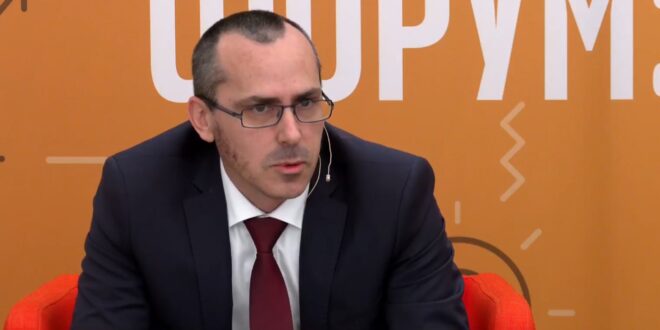
In the photo: Ivaylo Hristov, Deputy Minister of Finance
Last week, at the two-day banking and financial forum of Manager magazine, another propaganda “discussion” was held regarding the pros and cons of Bulgaria joining the eurozone. I call it propaganda because this is another “discussion” in which only ministers, employers and economists who unconditionally support the replacement of the lev with the euro are invited to participate. None of the participants in the discussion held a different position. In this sense, can we even call this a “discussion”, given that it was more like a monologue, but in several different voices?
The rhetoric of the discussion itself is shocking. Deputy Minister of Finance Ivaylo Hristov said in direct text that by joining the eurozone, Bulgaria would complete the work of Prince Boris I. In his view, the Christianization of Bulgaria was the first step towards the “Eurointegration” of the Bulgarian people. There is no need to comment on the absurdity of such comparisons. Especially considering Boris’s struggle to ensure maximum independence for the newly established Bulgarian Church, in order to prevent the loss of sovereignty. Something that Bulgaria will certainly suffer by giving up having its own currency.
There was no shortage of manipulations on the issue of sovereignty at the conference itself. Vasil Velev from the Bulgarian Association of Banks and Credit Institutions claims that “we are raising sovereignty to a higher level, which we do not have at the moment” by adopting the euro. This is an argument that the EKIP has repeatedly refuted in the past (for example, in more detail in this material ). The subtle manipulation consists in pointing out the fact that if we adopt the euro, the Bulgarian government will be able to take advantage of the ECB’s monetary policy instruments – it will now buy up our government debt and thus be able to practically finance it.
It is not clear how the average Bulgarian citizen will benefit from the fact that those in parliament can now afford to spend more. If we have learned anything from Bulgaria’s history over the past few decades, it is that more power and tools in the hands of our politicians are rarely a good thing for the people themselves. One only needs to look at the use of EU funds, which are mainly poured into politically connected businesses to the detriment of honest entrepreneurs.
What kind of sovereignty was Greece able to demonstrate when it fell into an extremely severe economic crisis, largely due to the structural weaknesses of the eurozone? Do you remember what happened during the political confrontation between it and other eurozone countries 6 years ago? Do you remember how the Greek people voted in a referendum on whether the government should accept the conditions set by the so-called "Troika" (ECB, EC and IMF) for providing a "rescue" package to Greece? Do you remember that they voted "no"? And do you remember what happened after that? So much for sovereignty in the eurozone.
But the absolute peak of nonsense in the eurozone discussion was reached when the question of holding a referendum on accession was raised. Of course, all participants unanimously said that there should be no referendum on the topic, but the argumentation of Deputy Finance Minister Ivaylo Hristov in particular is of particular interest here.
" Maybe some people think that we should ask the sovereign again, but this is not a working approach, because if we ask about something that has already been ratified by parliament, the whole scheme will be contrary to the law. We cannot ask about everything with referendums."
All this is a lie. Holding a referendum on whether Bulgaria should join the eurozone in 2024 (as is currently being considered) does not contradict any law. We at EKIP have consulted with lawyers on this very issue more than once. Yes, formally, upon adopting the EU treaties after accession, Bulgaria accepts to one day introduce the euro. But there is no specific deadline by which it must do so. If it decides, a country can postpone adopting the euro as long as it wants. This is precisely what countries such as the Czech Republic, Poland and Sweden have been doing for nearly 20 years.
It is in two of the most advanced democracies in Europe – Denmark and Sweden – that referendums were held regarding the accession of the two countries to the eurozone. In 2000 in Denmark and in 2003 in Sweden. In both countries, the citizens of the respective countries rejected accession and the political class listened to their decision. The latter must have been a shock for Bulgarian politicians and especially Deputy Minister Ivaylo Hristov.
Moreover, Denmark is even negotiating with the institutions of the European Union for a permanent exemption from the requirement to ever join the eurozone. And it is getting it. History clearly reveals the lies that politicians and the authorities in our country have been circulating for years regarding the desire of Bulgarian citizens to hold a referendum on the euro. Such a desire certainly exists – the sociology that we at EKIP published at the beginning of 2020 is eloquent. It showed that 54% of Bulgarians want a referendum.
Moreover, according to the most recent survey by the Trend agency this year, 58% of the population is against changing the currency. This is not surprising, especially given the increasingly opaque way in which the entire process towards adopting the euro is being conducted. Doesn't it strike you how experts with a different position than that of the authorities are never invited to such discussions? Why are experts who believe that adopting the euro is a mistake never invited to such forums? I'm not just talking about us from EKIP - why, for example, has Grigor Sariyski, who is a respected economist from the Bulgarian Academy of Sciences, never been invited?
The quality of public discussion on the eurozone has deteriorated significantly over the past two years. In the past two years, since the GERB government reneged on its promise that the euro would be adopted only after a public consensus, there has been virtually no public and media debate on the topic. Joining the eurozone is presented as a fait accompli, skeptical voices are silenced, and the principles of democracy are trampled on. If citizens do not stand up with clear actions, the political elite is on the verge of making one of the biggest mistakes in Bulgaria’s history.