EKIP– Expert Club for Economics and Politics A Different Opinion
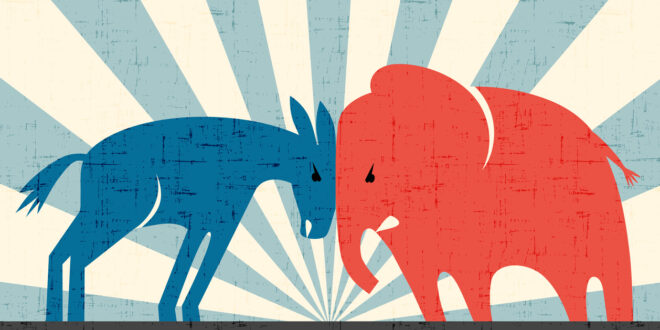
Twenty people walk into a bar. Five Bulgarians, five Americans, five French, and five British. In each group, there is one person born in 1880, 1920, 1950, 1980, and 2000. All of them identify politically as “right-wing” and “conservative.” The views of none of them have anything in common with the views of any of the others.
The experiment would sound the same if they were defined politically as “left” and “liberal.” And because of the new fashion for these terms to go in pairs, i.e. right-conservative and left-liberal, the labeling becomes even more meaningless.
In Bulgarian politics, and not only, at a certain period of time, politicians or parties appear who claim that there is no left and no right. A violent reaction follows – from “there is no politics without ideology”, to “everyone who is not explicitly right-wing is left-wing”, to the most simple “fraudsters”.
Actually, the problem with politicians who claim that there is no left and right is something else. They are not extreme enough. Most of them say that there is no left and no right, but only in the Bulgarian context or that left and right are meaningless at this particular historical moment.
In reality, whether there is a left or a right does not matter, because these are completely abstract terms that only make sense to the extent that they evoke some analogy in the mind of the person who hears the words in question. For example, the characters at the beginning of the article define themselves as right-wing (or left-wing, or whatever they want) because when they hear this word, they imagine some ideological version of themselves or a specific set of beliefs that coincides with theirs. However, the more pairs of ears and brains, the more definitions of left and right.
All of this makes these labels not just rigid, but downright harmful. They oversimplify complex issues and issues, while voters, commentators, and ideologues argue for years about the “authentic right.” There is, of course, no such thing, because there is no central unit that can define what the authentic right actually is. In other words, the purely semantic problem of left and right becomes a political problem.
The problem of the political center
The problem of the left-right, conservative-liberal, and all the rest of it, can be explained in a simple way: try to define what the political center is. Not something close to the political center or the contextual center, but a true political center – one that at best works universally regardless of time period or at worst takes time period into account but still gives a concrete answer to what it is.
Save yourself time: there is no such thing, for many reasons. First of all, the political center should be such both in relation to specific issues, for example, whether to raise taxes, and in relation to parties – for example, DPS versus GERB. Of course, this is impossible. Even if you take one of the popular political compass tests, basic arithmetic shows that if each answer pulls you one square forward, up, left or down, then with a different set of answers you may end up in the same place. Another problem is that in this type of test, the center is determined by the interviewer – i.e. what pulls you left or right depends on the person asking the questions and their interpretation of what is left and what is right.
The political center, like everything else in political theory, is an abstraction. This was not a problem in the past, because politics was the preserve of a small part of society, and political theory was the preserve of an even smaller part of the intelligentsia, for whom this abstraction was not a problem. Today, when politics is everywhere and participation in public debate is considered not only a value but even an obligation, terms like “left,” “right,” and “center” are so widely used that the main result is arguments of misunderstanding between the parties rather than a conversation on the merits.
The problem of specific cases
The debates about left, right, center, conservative, liberal, etc. are primarily the work of commentators and party supporters. They are rarely the problems of the politicians themselves, because anyone who has seen the program of the National Assembly or the Sofia Municipal Council, for example, knows that the vast majority of politics is the solution of specific cases, not an ideological competition. It is these specific cases that best show how absurd it is to constantly talk about left and right, as if any of these questions have a specific answer.
Let's take the example of taxes. The textbook definition says that the right is for flat and low taxation. The left is for progressive and high. But what if we have two options - a flat tax of 22% or a progressive tax with a top rate of 22%, in which all citizens would pay either the same or lower taxes than in the flat version? This is a completely possible scenario that causes many people to experience cognitive dissonance because it does not connect with their own simplistic understanding of politics.
Another example, at a local level, would be the incinerator project in Sofia. Is it left or right to be against such a project? Again, the answer is neither. Labeling is left to those who do not make decisions.
The problem of analogies
John Locke, Karl Marx, and Edmund Burke never imagined that politics would ever deal with such things. Their theories were much more general, at much different times and at moments in history when forms of government, not decisions in a particular government, were on the agenda. And since none of them wrote specifically about either the maximum social security income or the incinerator in Sofia, what political scientists do is take other cases they describe and make theoretical analogies.
This is another simplification of the debate – if Marx thought this way about that, he would probably think this way about that. Such thinking is wrong and puts everyone’s thinking into a rut that is entirely imposed from the outside. There is no reason why it is impossible to think abortion is immoral and want high taxes, or to be against the Soviet Army Monument and at the same time consider Crimea Russian. It may be unlikely, but it is not impossible.
Attributing political views and labeling them through analogies is wrong and harmful not only at the level of political debate, but also at the level of human relationships. If you identify as right-wing, it is very likely that you will automatically feel more or less dislike for a person who identifies as left-wing, without knowing what they actually believe. This is the power of analogies - your brain tells you what that person should be like, regardless of whether they really are or not.
The problem of the centralized unit
After all, why is there no left and no right? Because there is no centralized unit that can define what is left or right and judge whether someone is left, right, centrist, etc. In other words, if you can ask the medical union if someone is a doctor, you cannot ask any union or party to judge whether someone is right or not. In some cases, it would be difficult to judge whether someone is right or left even on a specific case, let alone an entire person with hundreds of views and opinions.
Here it can be argued that there are parties that define what is right and what is not, but they suffer from the problem at the beginning of the article – that positions change over the years. The European right in the West, for example, is mainly embodied by Christian democratic parties, but today they propose measures for a stronger state in every sense of the word – from high taxes against high social protection to gay marriage and active protection against discrimination.
Thirty years ago, such positions were absent even in parties that defined themselves as left-wing. The same is true in the United States, where the Republican and Democratic Parties fundamentally change their positions and programs every one or two decades.
In Bulgaria it is even more complicated. One of the most common definitions in the country is communist, which is currently a label emptied of content. The plus is that there was once a central unit that decided whether someone was a communist or not (the Bulgarian Communist Party), but the minus is that it is not clear what exactly this means. For example, whether someone is an ideological communist or is a former or current member of the Bulgarian Communist Party/BSP, or whether someone is simply a former civil servant during the totalitarian regime.
Here, personal preferences inevitably come into play– for example, Hristo Ivanov may turn out to be a communist without having been a member of the BSP or the BCP (but by virtue of the fact that his mother was), and the former BCP member Boyko Borisov, who is also an employee and friend of the sole dictator of the party regime, Todor Zhivkov, is perceived to this day by hundreds of thousands of Bulgarians as a fighter against the communists. In order for someone to be defined as a communist or a fighter against communism, all it takes is a small, noisy minority to introduce this label into the debate.
The issue of the “authentic right” is even more complex and absurd, to the point where “democrat” is perceived as an ideological affiliation. This is a rabbit hole whose depth the present material does not wish to examine.
In other words, if you hold the same views your whole life, you will probably get every possible label. Even if you stand on one place in terms of beliefs, you are very likely to end up being an extremist. Not because you really are, but because these labels have no weight as permanent meaning, but they do have weight in the court of public opinion.
Does this mean that everyone is the same?
The conclusion from all this is not that everyone is the same and that there is no difference between politicians, parties, or even voters. The conclusion is that labels lead to simplifications that are best avoided. If every 20 years someone has to try to define “What is conservatism today” and comes to the conclusion that it has little in common with the definition of 20, 30, or 50 years ago, it would be logical to use different words for different phenomena.
Of course, this is awkward. Most people use left, right, conservative, and liberal in context, but often that context is not very clear. Things get even more complicated if you throw in terms like populism, fascism, etc., which can mean anything. And if something can mean anything, it probably means nothing.
People and parties are indeed different, and therein lies the problem – it would not be fair to describe in five words complex individuals, organizations, or processes that weave together dozens or hundreds of separate issues and cases. Capturing them all in one or two words is harmful and foolish.