EKIP– Expert Club for Economics and Politics A Different Opinion
On October 29, 1940, from the rostrum of the XXV Ordinary National Assembly, the deputy from the government majority, Gavril Lenkov, declared: “ if it is necessary to enrage the speculators in Bulgaria, we are ready to legalize this sanction.” The context of his threat is important. After the start of World War II in September 1939 until March 1941, Bulgaria remained neutral, but nevertheless difficulties arose in supplying the population. Without much success, the state tried to prevent price increases and deficits. Lenkov’s words were uttered during the discussion of a Bill to amend and supplement the law on ensuring supply and regulating prices, which was aimed at improving the mechanisms for controlling the market.
The threat to drive all speculators mad is not an occasional outburst of sadism, but a symptom of the profound social changes brought about by the Second World War. This publication focuses on their causes and manifestations in the attitude towards private property, towards market mechanisms, towards rules and sanctions for non-compliance with them. Finally, based on the past, an attempt is made to understand contemporary trends and processes.
The command economy
Even before the start of World War II, a model of a command economy was being built in Bulgaria. Its most important feature, according to the political and academic authorities of the time, is that it replaces the free market, typical of the so-called "liberal economy". In theory, prices, production and distribution are placed under the control of the state, with the efforts of the authorities class contradictions are overcome, the supposedly unlimited greed that the free market stimulates is limited. During the war, retail prices, rents, the price of timber, supplies of raw materials, production, etc. are placed under control.
Already in the first year of the Second World War, it became clear that the market was not tamed by administrative regulations, that price fixing was formal, and the so-called black market was widespread. In response, the state was constantly expanding its powers. The National Assembly eagerly adopted normative documents that gave the Council of Ministers and individual ministries the right to order the chaotic world of the market economy. Deputies and other responsible political figures found an easy explanation for the failures. The National Assembly openly spoke about the lack of good faith, civil discipline and awareness of social responsibility among Bulgarians. Because of this, they did not comply with the laws on price regulation, and from this came the need to introduce an “ economic dictatorship” in the country. Probably the essence of the dictatorship was most clearly formulated by the MP Petar Koseivanov. In November 1941, he declared: “ It is absolutely necessary today for the citizen, the individual owner, to understand that he is nothing more than a proxy of the state, of the nation.”
The reality of the economic dictatorship reveals a bleak picture, completely different from the slogans and inflated phrases in parliament. People often hear insults and swearing from the officials responsible for food supply. Rudeness is combined with a lack of elementary competence, foresight and common sense. Price changes lead to a series of administrative blunders and poor coordination between state structures, which further increase deficits and discontent.
The obvious shortcomings of state intervention in pricing and distribution of products do not lead to criticism and readiness for its possible limitation after the end of the war. Politicians “sell” the idea of more state to the population with a simple but strong argument. Their explanation is that they do everything in the name of the common good, social justice and equality. Again P. Koseivanov is eloquent: “ Today, in the managed economy, it does not matter whether someone has huge wealth in real estate or money in the bank. Both the one who survives on wages and the one who is rich, in the managed economy, have the right to eat equally, to live equally. This is the equalization in satisfying needs.”
Private property
The security of private property in Bulgaria is guaranteed by the Tarnovo Constitution, but it has never been particularly respected by the authorities. In the conditions of the command economy of World War II, restrictions on private business initiative and private property in general noticeably increased. The beginning of the attack against them came from the fight against speculation.
The legal right of the executive branch to set prices and consumption dates back to May 1940. Attempts to limit price increases and regulate consumption by administrative means led to merchants hiding their stock of goods, selling at inflated prices, producers of scarce fabrics selling without permission from the authorities, etc. Already in the summer of the same year, a shortage of salt, oil, coal, firewood, building materials, etc. was noted on the "official" market. All scarce goods were found at prices higher than those fixed by the state. In the eyes of the public, the immediate culprits for speculation were private merchants. Therefore, deputies from the parliamentary majority expressed their readiness to socialize certain products, and their distribution to be taken away from private merchants and given to cooperatives. Ideas for limiting private property became radicalized during the Second World War. At a high state level, the advantages of cooperative land cultivation were discussed: an idea that was implemented after the end of the war by the communists with the forced collectivization and the de facto abolition of private land ownership. The property of speculators was confiscated in favor of the state, and shortly before the coup of September 9, 1944, one of the country's large hydroelectric power plants was nationalized.
The market
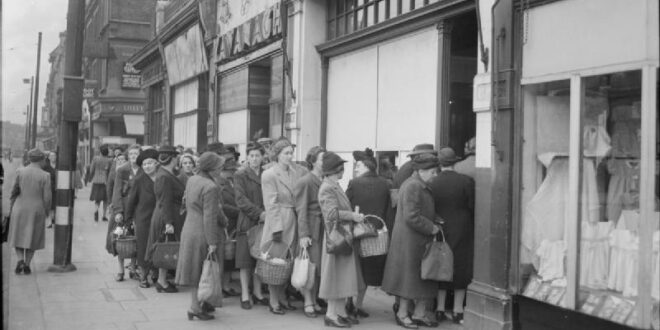
Government regulations influence the market, but they do not override its laws. After the official regulation of the price of a product, the price on the unofficial market becomes approximately twice as high. With the introduction of distribution cards (also known as coupons), which limit consumption, the corresponding product disappears from the market. As one MP noted in 1940, instead of executive orders “ directing the prices of objects, prices were directed by ministerial orders”, i.e. the prices that the government sets ultimately reflect market demand and supply, and not someone’s good intentions and motives.
When the government fails to meet market prices, the market corrects the government. In 1940, the official price of butter was increased from 55 to 70 leva per kilogram. In some regions of the country, the local population is too poor to pay the new price and refrains from purchases. Producers and traders are threatened with being left without any income and are forced to offer their butter at the old lower price. There have been cases where government authorities have introduced mandatory minimum prices supposedly in favor of producers. Data has been presented in parliament that dairy producers are demanding the abolition of minimum prices for cheese and yellow cheese “ so that they can sell their goods, because a lot of cheese and yellow cheese has spoiled.”
Crime
The changes in the socio-economic sphere caused by the war also have an impact on the specifics of the commission of crimes.
With the rationing of prices, reports of document fraud became more frequent. Invoices were issued en masse, in which the selling price of the goods was lower than the one paid. Thefts of goods that had become scarce due to the war, their prices had increased, and their consumption was limited by the state became more frequent. The former Minister of Justice Vasil Mitakov wrote in his diary that in the winter of 1943, passersby on the streets of nighttime Sofia were deprived of coats or other outerwear, as the thieves addressed their victims with the invitation "Please, wardrobe." Homes were attacked with the sole purpose of stealing the clothes of their inhabitants. Criminal sanctions for speculation became increasingly severe, and absurd situations were reached. Journalist Panayot Chinkov tells of a Jew who was sentenced to life in prison for illegally selling socks. The convict expressed the opinion that " if he had committed murder, some mitigating circumstance would probably have been found and he would have been sentenced to only 12 and a half years in prison "...
Pessimistic conclusion
War, speculation, deficits, crime and the inability of the authorities to fulfill their promises are causing a hardening of morals. Its hallmark is the words of Gavril Lenkov, quoted at the beginning, but the manifestations are not limited to bloodthirsty threats. The penalties for various economic crimes are becoming more severe. Obviously, with the rise in the price of goods, the price of human life is decreasing.
Perhaps a more important consequence of the command economy model was noted by Asen Khristoforov (1910-1970). In an almost prophetic text from 1947, he noted that inequality and insecurity push citizens towards more and more government intervention in the economy. Thus began an evolution of the free market economy, which passed through the command economy and ended with socialism, i.e. with the complete liquidation of economic freedom. The evolutionary change was not driven by the economic advantages and/or disadvantages of one of the two political-economic systems, but by the tempting promise of eliminating inequality and insecurity.
It is not clear whether the events that contemporary Bulgaria is experiencing can catalyze an evolutionary process similar to the one described by Khristoforov. Such a scenario is not excluded because it has already been tested once, and despite the risks of historical analogies, the past is a good guide for the future.
You can learn more about the consequences of a war, even on the lives of people in neutral countries, in this video.