EKIP– Expert Club for Economics and Politics A Different Opinion
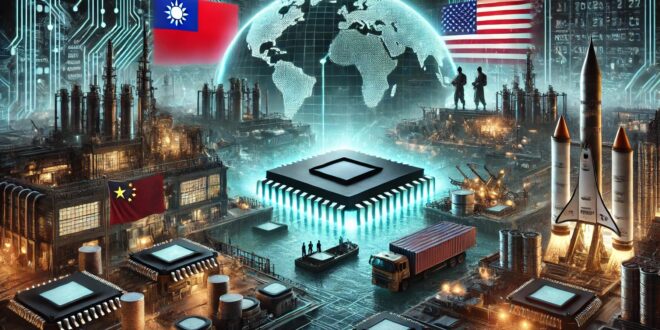
Once upon a time, in mysterious California laboratories in the mid-20th century, microchips were born as small, fragile dreams, barely whispering promises of a future in which machines would think faster than their creators. Engineers like Jack Kilby and Robert Noyce were the alchemists of this new world, turning sand into sheets of silicon on which they engraved the possible and the impossible. With each passing year, microchips became smaller, more powerful, and more integral to the fabric of modern life, becoming the foundation of a new era. Recently, however, the world has found itself entangled in a complex web of technological dependence and geopolitical conflict. Microchips - the silicon brains of modern devices - are at the center of it all. These tiny processors, once considered the pinnacle of human genius, have become both the lifeblood of global infrastructure and a factor that can decide and disrupt the international balance of power. As HAL 9000 in the movie "2001: A Space Odyssey" creepyly and in a deadpan tone noted: "I'm sorry, Dave, I'm afraid I can't do that." In an age where microchips run our communications, industry, and even military operations, this line rings a warning bell about our overreliance on technology.
Taiwan, a seemingly inconspicuous island, has become a key hub for global microchip production. Its dominance, producing over 90 percent of the world's most advanced semiconductors, makes it indispensable to the tech ecosystem. At the same time, it has also become a target, a flashpoint in rising tensions between superpowers.
The United States, concerned about China’s ambitions and its own technological vulnerabilities, has imposed strict export restrictions to limit Beijing’s access to advanced chip-making technology. The move, while aimed at preserving a strategic advantage, has further strained already fragile relations between the two nations. China’s relentless drive for technological self-reliance has led to massive investments in the semiconductor industry. Despite these efforts, however, the country remains heavily dependent on foreign technology for its cutting-edge microchips. This dependence, exacerbated by U.S. sanctions, reflects a broader trend toward technological disintegration, in which the world is increasingly realigned along lines of access to critical resources. Ray Dalio warns that such economic disintegration often precedes periods of major conflict between great powers, reminiscent of historical cycles in which technological and economic shocks trigger geopolitical shifts.
Meanwhile, Russia, while not a dominant player in microchip production, is recognizing the strategic value of semiconductors in modern warfare and intelligence. The global race for technological supremacy provides Moscow with opportunities to exploit the fissures between other powers, allying with China to counter Western influence. This alliance echoes Neil Ferguson’s observation that fragile alliances formed in the shadow of technological rivalry can lead to unintended consequences similar to those that preceded World War I. Amid this global chaos, Africa remains a largely untapped reservoir of critical minerals needed for microchip production. Countries like Kenya, Nigeria, and Rwanda have raw materials and an increasingly technologically literate youth that could, with strategic investment, transform the continent into a significant player in the semiconductor ecosystem. However, Peter Turchin’s theories of societal collapse highlight the dangers of such a development. As wealth and resources accumulate, inequality and internal conflicts often grow, threatening progress before it fully materializes.
The Netherlands, as part of the European Union, also plays a crucial role in the global microchip supply chain through its company ASML, which produces the world's only deep ultraviolet (EUV) lithography machines. These machines are essential for the production of the most advanced semiconductors. Without them, the production of nanoscale chips would be impossible. Under pressure from the US, restrictions were imposed on the export of these technologies to China, further increasing geopolitical tensions and forming a new front in the technological race. This underlines how fragile and central Europe's role is in this global battle for technological supremacy.
In this context, the European Union is trying to keep up with the latest innovation trends, the problem is that the fight is only on paper. Despite its ambitious verbal initiatives, it is lagging behind in the development of cutting-edge technologies, such as artificial intelligence and semiconductor manufacturing. Political disagreements between member states and slow bureaucratic processes contribute to the lack of a unified and effective strategy for technological progress. This political impotence not only weakens Europe's competitiveness on the global stage, but also makes it vulnerable in an era in which technology determines the future of world power.
Moore’s Law has long driven exponential technological growth. It states that the number of transistors on a microchip doubles roughly every two years. However, as physical limits are approached, the pace of development slows. The semiconductor industry now faces the challenge of sustaining innovation through architectural improvements and new materials, rather than simply shrinking transistor sizes. This in turn has profound implications for global power dynamics, as nations race not only to produce chips but also to redefine the boundaries of computing itself. Chris Miller highlights this transition as a critical point at which leadership in next-generation technologies will determine economic and military superiority.
Musk’s projects in artificial intelligence and neural interfaces highlight the dual nature of innovation. While technological advances have fueled economic growth, Musk has repeatedly warned of the existential risks that artificial intelligence poses. His concerns resonate deeply in the microchip industry, where processors capable of training complex AI models are becoming instruments of both progress and potential repression. This duality is reminiscent of Aldous Huxley’s dystopian vision in Brave New World, where society’s reliance on technology for stability masks deeper currents of control and manipulation. The convergence of these factors paints a dystopian picture reminiscent of the warnings of visionary science fiction writers. Isaac Asimov said, “The saddest aspect of life right now is that science is accumulating knowledge faster than society is accumulating wisdom.” This summarizes the current situation – Planet Earth, where technological capabilities are outpacing the ethical and social frameworks necessary for their responsible management.
As the world stands on the threshold of a new era defined by technological dominance and geopolitical fragmentation, the lessons of dystopian novels serve as both warnings and guides. The microchip industry, once a symbol of human progress, now stands as a harbinger of potential collapse. The decisions made today in boardrooms, laboratories, and parliaments will shape the contours of the future, determining whether humanity soars to new heights or descends into a fragmented, silicon-powered dystopia.