 EKIP– Expert Club for Economics and Politics A Different Opinion
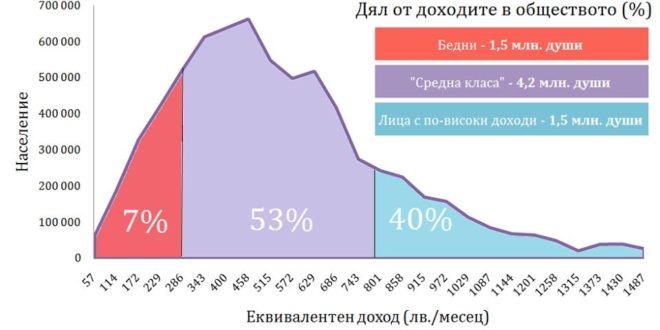
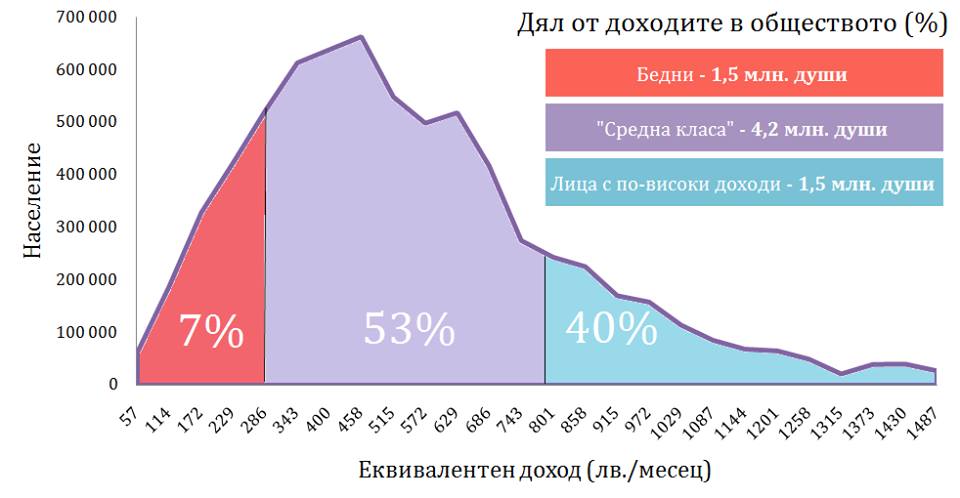 В началото на седмицата Институтът за пазарна икономика (ИПИ) представи пред публика своето детайлно проучване на подоходното разделение в България – „Разрези на бедността - образованието и заетостта като фактори за кривата на доходите и щастието в България“. Изследването е продължение на дълготраен интерес, който ИПИ има в областта – дори самият аз писах по темата „средна класа“, когато прекарах половин година като икономист в Института. Още тогава ми стана ясно (по трудния начин), че коментирането на темата публично ще е изключително сложно поради две причини: нуждата да се обясняват статистическите особености на данните и голямата емоционална натовареност на темата.
Too complicated to comment on sensibly
Both issues are being exposed in attacking works by our friends on the left. A prime example is Alexander Simov’s blog post – “ Hey, minimum wage proletarian, have you enrolled in the middle class!?” After accusing the economists from the Institute of Economics of using illegal substances, Simov proceeds to the theses of his criticism. The first thing that always strikes people who look at income distribution graphs without reading or understanding the data behind them is that the “middle class” is too big. In the case of this study – 4.2 million people. And what’s more, the lowest and most extreme of people with middle incomes starts at 286 leva, which Simov points out is a number less than the minimum wage, which is currently 420 leva.
Unfortunately, Mr. Simov has not used an iota of the efforts that the authors of the study have invested in getting acquainted with it and presenting a meaningful criticism. These 286 leva are not a malicious invention of the IME, but the method adopted by Eurostat for marking the poverty line - it is 60% of the median equivalent disposable income in a household. In other words, the money that a family member in a household has after deducting various transfers. Now, hardly anyone would argue that the median equivalent income (i.e. the one where half of the people have more and the other half have less) for the country is low, but this has nothing to do with the methodology of the study - rather with 45 years of planned economy, socialism, belated privatization, hyperinflation since 1997 and other factors that have no connection with the organization of which Simov is a member.
The moment with the methodology is important and this is where Simov could have criticized the authors if he had done his homework or aimed to give constructive comments. The approach of the sections and the comparison, which is made in the study, is based on the idea that we are looking for the class with average incomes for Bulgaria. We are not talking about someone's idea of what a member of the middle class should look like (in terms of consumption) - but actually how much income the "people in the middle" have in our country. The first would be another study, potentially with interesting results, but it does not appear as a topic in the post-comment of the journalist from "Duma".
In the second half of his critique, Simov makes an interesting assumption - that the IME is trying to "convince the poor that they are rich". Taken as a whole, Bulgarians are certainly richer, if we look at data such as GDP per capita and take into account factors such as technological development and the diversity of products we have access to now compared to the past. But this does not apply equally to everyone, especially, as the authors of the study themselves show - to pensioners. Pensioners are among the poorest members of Bulgarian society thanks to a fraudulent and bankrupt pension system, emptied of funds by Mr. Simov's colleagues (bosses).
Criticism can be for other reasons
If we are looking for something to pick a fight with the Institute about this study, let's focus on the connection they draw between higher education and prosperity. It is true that, as the data indicate , the poverty rate among university graduates is below 5 percent, and their equivalent income is about 1,000 leva. In contrast to the data, the conclusion put forward as a headline in Dnevnik that lack of education is a sentence to poverty, supplemented by the thesis that "higher education guarantees that a person will not fall into poverty in Bulgaria," is not so solid.
This educational romanticism is extensively criticized in Charles Murray’s book, True Education. In short, the causal link between education and prosperity, which is strongly implied in the study, is at best unproven and at worst nonexistent. In fact, the conditions that are associated with prosperity and with obtaining a higher education are quite close – belonging to a certain social class, having a suitable family environment, intellectual abilities, etc. In other words, both higher education and good income are much more likely to be consequences, not causally related phenomena.
The worrying thing is that by concluding that higher education makes us richer as a society, we will bring it to the European policy in the field – which aims to mechanically increase the number of people passing through universities by 2020. The effect of this will mainly be an inflation of the signaling value that diplomas have – not an explosion of unprecedented prosperity. However, thanks to the efforts of the IME, we have the opportunity for the first time to talk about the real income situation of Bulgarians, as shown by the NSI statistics – it is simply that the Bulgarian left does not have the preparation to understand, make sense of and interpret the data, which is why the level of criticism is simply a reheating of the classic red poverty.






Whether the authors of "Sections of Poverty" or you, Mr. Panchev, use prohibited substances is really not a socially significant problem. However, poverty is such a thing and you should really be happy that by coincidence you touch it not only with your eyes, but also with your heads and stomachs.
According to the methodology used, the middle class in Bulgaria starts from where disposable income per day amounts to $5.25. Since October 2015, the World Bank has set the poverty line at $1.90 per day, so left-wing populism will really be banging its head against the wall if it sits down to argue where exactly the poverty line in Bulgaria is.
But there are also a few big "buts". Right-wing economic extremism, briefly summarized in the term libertarianism, never deals with the process of tearing apart the social fabric over time. That is why the above text also makes references to the period before '89, which are inappropriate in view of the significantly increased inequality since then. It is not yet noted that the process increases its speed, the scissors are opening up and at the end two strata remain: a small group that seeks and finds rent, that is, income from property or power; and a large group that is exploited and secures its income through labor.
Perhaps here right-wing economic theory, for its part, will point out that the term "exploitation" is inappropriate, since everyone is free to make their own choices in the labor market and regarding their lifestyle. This would be true if the labor market were not among the most obvious examples of market failure. In fact, there is no functioning market on the globe that even comes close to the definition of perfection. And since the labor market in Bulgaria is highly deformed by numerous factors, those offering labor are forced to accept the extremely unfavorable conditions that those seeking it provide them.
And here come the last two "buts". The first is that right-wing economic theory fails in the part where it connects quality education with high incomes. The nature of economic activity is such that jobs are constantly being closed and new ones are being opened. After the crisis, thousands of qualified specialists were forced to change their jobs. They ended up in industries for which they were not qualified, and this accordingly eroded their incomes.
Separately, the last few generations have been confronted with the conclusion that higher education does not guarantee either a salary or even a job. Therefore, the relationship between high qualifications and high incomes is weaker than the relationship between something else (say what?) and high incomes. There are hundreds of examples of young professionals who, upon leaving university or college, are forced to start their careers either under significantly worse conditions for the industry, or in a job outside their specialty. In the graph shown in the study, a large share of people falling into the median income sector probably have higher education. Until these individuals are explained why the distribution of income is so uneven (even unfair), they will have the legitimate right to protest, regardless of whether they live on $5 a day or $15. Libertarianism has no answer to this serious discrepancy between qualifications and income distribution.
Finally, in conclusion, I will say that there is no strong evidence that pursuing far-right economic policies leads to greater economic growth, compared to a policy of more state. It is true that the state is a failure just as much as the free market, but in the end the only question remains which model is more humane and which model produces more happy people. What I know for sure is that the current world order is not working and is therefore unsustainable.
A study by the Institute for Social and Trade Union Research of the CITUB was recently released - 2,243 leva per month is needed for a normal life for a four-member household
80.5 percent of households in the country live with a total income per person below the necessary means of subsistence.
The data show that 32.3 percent of households have a total income per person below the subsistence level for poor households - 295.41 leva, or about 2.5 million Bulgarians.
With a total household income per person of 295 to 561 leva, 48.2 percent of Bulgarians, or over 3.5 million people, live. Households with a total income above the subsistence level (560.81 leva) live 19.5 percent, or about 1.4 million people.
I have long written that this is a violation of the Constitution and GENOCIDE - https://www.facebook.com/atanas.shalapatov/posts/1562875143990714
, and the Supreme Court confirmed it for healthcare
A separate topic is a study prepared by the IMF based on data from 159 developed and developing economies for the period 1980-2012, which establishes a direct relationship between how income redistribution affects national growth.
According to IMF economists, when the income share of the richest 20% of the population of these countries increases by one percentage point, GDP growth increases by only 0.08 percentage points over the next five years, suggesting that "the benefit from this is not large."
At the same time, a one percentage point increase in the income of the poorest 20% in these economies leads to a 0.38 percent increase in growth, the report shows.
TO REPEAT - a one percentage point increase in the income of the poorest 20% in these economies leads to a 0.38 percent increase in growth
It is about fair distribution and Prof. Dr. Ivan Angelov said it clearly - ''The difference in GDP per capita (i.e. in social labor productivity) and in average salary per employed person with those in the EU is huge (45% and 22-23%, respectively) and contradicts all economic logic and elementary justice.
HOW MUCH SHOULD THE MINIMUM AND AVERAGE SALARY BE????
The competitiveness of our economy depends not so much on high wages, but on high energy, material, transport and other costs per unit of production, on poor management at the national and company level, on theft and corruption -
According to Eurostat data for 2010, our country consumes 853,774 kg. oil equivalent per 1,000 euros of GDP. For comparison - the energy intensity of the Danish economy, for example, is 104.05 kg. oil equivalent per unit of GDP, Ireland (112,367 kg.) and Great Britain (115,469 kg.) - of course, this is not an accurate criterion because the financial "industry" is included in GDP, but it gives a rough idea.
IN BRIEF MINIMUM. SALARY IN THE EU SHOULD BE ABOVE 560 BGN. and progressive family taxation - the average level of corporate tax in the EU is 2.5 times higher than ours, and the personal income tax is 4 times higher, which means that the EU is full of communists, oligophrenic people
Things are not going well because of usury, etc. deregulation of financial capitalism