EKIP– Expert Club for Economics and Politics A Different Opinion

The Council of Ministers has adopted the new budget of the National Health Insurance Fund, the next step is for it to be adopted by the Parliament. Here is what we know so far:
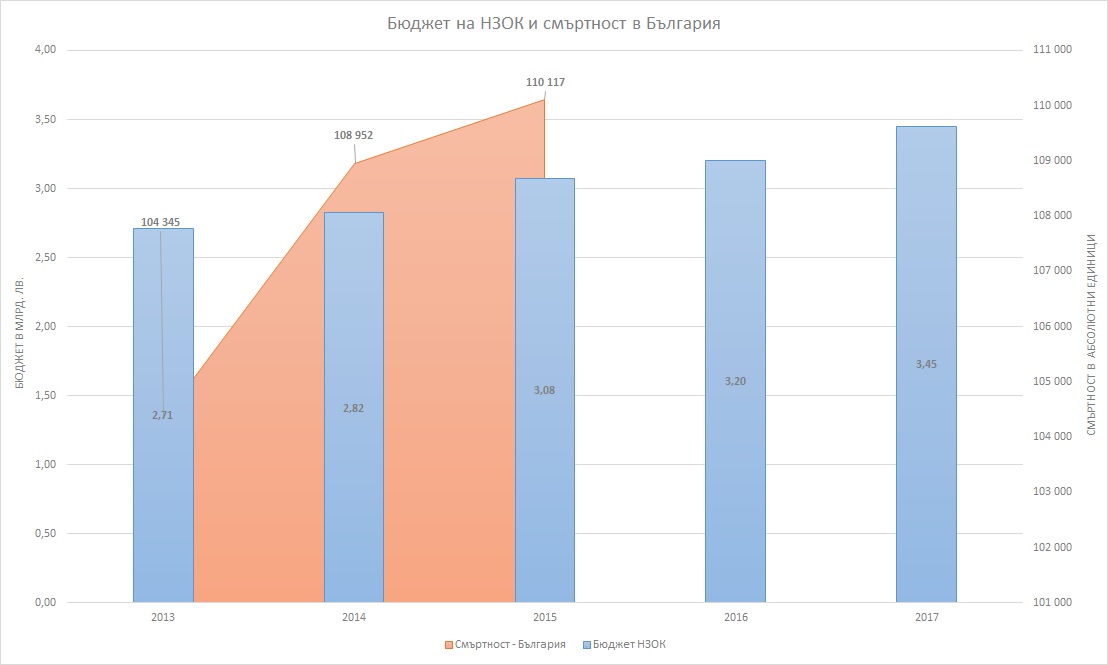
The budget is growing, so is the mortality rate
This is nothing new - since the NHIF was established, its budget has been growing rapidly every year, with the Ministry of Health justifying this with several arguments - the increase in the average age of the population, increased morbidity, increased prices of pharmaceutical products and the constant deficit of funds in the healthcare system.
Everything would be fine if the increase in the department's budget had led to a decrease in mortality. However, in practice, from 2013 to 2015, mortality increased by 5.53%, and in absolute numbers - an increase from 104 thousand to 110 thousand. The accounts of the rulers are not coming out, apparently the problems come from elsewhere.
We are treating those who are already sick instead of investing in prevention
Two of the largest items in the budget over the years have been payments for hospital medical care and for pharmaceuticals. In 2017, approximately 1.5 billion leva were allocated for hospital care, 800 million leva for pharmaceuticals, and for outpatient care – cumulatively only 489 million were allocated. The problem comes from the fact that treating a disease that has already reached the hospital level is many times more expensive because it requires interventions, prolonged treatment on site, high commitment of medical staff and prolonged intake of medications.
NHIF is in deficit every year
However, this does not lead to bankruptcy, as it should be in a private fund, on the contrary - the NHIF is constantly supported with financial injections. It can be said that the Fund is drained by public and private hospitals through clinical pathways and drug dealers (with the help of various patient organizations).
The problem is in the system, not in finances.
NHIF is a public body and a payment institution. Who has an interest in keeping other people's money? The answer is nobody. One of the things that is problematic in the current system is the payment methods and the control that is missing. NHIF has no competition, this allows it to be a monopoly structure that has no interest in improving its service, since consumers have no choice but to choose it or pay for health services directly from their pocket, which is also happening. In 2009, the health contribution was increased by 2% and from 6% to 8%. The money from this 2% would provide a reserve for the treasury, which would later be used for a partial transition to a mixed public-private model of health insurance. This, of course, did not happen, and in 2011, this reserve was literally stolen by the then Minister of Finance, who used the money for payments under other items of the national budget.
Are you coughing? You probably have bronchopneumonia!
At least that's what the statistics show, but what's actually happening is that in order to prevent the NHIF from falling into deficit, in 2015, lawmakers decided to set limits on the total hospital budget and the one for illnesses. So in small and large settlements, in order not to go bankrupt, hospitals successfully reached these limits by falsely writing out referrals. And since there is no control, the payments were made.
What is the solution?
The problem with any monopoly is that it can impose its own rules on consumers, regardless of the general framework. With NHIF competition, every participant in the health insurance market will have to constantly improve the quality of its services or lower the price to stay in the market. What Milton Friedman said applies here - "No one spends other people's money as rationally as they spend their own."