EKIP– Expert Club for Economics and Politics A Different Opinion
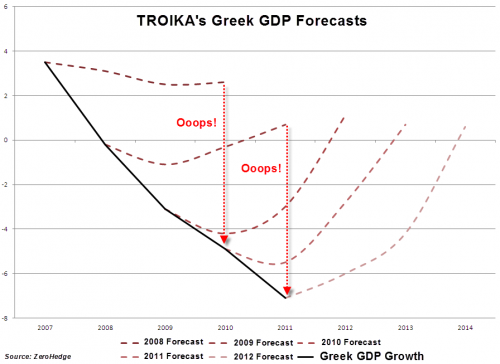 През 2013 г. станахме свидетели на различни (повече или по-малко) креативни начини да се манипулира БВП. От САЩ, през Гърция и Обединеното кралство, до Нигерия[1], индексът стана жертва на желанието на политиците да не плащат цената за икономическите кризи, вредните политики и кронизма, които създават. От тази година НСИ също ще изчислява БВП според нов механизъм.
We have already written [2] that GDP is not the most accurate measure of economic activity and people’s wealth, expressed in goods and services produced over a given period in a given territory. The innovations in the methodology, which will come into effect in September, are the addition of economic activity from the black economy, including prostitution, drug trafficking and “smuggling”. This beautifully demonstrates the will of the rulers to take advantage of the votes of certain social groups by banning certain substances and activities (which only leads to the creation of a black market that is harmful to consumers and to the violation of individual rights of people). [3] At the same time, by introducing the additions to the calculation mechanism, these same politicians are now doing everything possible to capitalize on the benefits of the things they themselves have outlawed.
At first glance, the “new” activities that the NSI will officially include in the GDP statistics sound reasonable. But if we look more closely, however, we will see that the change cannot measure real welfare and production. First, it is absolutely impossible to collect data from sectors that are either declared criminal (drug production and trade and “smuggling”) or are not legal (prostitution). Only approximate calculations and forecasts can be made about economic activity in them, which will significantly differ from reality. This is not something that statisticians are unaware of. Second, the addition of indicators is not at all accidental. With more aggregates, ceteris paribus, the sum cannot decrease – and this is exactly what those in power are aiming for, indicators with which to show “achievements”
The logical conclusion is that, since the changes in methodology clearly cannot accurately capture economic activity, their effects will be entirely political. It is hardly a coincidence that the changes in the calculation method come at a time when GDP growth in the 27 EU member states in 2012 was negative (-0.4%), and in 2013 it achieved a “cosmetic” growth of 0.1%. [4] Data, which cannot be objective, can be extremely easily used to point the finger at the public (i.e. the electorate).
Чрез лесно манипулиране на показателите, политиците могат да кажат, например, че „престъпността“ е намаляла, извличайки съответните дивиденти.[5] Друг явен начин, по който могат да се използват данните от „новия БВП“, е като се отчита фиктивен икономически ръст. Както вече видяхме, добавяйки индикатори към методологията може само и единствено да доведе до увеличаване на съвкупната му стойност. Това също дава съвсем реални предпоставки да смятаме, че изгодите от статистическите данни ще се използват само с политически цели – пред публика, която не включва икономисти и която не се занимава да изследва детайлно структурата на националния продукт.
If we look at other countries, the benefits for the rulers of the changes in the mechanism for calculating GDP are also obvious. The countries in the southern part of Europe, which, together with Ireland, are the most severely affected by the crisis and which suffer from chronically high levels of debt, will certainly use the imaginary statistical increase in national product to reduce the debt-to-GDP ratio, without making any reforms at all. If this strategy succeeds in deceiving the markets, it is likely that the interest rates on government loans could at least temporarily fall, which will be an extremely good opportunity for politicians to take on more debt. The long-term effect of more borrowing in already highly indebted economies will be highly negative, especially for taxpayers, who at one point or another will have to pay the price of the political projects implemented today.
In conclusion, it can be said that changes in the calculation of GDP around the world will not contribute to more accurate economic data. Quite the opposite - the national statistical agencies of various countries, including Eurostat, are once again lending a hand to politicians (i.e. their employers) when the latter are faced with the social consequences of stagnant economies and economic crises for which they themselves are responsible.
[1] In 2013, the US changed its GDP calculation methodology to include “intangibles” (intellectual property, patents, trademarks, etc.). This statistical trick did not make the measure more accurate, but it did add about $500 million to the US’s supposed economic activity out of thin air. Eurostat did the same with its new methodology, which also includes “intangibles.”
[3] Much could be written about the genesis of “black markets” and their extremely negative effects. We will only mention here that, thanks to prohibitions, consumers suffer from higher prices, may be subject to price discrimination, and there is a high chance of receiving a poor-quality product that they cannot replace with one from another supplier (especially with regard to drugs). The economic damage that the state inflicts in its overall activity of prohibiting and prosecuting individuals involved in the trade of prohibited substances is enormous. First, resources are taken from productive activities (regardless of whether taxpayers want it or not) to finance the police, the judiciary, and the prosecution. Second, additional resources are wasted on throwing the convicted in prison. It is also important to emphasize that prohibitions actually create crime related to prostitution and drugs, including violence between different groups and police brutality – things that we do not see in the free market.
[4] Moreover, in 2013, every country in the PIIGS group reported a decline in GDP, as follows: Portugal: -1.4%, Spain: -1.2%, Ireland: -0.3%, Italy: -1.9%, Greece: -3.9%.
[5] Unlike all large private companies, the state police hardly publishes any reports on its activities. Logically, there can be only one reason for this – it is an extremely inefficient structure; however, if it were coping with the duties it is supposed to perform, its management would be proud of it. As we know, successful students do not hide their notebooks. For a more detailed analysis of the state police, see here.