EKIP– Expert Club for Economics and Politics A Different Opinion
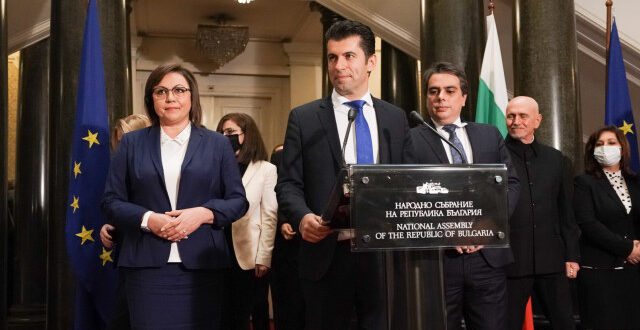
The four-party government is now in place and the communication about the governance priorities is in full swing. Not only do we know what has been agreed by the coordination groups in the mall [1], but we are also listening attentively to the first moves of the new ministers. What we hear immediately points us to the ongoing process of political realignment, in which every 40-50 years the main dividing line in politics changes, leading to serious shifts in party ideologies. [2] The new division emerging across Europe is globalism versus anti-globalism, cosmopolitans versus nationalists, “experts” versus “everyone judges for themselves.”
The new government takes a clear position on this division – firmly on the side of the pro-globalist theses. We saw full confirmation of direct action on the key issues defining the new rearrangement in our country. A course towards rapid adoption of the euro, an active vaccination campaign, adoption of texts from the Istanbul Convention, elimination of the coal industry, a U-turn on Macedonia and this only in the first 24 hours of the “Petkov” cabinet. Another step in the process of crystallizing the new division. While GERB was governing, although extremely obedient to external demands, the government still slightly opposed some of these issues, Macedonia for example. Or it was sneakily trying to push them through, secretly from the public, like the Istanbul Convention.
In fact, if we look closely at the signed coalition agreement, we can see that the big (in a political sense) goals are exactly those listed above. The budget, which is formed by the finance and economy chapters, is practically a copy of the updated Budget 2021. The overall economic framework is an amalgam of what was already started during the last GERB government (the increase in the minimum wage, 60/40, the jumps in pensions, VAT discounts, and even the failed attempt to increase the MOD), plus some ideas from the previous short parliament (the increase in the VAT registration threshold, maternity benefits, improvements in the voucher system). And no wonder, the update a few months ago was made by almost the same people, albeit in a different political combination – even the Minister of Finance was Assen Vassilev.
The proliferation of ministries is a function of the need for jobs for more political figures. But whether Bozhidar Bozanov will digitize the administration from the National Assembly or from his own ministry, the difference is in the available political leverage, not in the content. The Ministry of Innovations will deal with the redistribution of EU funds in "innovation" areas, a process that began on a more modest scale years ago. A funny moment occurred in the previous edition of "Referendum" on BNT, when Daniel Lorer mentioned that the new government will build highways, tunnels and bridges - and the presenter exclaimed, something that any other viewer would have thought of - but that sounds like GERB. We have also heard a lot about corruption and downsizing the state administration, as the MRF pointed out in the hall yesterday.
Where is the change then? First, in replacing a metastatic, bandit regime with another (at least initially) more civilized one. And second, embracing the new realignment and openly supporting pro-globalist positions, instead of peasant trickery and handing out from the jeep.
The clear pro-globalist position, however, puts the coalition partners in a difficult situation. For the BSP and Cornelia Ninova, this will be the hardest. Obviously for every observer (except for the Socialist MPs) the red lines from a week or two ago will be crossed very soon. We understood it from the rostrum of the National Assembly and from the pages of the Financial Times – there will be an EC, we will give in to Skopje, Brussels and Washington.
No matter how much she talks about the prices of electricity and heating, Ninova will not be able to pretend if (when) the cause of Macedonia is sacrificed. And there are hardly more anti-globalist voters (outside of "Vazrazhdane") than those of the BSP. In addition, the electricity and heating bills are in the portfolios of the PP and ITN, they will also have the laurels, if they have any at all. Access to power and jobs is important for every party, but at what price?
In fact, a semi-transparent veil has been placed over all truly controversial cases. We will not introduce the entire EC, only some individual texts against domestic violence. We will enter the eurozone after a serious explanatory (i.e. propaganda) campaign. We will significantly increase vaccination, but it will not be by force - followed by mandatory entry with a certificate to the Council of Ministers, then to ministries, then an appeal to business for the same. We will not turn to Macedonia, we will find a new way for dialogue and understanding. But with or without the veil, in the end we are already in the marriage bed.
This is not a good situation for the other smaller partners either. ITN voters will also not appreciate radical, clever-beautiful policies. Apparently, many of them punished the party not only because of the failed experience in the past National Assembly, but probably also because of the Nikolay Vassilev cabinet and Slavi Trifonov's incomprehensible affinity for the idea of a United States of Europe. As I wrote, there is nothing left for them from the "Yes, Bulgaria" portfolio, a Bojo will remove viruses from the state systems. Besides, DSB [3] has already sunk into non-existence, and although it is right that they do not have ministers, it would be useful for them to start with the other part of a renaissance plan, if they are no longer cashing in, of course.
In previous articles on the issue of political realignment, I wrote that the BSP’s reversal on the euro issue and its behavior on other key issues of the realignment will show the next step in determining the new political compass. I would like to add and clarify – the collapse of the coalition, due to a controversial issue of the new realignment, would be a clear signal of entering the final phase of the process of a new division. There are significant headwinds against such a development of events, some of which were hinted at above. If the coalition is preserved and at least part of the program is implemented – get ready for “Vazrazhdane” with 15%. [4]
[1] The mall is a kind of display of the diversity and abundance of capitalism, so symbolically it is a proper gathering place, especially with the socialist party.
[2] You can read more about the rearrangement in our other publications – HERE, HERE, HERE and HERE.
[3] Another signal of the exhaustion of the old division (socialism/capitalism) is the fact that Democratic Bulgaria is in coalition with the Bulgarian Socialist Party.
[4] There is no space left in the article, but let's observe GERB and DPS. Politics is binary, sooner or later they will take anti-globalist positions. In fact, Borisov's followers are already starting slowly - an example is their "hesitations" about the green certificate. For Macedonia, it will be even easier. They don't quite understand it yet, but let's give them time.