 EKIP– Expert Club for Economics and Politics A Different Opinion
The news about the sale of 5 electric buses to the Bulgarian-Israeli company Chariot Motors in Belgrade did not find a place in the media flow in Bulgaria. In Serbia, on the other hand, they are ecstatic: "Belgrade will be the first capital in Europe to have an entire bus line with only electric buses," said Mayor Borko Milosavljevic. This is happening with funds from the state budget with minimal European co-financing, that is, even though the Serbs still do not have access to the deep vat of honey in Brussels.
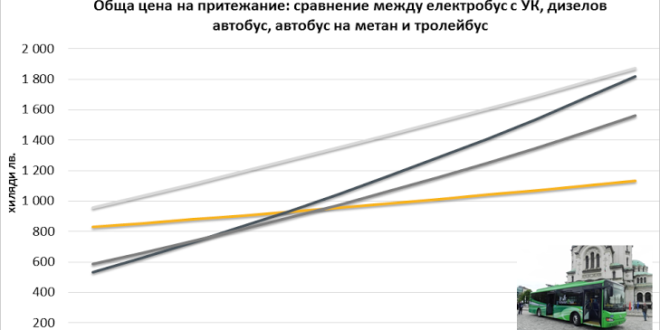
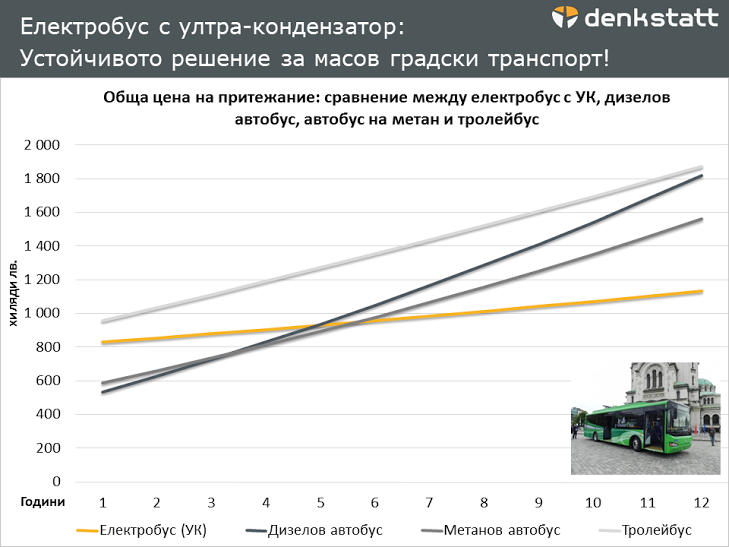
The Chariot Motors ultracapacitor electric bus was tested in Sofia in 2014. The results are impressive. We had the honor of comparing them with the alternatives and the conclusions are clear – they are not only the cleanest, but also the most economically advantageous option for public transport at the moment.
Yes, but apparently the responsible persons and institutions in our country are not easily impressed. How did it happen that the Serbs got ahead of us? Why is our company successful in a tender against all the world giants in such a high-tech business there, and not at home?
It's simple - there is no such tender here. Nobody wants electric buses, or at least they don't show it officially. Against the background of almost daily news about excessive air pollution, Sofia Municipality bought 110 new diesel buses. And at this time, another city Air Quality Program is waiting for approval from the municipal council. Last year, new trolleybuses were also purchased en masse in Bulgaria, including by cities where the trolleybus network is in a terrible state and requires huge investments to be able to be used at all. And a trolleybus costs more than an e-bus, not counting the maintenance of the network.
The Ministry of Environment is still trying to figure out what exactly to do with the European millions under the Air Axis in the Operational Programme Environment 2014-2020. The only clearly stated intention related to transport is “replacing the exhaust devices of public transport vehicles”. In other words, here we are betting on the mind-bogglingly innovative option of replacing the exhausts of 20-year-old taralyasniki in the hope of using them a little longer before they completely fall apart… I write this with a great deal of bitterness, because all my attempts to change it in my capacity as the head of the team that prepared the Preliminary Evaluation of the programme have been in vain… for now.
The success of the Cheriot e-bus in Belgrade is not accidental. They simply offer the best available technology for urban transport in the world – namely an electric bus with an ultracapacitor. Unlike heavy batteries, which take away from the load capacity and take a long time to charge, the ultracapacitor is lightweight and accumulates large amounts of electricity in a short charge – it travels 20 km after a 6-minute charge at both ends of the line. Electricity consumption is about 40% lower.
All over Europe they are already aware that this is the best option, but there is one "problem". The ultracapacitor of our e-bus is from the Chinese Aowei, which has been used in Shanghai for ten years with over 8 million km traveled. And it is much better than those of European companies, which until yesterday stubbornly relied on batteries. The situation is similar to that with diesels in Europe and hybrid cars in Japan, and the Old Continent is again with the wrong choice.
However, the pressure of market advantages is strong and pragmatic local authorities are forced to ignore political arguments. In Graz, the city with the dirtiest air in Austria, they want to actually solve their problem by replacing all of their remaining 150 diesel buses with electric buses. And they launched a tender for tests only for an e-bus with an ultracapacitor, which was won by two suppliers, one of which was again Cheriot e-bus. The competitor needs charging at several stops and, accordingly, many more charging stations, which means that our company's chances of winning a huge order that will be noticed by everyone in Western Europe are quite high. Other Bulgarian companies are also joining it - for the construction of charging stations and diagnostic equipment, for example.
With this technology, no one anywhere and never has an excuse to buy diesel buses anymore. My personal impressions show that Sofia, Plovdiv and other large Bulgarian cities have a desire for change, because the advantages are obvious. However, since we have been in the EU, the capital expenditures of municipalities are practically determined by the priorities of European programs, that is, by the state. In principle, I think that this money does more harm than good, but the reality is that it is there and we must fight for maximum benefit from it.
Today, single units of the Chariot e-bus are produced entirely in China. Tomorrow, when the market demands hundreds, a factory will have to be opened in Europe. Do we want it to be in Bulgaria? We have a chance for a leadership position in a high-tech sector destined for growth. Air pollution in cities is our most important environmental problem. We have the money with which to both take real steps to solve it and to create an internal market to boost the development of an entire industry. We can show that European funds serve not only for absorption, waste and filling the pockets of the right people, but for real progress.
What the hell is the Bulgarian state waiting for?





And I ask myself the question: what are we waiting for, that we do not start the transformation of transport, energy and agriculture, as the main strategies in which we should invest are hot water from the sun, energy efficiency and electric transport - https://www.facebook.com/atanas.shalapatov/posts/1436573383287558
to avoid planetary catastrophes
Is this a paid article?
No, unless you don't want to pay us?
Firstly, the mayor of Belgrade is called Sinisa Mali, Borko Milosavljevic is the deputy mayor. Secondly, the ecstasy of the Serbian media, to the extent that it exists at all, is more of a pre-election exaggeration of the ruling party regarding the uniqueness and significance of the acquisition. Thirdly, it is difficult to talk about the Serbs being ahead in ecological transport, given that Belgrade still does not have a metro and relies entirely on surface urban transport (plus urban and suburban railways with two underground stations in the city center). Finally, congratulations on the deal with "Cheriott Motors"!