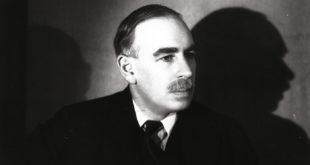
Pencho Penchev
Professor Pencho Penchev is a lecturer in "Economic History" at the Department of "Political Economy" at the Faculty of General Economics of the University of National and World Economy.
Pencho Penchev July 10, 2021 Culture and History, Politics
Different views on the (re)organization of society are promoted with different labels. Probably the most widely used are left and right. They should briefly explain the essence of proposed reforms and policies, and help identify the political opponent. In this text we will read the views of a Bulgarian “right” from the 1930s and early …
More » Pencho Penchev June 29, 2021 Culture and History, Society
In his book "Capitalism, Socialism and Democracy", the economist Joseph Alois Schumpeter (1853-1950) argued that capitalism is an evolutionary and dynamic system. The main impulse that causes evolution and dynamism comes from the supply of new consumer goods, new methods of production or transport, new markets and new organizational forms of enterprises, ...
More » Pencho Penchev June 15, 2021 Culture and History, Society
...between those at the state table and everyone else. The restoration of Bulgarian statehood in 1878 marked the beginning of a deep class division in the Bulgarian nation. From the very first days and months of the Third Bulgarian State, two classes quickly and spontaneously formed. One can be conditionally defined as taxpayers, and the other ...
More » Pencho Penchev May 06, 2021 Culture and History, Society
The title is a quote from the popular Bulgarian march "Great is our soldier", which was written in 1916. The author of the text is Second Lieutenant Konstantin Georgiev Popov from the 23rd Infantry Shipka Regiment. The year of writing is important. At that time, the country was involved in the third war in the second decade of the 20th century. Bulgarian participation ...
More » Pencho Penchev April 20, 2021 Culture and History, Society
The April 1876 uprising is a landmark event in Bulgarian history. The motives for it lie in the dissatisfaction of some of the Bulgarians of the time with the Ottoman state power. The history of the uprising is often misused, but there are two neglected and important aspects in it. First of all: it covered settlements with …
More » Pencho Penchev January 17, 2021 Culture and History, Society
The market process played an important role in the development of Bulgarian society before the Liberation. It steadily penetrated even into spheres and areas that were perceived as isolated from it. Its spontaneous manifestations left an imprint on educational work, cultural institutions and social life. Read through the prism of voluntary exchange, supply and demand …
More » Pencho Penchev May 12, 2020 Politics
In the mid-19th century, the French economist Frédéric Bastiat gave perhaps the most brilliant definition of what a state is. It is “the fiction by which everyone wants to live at the expense of everyone else.” At the same time, another French-speaking economist, Gustave de Molinari, wrote an article in which he questioned the state’s …
More » Pencho Penchev May 04, 2020 Economics, Economic theory
Recently, the prophecies that capitalism is going away have become more and more frequent. One of the most profound researchers of capitalism is Adam Smith. Therefore, it is worth checking to what extent his ideas are accepted and/or rejected by Bulgarians. This is how we will assess whether he, and with him capitalism, are going away from Bulgaria? Adam Smith (1723-1790) is …
More » Pencho Penchev April 24, 2020 Economics, Economic theory
One of the oldest dilemmas in economic policy is protectionism or free trade. In economic history, there are no countries that adhere entirely to one of the two principles. Although with too many conditions, free trade seems to prevail in modern practice. From the point of view of economic theory, this …
More » Pencho Penchev April 18, 2020 Economic theory, Culture and history
Many of the policies that our and foreign leaders are proposing in the context of the Covid-19 pandemic can be described as Keynesian, named after the English economist John Maynard Keynes (1883-1946). He was born in Cambridge, UK, his basic education was in mathematics, he listened to lectures on economics from brilliant scholars such as …
More »
 EKIP– Expert Club for Economics and Politics A Different Opinion