Theodore Karakolev April 14, 2018 Economic and Fiscal Policy, Culture and History
The dream of the perfect city is almost as old as civilization itself. Whether city planners dream of parallel and perpendicular straight streets, or radial streets intersected by smaller and larger rings of "rings" or some other variation - proto-urbanists' attempts to create the ideal urban environment have been around for centuries. Older than them...
More » Pencho Penchev April 05, 2018 Culture and History, Society
The Bulgarian Army was formed as one of the important national institutions after the Liberation. It was supported by Bulgarian taxpayers and was entrusted with the task of protecting the national state in the powder keg called the Balkan Peninsula. Some of the truest heroes, before whom we rightly bow our heads, served in the Bulgarian Army. Part …
More » Christian Atanasov March 20, 2018 Economic and Fiscal Policy, Culture and History
Author: Assoc. Prof. Dr. Hristiyan Atanasov How the state's departure from its priority can have a positive impact Let's start with the fact that agriculture was the main priority of the Ottoman state throughout its existence. It can be said that the reasons for this are mainly fiscal, but also social. So …
More » Pencho Penchev March 13, 2018 Economic and Fiscal Policy, Culture and History
Five-year plan is the abbreviated name of the five-year plans, through which economic development is centrally controlled and planned under socialist conditions. That is why the socialist countries of Eastern Europe are often called countries with central planning, although five-year plans also exist outside the Eastern Bloc. The implementation of the economic goals set by the political leadership …
More » Pencho Penchev February 27, 2018 Economic and Fiscal Policy, Culture and History
The first Bulgarian capitalism roughly covers the period from the Liberation in 1878 to the September 9th coup in 1944. The economic, social and cultural achievements of these decades are the subject of numerous assessments. Even the most optimistic among them do not show particularly impressive results. Results of the first Bulgarian capitalism From 1878 to 1944 …
More » Boryana Yosifova February 21, 2018 Economic theory, Culture and history
There comes a time in every person's life when he or she must decide for themselves which values will be the compass by which they will choose their direction of movement. Inevitably, this also applies to larger organisms, and here let my analogy abruptly shift to companies and countries. Lately, many different …
More » Pencho Penchev February 15, 2018 Economic and Fiscal Policy, Culture and History
Bulgarian economic history cannot provide a universally valid answer to this question, but it can suggest in which direction to look. Therefore, it is worth paying a little attention to some of the supposedly “generally accepted” truths about Bulgaria’s economic past. Among them, one can point out the almost axiomatic statement that the economic …
More » Theodore Karakolev February 02, 2018 Culture and History, Society
Jane Jacobs is a curious figure – one of the legendary civil rights activists in the United States, without a college degree, she sees herself as an economist, but with the greatest influence on urban planning. She was born in 1916 and became famous for her book “The Life and Death of Great American Cities”, which was published in …
More » Pencho Penchev January 28, 2018 Culture and History, Society
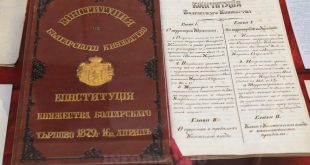
If democracy is the rule of the majority, then the constitution is the mechanism that must ensure the rights of the individual against encroachments by this same majority. In the historical development of modern Bulgaria, four constitutions have operated – the Tarnovo Constitution of 1879, the so-called Dimitrov Constitution of 1947, the Zhivkov Constitution of 1971…
More » Pencho Penchev January 14, 2018 Culture and History, Society
Historical knowledge is overgrown with myths. The reasons for this can generally be reduced to two. First, the past is usually projected with political or other goals of contemporary elites and their court historians. The other reason for the mythologizing of the past is its use as a means of escape from …
More »
 EKIP– Expert Club for Economics and Politics A Different Opinion